
The centre of Szczecin is laid out so that the main places can be linked by walking, and the more distant ones by tram. This plan starts at the Main Railway Station, because that is where the first stop is, and on Saturday leads along the old walls, the terraces above the Oder and the castle, and on Sunday through greenery and buildings on Niepodległości Avenue. The order can be reversed. Opening hours and admission rules are given by the institutions, so check them before you travel.
Saturday morning: the shelter under the station and a city gate
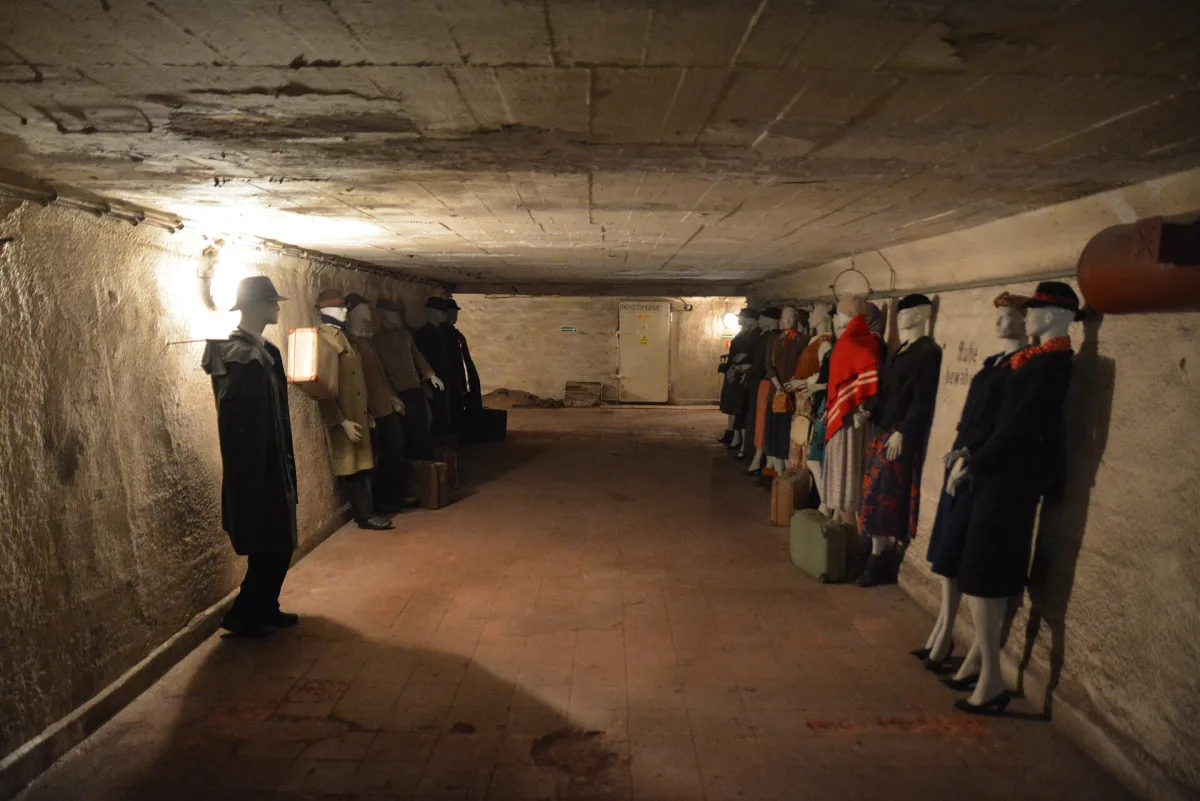
If you arrive by rail, start with the Szczecin Underground Routes (Underground Szczecin). The entrance is from the main hall of the Main Railway Station, then onto platform 1, to the right and down the stairs. It is a former German air-raid shelter made available in 1943, built in the undergrounds of the 18th-century fortifications. According to the site's website, one ticket covers three routes: “World War II”, “Cold War” and “Selfie with the PRL”. Visiting all the routes takes at least an hour, and the temperature inside is 14 degrees.
Nearby stands the Port Gate, the former Berlin Gate, Baroque, of brick. The construction dates vary depending on the source: Wikipedia gives 1725-1727, the Encyclopedia of West Pomerania 1724-1725. On the façade there is a shield with the monogram of King Frederick William I and a Latin inscription on Brandenburg's rights to Pomerania. The gate is easiest to view from outside.
On Batory Square stands the Red Town Hall, a neo-Gothic building from 1875-1879, designed by Konrad Kruhl. The city administration sat here until 1945, and today the building contains offices of state institutions, so you view it mainly from outside. Note the four allegories above the pillars of the portico: Industry, Agriculture, Seafaring and Knowledge.
Saturday afternoon: Chrobry Embankment, the museum and the castle
From the Port Gate to the Chrobry Embankment it is, according to the description, about a kilometre. It is a viewing terrace about 500 m long on the bluff above the Oder, built in 1902-1921 to a design by Wilhelm Meyer-Schwartau. The terrace lies about 19 m above the level of the river, and in the middle stands a semicircular central terrace with a fountain. The original name was Hakenterrasse, after Lord Mayor Hermann Haken. At the ends stand restaurant buildings.
The building at Wały Chrobrego 3 houses the headquarters of the National Museum in Szczecin. According to Wikipedia, the museum looks after more than 150,000 objects and has four branches in the town centre. A ticket is valid for one entry to one branch, so choose the one that interests you most.
From the Embankment it is close to the Ducal Castle (the Castle of the Pomeranian Dukes) on Castle Hill. According to the description, the beginnings of the present castle go back to 1346, when Barnim III began to build the so-called stone house. In 1573-1582 Duke John Frederick rebuilt it in the Renaissance style, and after serious destruction in 1944 the castle was rebuilt in 1958-1980. In 1946 a crypt with the sarcophagi of the Pomeranian dukes was discovered here.
Sunday: plane trees, roses and the Philharmonic
The second day begins in greenery. Jasne Błonia (the Bright Meadows) is a square from 1925-1927 with 213 London plane trees. According to the Visit Szczecin website, it is the largest cluster of this species in Poland. The avenue leads on to Kasprowicz Park, and in it, between Jasienicy, Zaleskiego and Moczyńskiego streets, lies the Rose Garden (Ogród Różany). It was laid out in 1928 and after reconstruction put back into use in 2007. According to the description, more than nine thousand roses in 99 varieties grow in it, and the Bird Fountain has four concrete geese, three of which are original.
At Niepodległości Avenue 40 stands the Palace of the Pomeranian Landschaft, a neo-Baroque building from 1893-1895, designed by Emil Drews for the Pomeranian Landschaft Society. Today it belongs to the Academy of Art, so it is usually viewed from the street side, and the possibility of entering should be checked on the academy's website.
From Jasne Błonia to the Mieczysław Karłowicz Philharmonic it is about 300 m. The building at Małopolska Street 48 was built in 2011-2014 on the site of the Art Nouveau Konzerthaus destroyed during the war. The white building was designed by the Estudio Barozzi Veiga studio. The symphonic hall has 953 seats. The philharmonic's website gives dates of guided tours of the building, and the repertoire leads to ticket sales.
The site of the synagogue and a view from Gocław
About 800 m from Jasne Błonia, on Dworcowa Street, next to the Pomeranian Library (Książnica Pomorska), stood the New Synagogue. It was built in 1873-1875 and could hold 1,500 people. In the night of 9 to 10 November 1938 it was burned, and in 1941 its ruins were blown up. There is no building to visit there: the synagogue is commemorated by a memorial plaque. It is a place to pause for a moment, not a point on the programme.
If time remains, the Bismarck Tower, today called the Gocław Tower, stands on Zielone Wzgórze (Green Hill), outside the centre. It was built in 1914-1921, is 26 metres high and has a viewing terrace. According to Wikipedia, the way there leads by tram to the Gocław terminus, then along Narciarska Street and the yellow walking trail. Since 2020 the tower has been leased by a private company, which is carrying out its revitalisation, so information on the possibility of entering is given on the website wiezagoclawska.pl.

Be the first! Add a comment.
You need to log in to add a comment.
Log in