
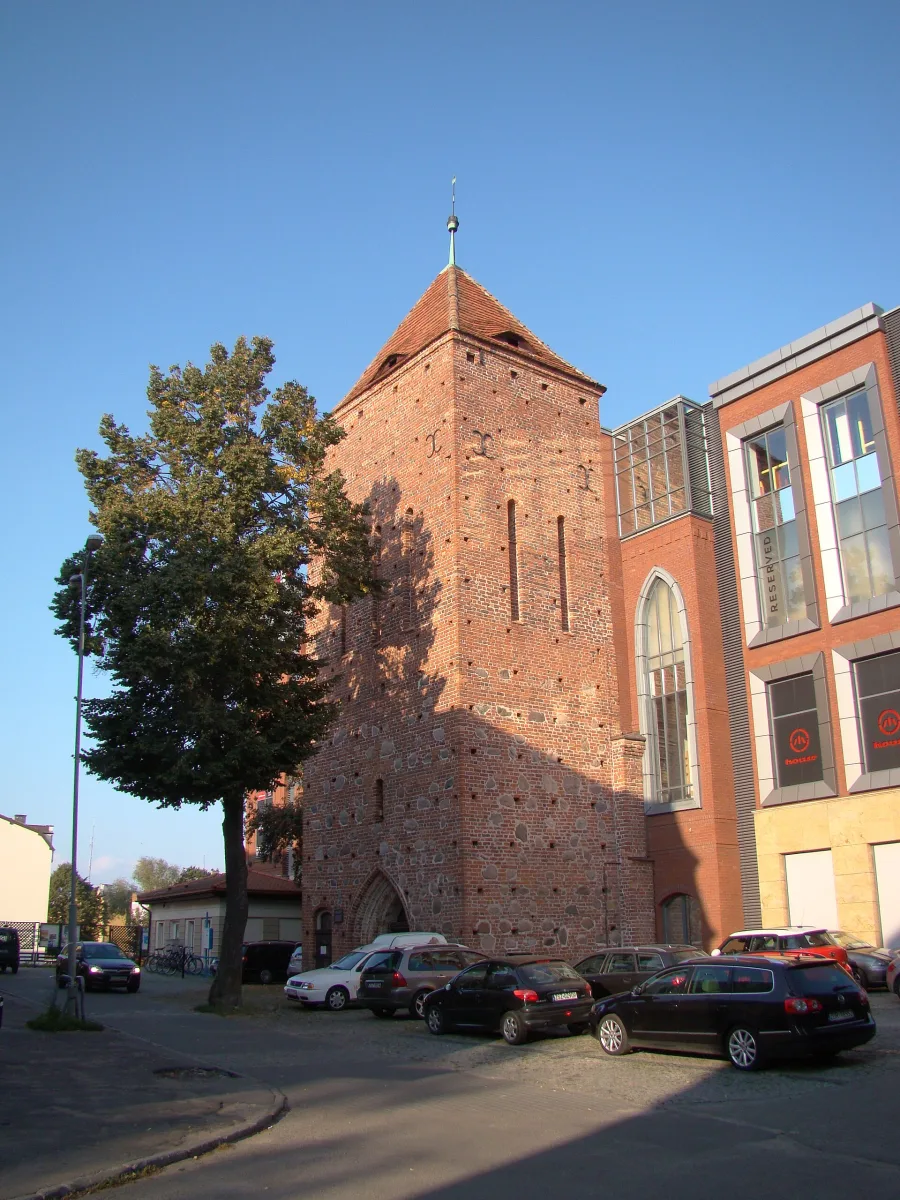
The Regional Museum in Szczecinek is one of the oldest museums in West Pomerania, and its history is linked to the tower of a demolished church. The date of foundation is given in different ways, because the institution grew out of an earlier exhibition, and the officially accepted year is 1914. Below is the order of the facts, with an indication of who claims what.
Two starting dates: 1866 and 1914
The museum's website and the Wikipedia article on the museum give 1914 as the year of foundation. Wikipedia adds, however, that the museum was created on the basis of an archaeological exhibition of 1866, organised by the Prussian major F. W. Kasiski. The exhibition comprised more than 700 objects from his excavations of the 1860s in what are now the Człuchów and Szczecinek counties.
This first collection did not stay in Szczecinek. According to Wikipedia it was taken to Berlin, where it formed the beginning of the Ethnological Museum in Dahlem. So it can be said that the exhibition of 1866 is the beginning of a tradition, and 1914 is the beginning of the institution that operates to this day.
The Museum Society and the tower
According to Wikipedia, for the 600th anniversary of Szczecinek in 1910, works on the history of the town and the region were published, among others by Karl Tümpel and E. Wille. In autumn 1913 the mayor K. Sasse established the Museum Society, which included Tümpel, Wille, the district head Ernst von Hertzberg and the painter Paul Stubbe, among others. Thanks to the society, the museum was organised in June 1914 in the tower of St Nicholas' Church.
According to Wikipedia the tower dates from the 16th century. The tower of St Nicholas' Church is the only remnant of a late Gothic church that was demolished in 1909. The nave was taken down, and the tower was kept. Wikipedia states that from 1913 adaptation work was carried out in it to fit it for the needs of the museum, opened a year later. The walls of the lower parts are in places 2.5 m thick.
At the same time a new church was being built in the town. The Church of the Nativity of the Blessed Virgin Mary was built in 1905-1908 as the Protestant St Nicholas' Church. According to Wikipedia, part of the furnishings of the old church were moved into it, among others an epitaph from 1621 and brass chandeliers from the first half of the 17th century.
The war, the castle and the return to the tower
According to Wikipedia, the outbreak of the First World War made it impossible for the new institution to operate. Thanks to the efforts of Georg Zehm, in 1935 the museum was moved to the castle in Szczecinek. In February 1945, after the town was taken by the Soviet army, part of the collection was thrown out of a window. Some historic objects were saved by the Immaculate Conception Sisters, and one of them, Maria Krysta, wrote the first post-war booklet on the history of the town.
The museum was revived by, among others, Aleksander Stafiński and Anatol Sałaga, who organised the Citizens' Committee of the Museum of Szczecinek and the Szczecinek Land. In July 1947 they took over the St Nicholas tower as a temporary seat. In September 1957 the Presidium of the Municipal National Council established a new Organising Committee of the Museum, and on 28 February 1958 the Museum of the Szczecinek Land was opened. Wikipedia notes that it was to be housed temporarily in the tower and in the near future in the castle.
In the end it turned out differently. According to the article on the tower, in 2006 the exhibitions were moved to a new seat. The Regional Museum is at Szkolna 1, in a brick building in the eclectic style from 1879-1880, which according to the heritage register was originally a school. Right next to it stands the Orthodox Church of the Holy Trinity, housed in a building from 1824.
What the collections show
According to Wikipedia the collections include archaeological collections, among them a stone statue of a Slavic deity, pottery, jewellery and tools. There are also regional collections connected with the town and the region, a hunting collection of more than 130 objects, with the most valuable objects from the 18th century, and goldsmiths' work.
Wikipedia lists six permanent exhibitions: From the History of the Town and the Region, the Nobility Room devoted to the Golz family of Siemczyno, the Hertzbergs of Lotyń and the Podewils of Krąg, Old Silver with more than a hundred objects from European workshops, the Hunting Salon, the Szczecinek Garrison and European Goldsmiths' Workshops of the 18th-20th Centuries.
Be the first! Add a comment.
You need to log in to add a comment.
Log in