
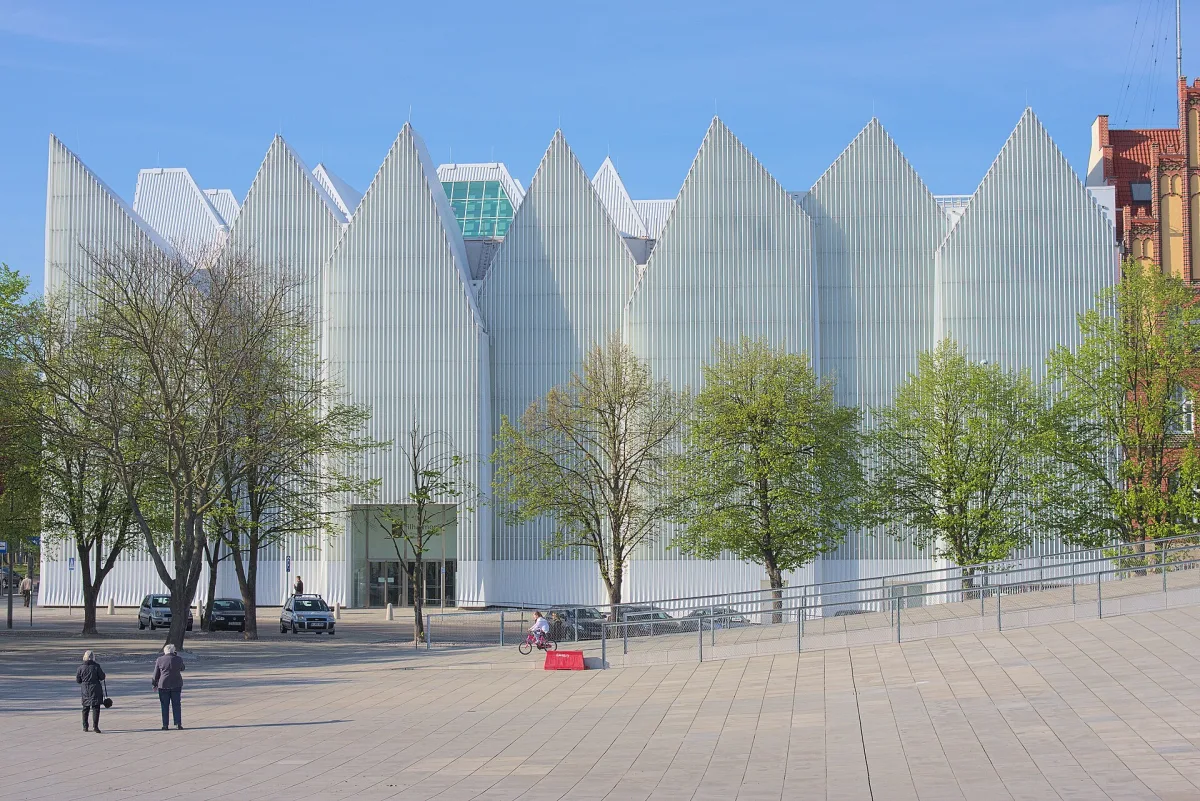
The Philharmonic and the Mies van der Rohe Award
The Mieczysław Karłowicz Philharmonic at Małopolska 48 was built in 2011-2014 on the site of the Art Nouveau Konzerthaus, destroyed at the end of the Second World War. According to Wikipedia, a design competition was announced in 2007 and, out of 44 entries, the design by the Barcelona studio Estudio Barozzi Veiga was chosen. Construction began in April 2011, and the general contractor was the company Warbud. The acoustics of the halls were designed by Higini Arau. The white block is meant to resemble the tip of an iceberg.
The building was opened on 5 September 2014 with a concert by the philharmonic orchestra, during which, among other pieces, Krzysztof Penderecki's specially written Fanfare for the Philharmonic was performed. According to the philharmonic's website, the symphonic hall has 953 seats and the chamber hall 192.
In May 2015 the philharmonic won the European Union Prize for Contemporary Architecture - Mies van der Rohe Award. According to the Czech portal Archiweb, the winner was announced in Barcelona and the prize was awarded to the Barozzi Veiga studio for the design of the new philharmonic in Szczecin. According to the same source it was chosen from among 420 buildings entered in the competition, and only buildings no more than two years old can be entered for the prize. Wikipedia gives 8 May 2015 as the date of the decision and 25 February as the day the building entered the final five. The philharmonic's own website, on the other hand, mentions first place in the Eurobuild Awards 2014 in the category Architectural Design of the Year.
Theatres in the city centre and in the Castle
The Opera at the Castle has been housed since 1978 in the south wing of the Castle of the Pomeranian Dukes. According to Wikipedia, the wing suffered most during the air raids on Szczecin on 17 August 1944, and in 1972 it was decided to assign it to a musical theatre. The institution has operated since 1956, at first as the Szczecin Operetta, and has had its present name since 2000. The renovation of 2010-2015 included, among other things, the modernisation of the main hall, which has 540 seats, and the uncovering of the castle's foundations on the lowest level.
In the same castle is the Piwnica przy Krypcie, formed in 2015 from the merger of the Crypt Theatre, a drama theatre, and the Piwnica przy Krypcie cabaret. According to Wikipedia, the Crypt Theatre has existed since 1965 and was housed in the Griffin crypt, discovered in 1946, and the cabaret was founded in 1990. From May 2017 to November 2025, because of a construction disaster at the castle, the theatre temporarily performed in a cinema hall.
The Contemporary Theatre is housed in the building of the National Museum on the Chrobry Embankment. According to Wikipedia, in 1950 part of the building was temporarily adapted for the performing arts, and in 1975 it was decided to create two separate theatres in the city. Besides the stage in the museum building, the theatre has a second location, the so-called Small Theatre, on the Bogusław Promenade. It was in the domed hall of this building that the equestrian statue of Colleoni once stood.
The Polish Theatre, founded in 1946, is housed in a historic building at Swarożyca 5. According to Wikipedia, it was designed around 1920 by Adolf Thesmacher to serve as the seat of a Masonic lodge, and in 1935-1937 it was rebuilt for the women's organisation of the NSDAP. A renovation combined with an extension began in April 2020. The design was prepared by the studio Atelier Loegler Architekci, and in the new part, set into the escarpment above the Oder, three stages were created: the Shakespearean, the Italian and the Chamber stage. The historic building houses the Jan Banucha Stage and the Cabaret Stage. The first performance in the new interiors was given on 3 August 2023, and the official opening took place on 6 August 2023.
Puppets, alternative theatre and the amphitheatre
The Pleciuga Puppet Theatre has operated since 1958. According to Wikipedia, in May 2009 it moved to a new seat at Theatre Square, described as the first theatre in Szczecin built from scratch after the Second World War. In 1900-1945 the square was called Blücher Platz, after the war it bore the name of Georgy Zhukov, and it received its present name in 2008, when it was built up with the theatre's new seat. As early as 1964 the company gained nationwide fame with the television show Misie Ptysie.
Kana is an alternative theatre founded in October 1979 by Zygmunt Duczyński and his students, housed since 1994 in a tenement house at Piotra i Pawła Square. According to Wikipedia, the 1993 production Noc won a Fringe First award in Edinburgh, and since 2007 the company has been a cultural institution of the city and the voivodeship self-government.
Among the city's stages there is also the Helena Majdaniec Summer Theatre, an amphitheatre in Kasprowicz Park by Lake Rusałka. According to Wikipedia it has more than 2.7 thousand seats, and its reconstruction to a design by the London office Flanagan Lawrence ended with an official opening on 29 July 2022.
Be the first! Add a comment.
You need to log in to add a comment.
Log in