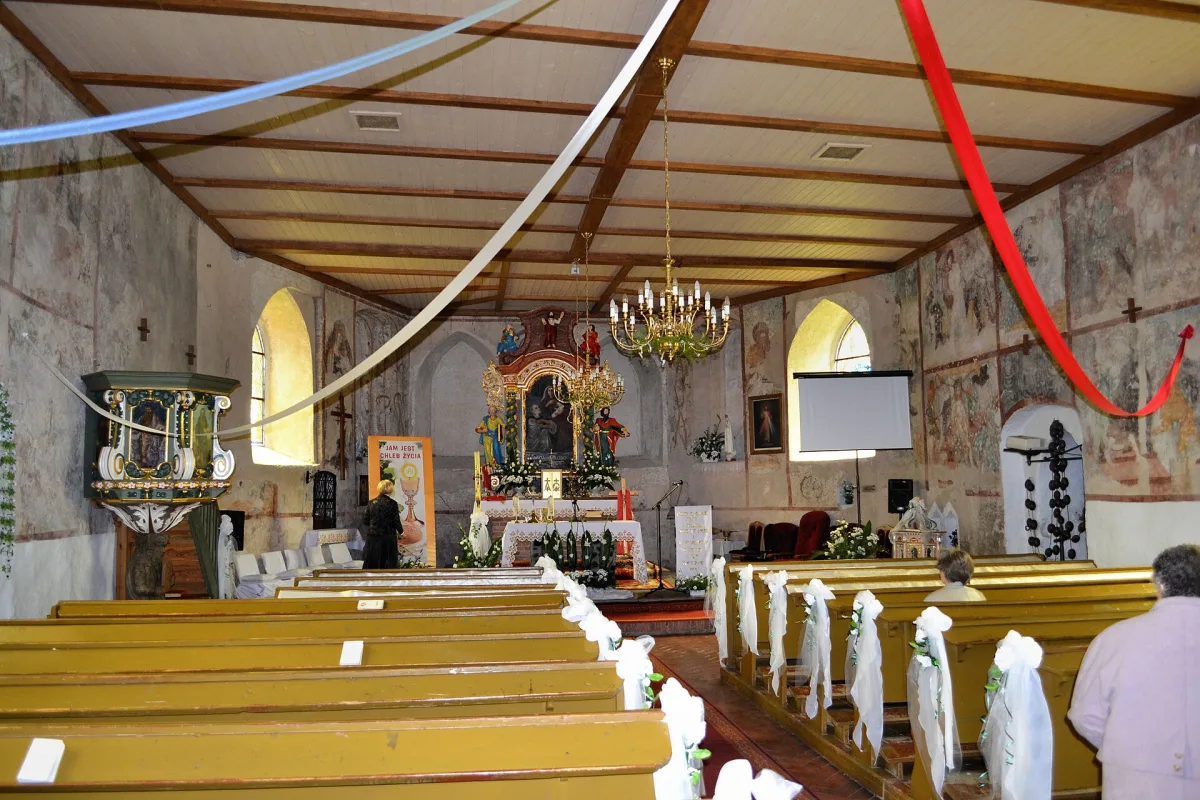
Stone-and-brick church in Wełtyń from the second half of the 15th century, with Gothic-Renaissance polychromes of 1520-1534 covering almost the whole interior.
The Church of Our Lady of the Rosary in Wełtyń is a stone-and-brick church from the second half of the 15th century. It is distinguished by Gothic-Renaissance polychrome painting, which covers almost the whole interior.
The paintings were most probably made in 1520-1534, just before the introduction of the Reformation. They show Gothic features, such as the division into panels and rigid figure schemes, and Renaissance ones, such as the handling of light and shade. In the 17th century they were covered with plaster because they did not agree with Protestant theology, and they were uncovered again in 1961. They show the history of Salvation, from the creation of Eve through the Passion scenes to the Last Judgement. The colours have faded, the outlines are blurred, and alterations to the windows damaged some of the paintings, so reading the scenes requires attention.
The first church in Wełtyń was built in the 13th century and was under the patronage of St Mary's Church in Szczecin. The present church is later, the tower and the sacristy were added several decades after the nave, and rebuildings took place in 1690 and 1784. The wall of unworked stones of various sizes is not plastered, so many bricked-up window openings can be seen from outside, and the corners of the tower and the chancel are made of brick. A wooden clock face has survived on the north wall of the tower. In the wall of the former churchyard stands a stone gateway from the 15th century.
Apart from the polychromes, inside there is a Baroque altar and a pulpit from the 18th century.

Be the first! Add a comment.
You need to log in to add a comment.
Log in