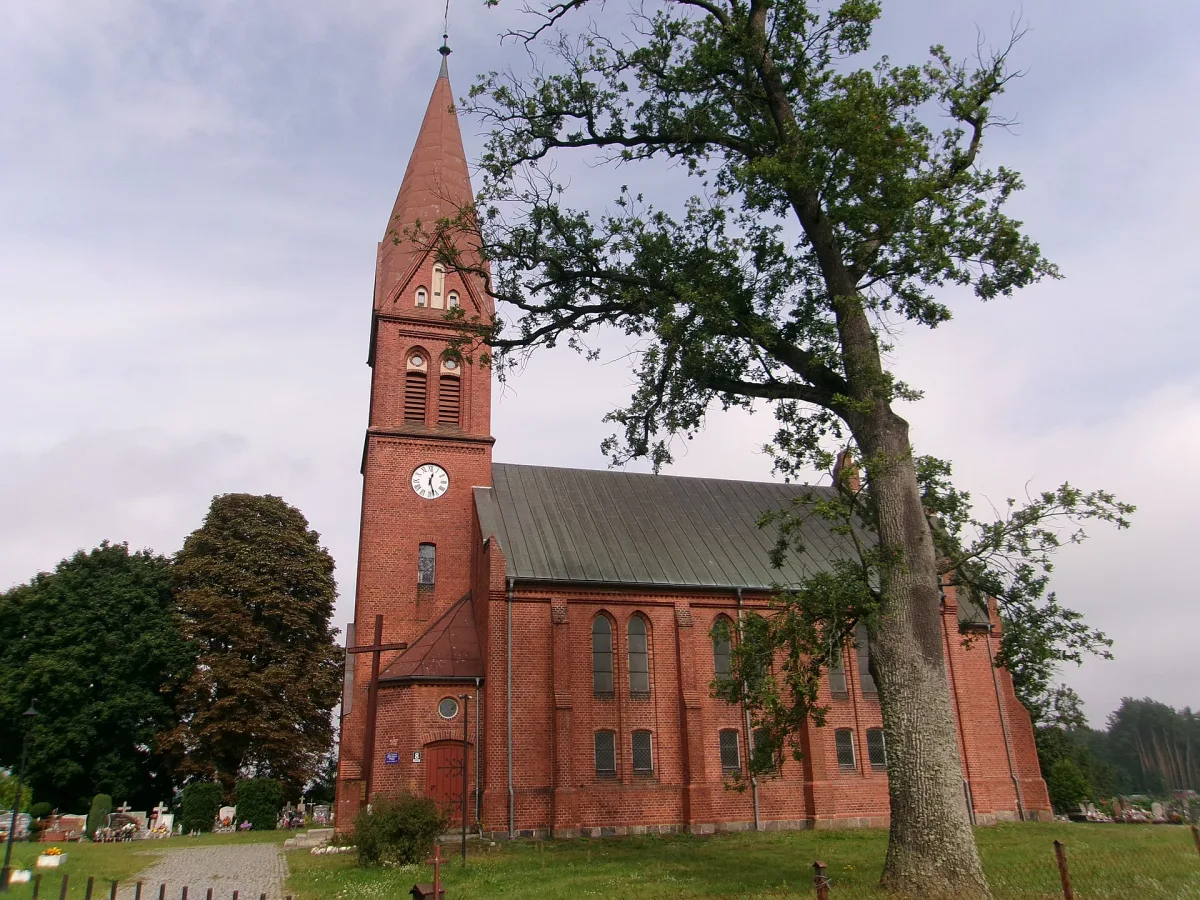
A neo-Gothic church of 1889 in Sowno with a Renaissance altar from the middle of the 16th century, a pulpit by Hans Peisser and the tombstone of the jester of Duke John Frederick.
The Church of St Mary Magdalene in Sowno, in Stargard County, is neo-Gothic and dates from 1889, but its interior is much older. It holds a Renaissance altar from the middle of the 16th century, a pulpit from the same period and the tombstone of Mikołaj Hinze, jester of Duke John Frederick.
The building is of brick, on a rectangular plan, with a chancel closed on three sides and a three-storey tower, narrower than the nave, crowned with a slender octagonal helmet roof. In the interior 19th-century pews, a choir gallery and an organ case have also survived. Earlier churches on this site were destroyed by the Thirty Years' War, and then pulled down because of their poor condition: the first around 1720, the next, probably timber-framed, in 1880.
The altar was made in the middle of the 16th century, founded by Duke Barnim XI, and was carved by the court sculptor Hans Peisser of Gdańsk. Even then a legend circulated that the duke, known for his love of carving, had carved it himself. The altar was intended for the ducal residence known as Oderburg, then went to St Mary's Church in Szczecin, and then to the hunting residence of Friedrichswalde near Sowno. When the residence was destroyed during the Thirty Years' War, only the church with the altar survived. For about a quarter of a century the altar stood in Stargard, lent to the townspeople after their St Mary's Church had been destroyed, and in 1661 it returned to Sowno.
In the 20th century the altar was altered and began to deteriorate: its central part was removed and a painting of the Holy Family inserted, a relief from the predella was lost, and many figures lost their heads and hands. The turning point was the conservation work in 2010, with the reconstruction of missing elements and the recreation of the polychromes and gilding. The wooden case is today dark green, covered with a gold-and-red ornament and filled with about a hundred figures. In the centre the Last Supper is shown, at the sides scenes of the Passion, and in the predella the Entombment of Christ and likenesses of the Elector of Saxony John Frederick and Martin Luther.
The pulpit also came from the hand of Hans Peisser. It has rich decoration based on Netherlandish pattern books by Cornelis Bos, among them pairs of slender herms at the corners of the basket, and in the panels reliefs of scenes from the life of Christ.
Set into the wall of the vestibule is a slab from the grave of Mikołaj Hinze, jester of Duke John Frederick, who died in 1599. According to tradition he died as a result of a joke by his master, who staged his execution. On the slab the jester holds in his right hand an object interpreted as a length of sausage, and at his feet lies an overturned tankard.

Be the first! Add a comment.
You need to log in to add a comment.
Log in