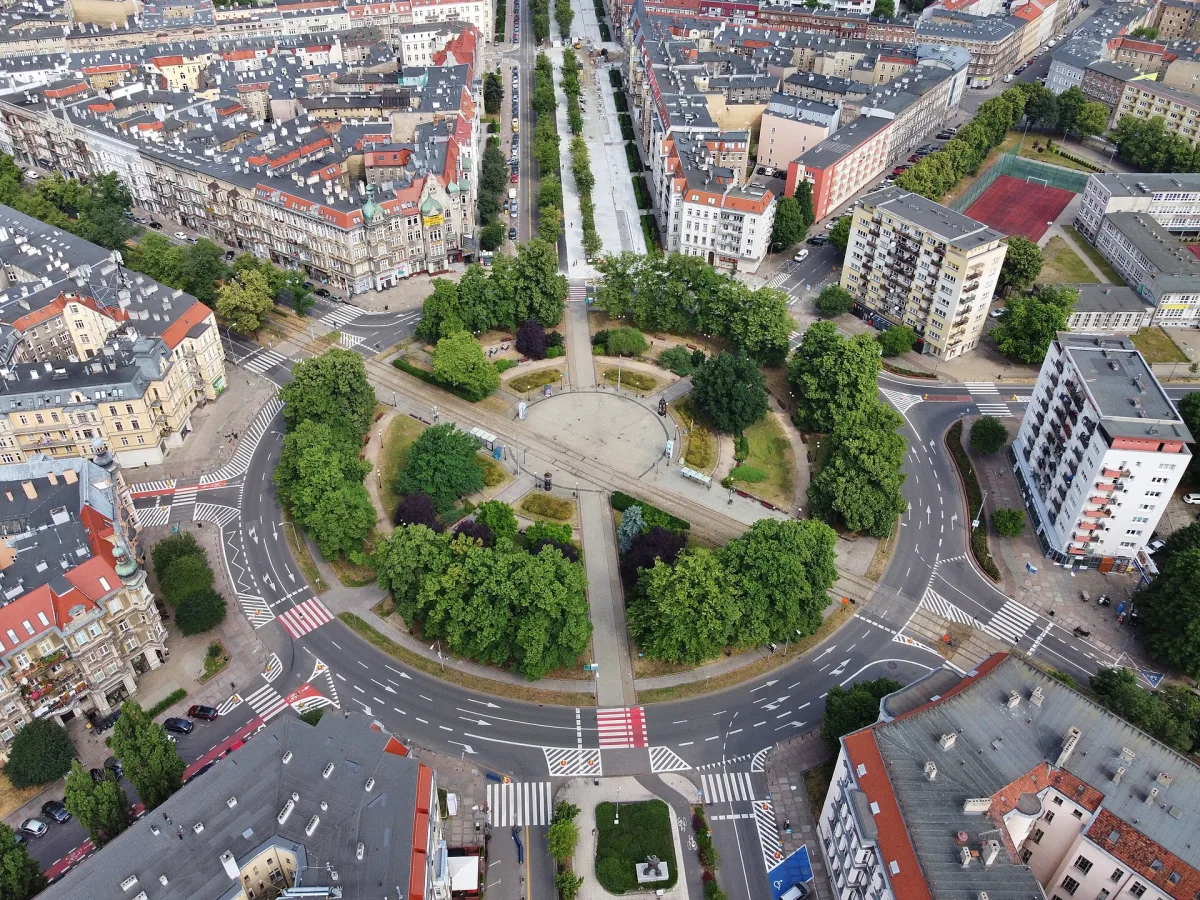
Szczecin's largest star-shaped square, from the late 19th century, with eight roads converging on it, modelled on Parisian solutions.
Grunwaldzki Square is the largest and most impressive star-shaped square in Szczecin, in the Śródmieście district, on the Centrum housing estate. Roads converge on the square from eight directions. Jana Pawła II Avenue, Piłsudskiego Street, and Rayskiego and Śląska streets cross here. The geometric layout of the square is the motif of the logo of the "Szczecin European Capital of Culture 2016" project.
The history of the square goes back to the 1860s, when the municipal building councillor James Hobrecht drew up the first development plan for this area. It assumed the growth of the city to the north-west and the linking of what was then the city centre with the Westend district then under construction, today the Łękno estate. A representative square, originally rectangular, was planned at the crossing of two main avenues.
The plans were halted by negotiations with the army, which owned the land. They returned in the following decade, when Szczecin ceased to be a fortress. The plan of 31 March 1874, based on Hobrecht's design, was amended by Lord Mayor R. Burscher and the councillor K. Krühl, drawing on the solutions of Georges Haussmann from the rebuilding of Paris.
After the war the claim became widespread in popular guidebooks that Haussmann designed the square and the whole star-shaped layout of Szczecin. According to present knowledge, as the Wikipedia entry states, this is untrue: the Szczecin designs were modelled on Parisian solutions, as in many European cities, but Haussmann was not their author.
The square was created in the late 1880s on the site of Fort Wilhelm, which was dismantled in 1884. The building of imposing tenement houses, mostly eclectic, continued into the early 20th century. In 1944 bombing destroyed the tenement houses on the corners of the square with Śląska, Rayskiego and Piłsudskiego streets. In 1964 the plots were built up with two eight-storey tower blocks designed by Tadeusz Ostrowski and a four-storey block of flats. The Polish name was given on 15 July 1945, on the anniversary of the Battle of Grunwald.
Beyond the square, towards the Old Town, lies Grey Ranks Square, and a little further on the Palace of the Pomeranian Landschaft.
The square is planted with mature trees, among them rare specimens: buddleia and yew shrubs. The paved pedestrian surface of cobblestones and the lamps with a griffin on the base date from the refurbishment of the 1990s and echo the lamps of the 1930s. In the central part, on an island, is the "Plac Grunwaldzki" tram stop, and at one of the corners a station of Szczecin's Bike S city bike scheme. The square is also one of the places where demonstrations are most often held in Szczecin.
In the area lies the Basilica of St John the Baptist, about 600 m from the square.

Be the first! Add a comment.
You need to log in to add a comment.
Log in