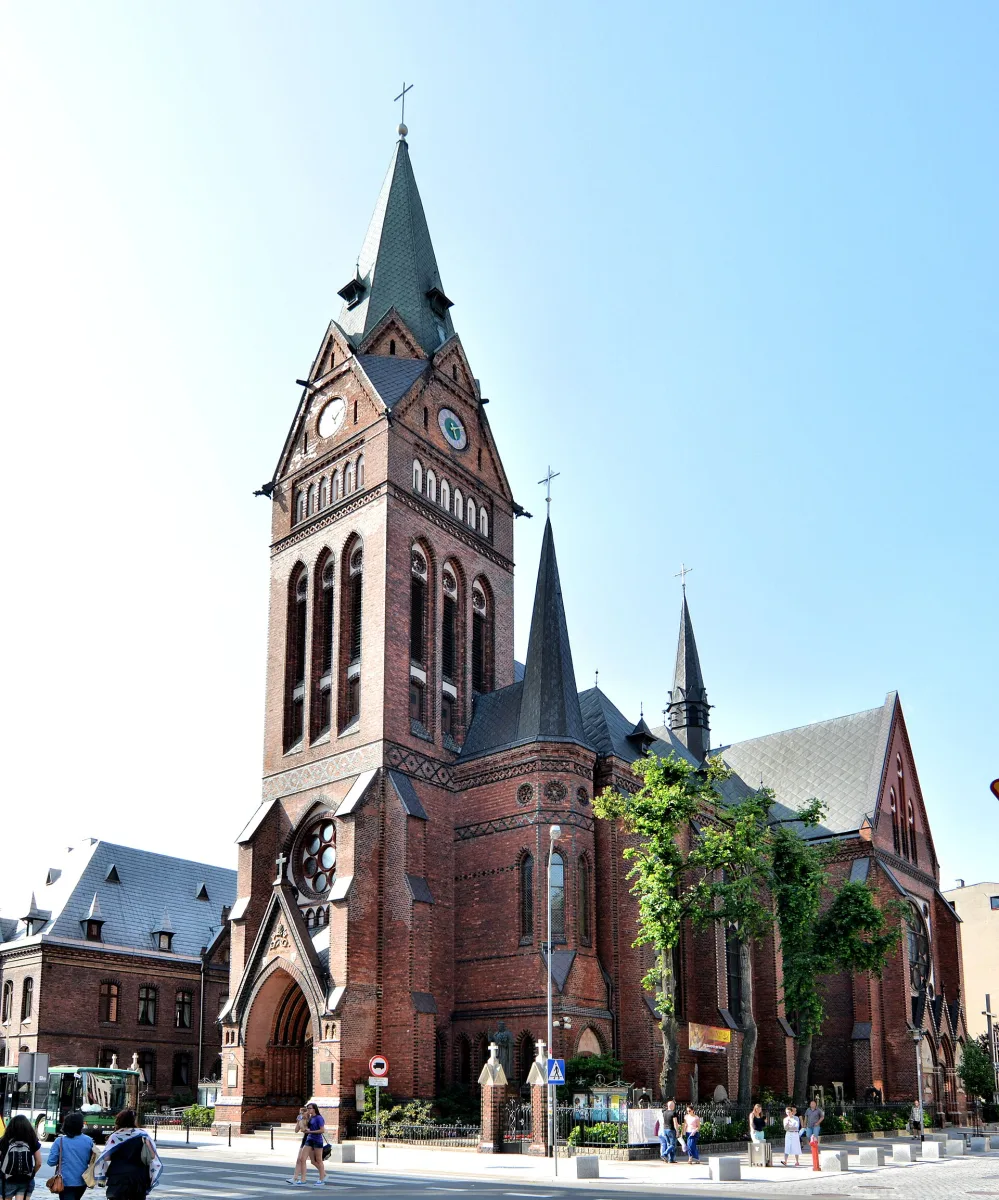
A neo-Gothic hall church from 1888-1890 in the centre of Szczecin, a minor basilica since 2008 and a Marian shrine.
The Basilica of St John the Baptist is a neo-Gothic hall church on a Latin cross plan, standing in the centre of Szczecin at the junction of Bogurodzicy and Kaszubska streets. It was consecrated on 30 September 1890. It was the first Catholic church in the city after the introduction of Lutheranism in 1534, and since 2008 it has held the title of minor basilica, granted by Pope Benedict XVI.
After the Prussian king Frederick William I proclaimed equal rights for Protestants and Catholics in Pomerania in 1722, the first masses were celebrated at the Castle of the Pomeranian Dukes. Soon the first Catholic community was opened on Łasztownia, which became a parish in 1805 and was subject to the Bishop of Wrocław. In 1888 the parish bought land for the church, on 24 May the foundation stone was laid, and the consecration was performed by the Archbishop of Wrocław, Cardinal Georg von Kopp. The design was prepared by the Berlin architect Engelbert Seibertz. Until 1931, when the Church of Christ the King on Łasztownia was consecrated, it was the only Roman Catholic church in Szczecin. Some of the faithful were Poles, and every fourth Sunday services were held in Polish.
In 1944 the roof, the tower spire and the bell tower burned down, and the vaults were also destroyed. The first post-war mass was celebrated on 6 May 1945 in a chapel next to the church. In 1947-1948 the church was partly rebuilt as a rectorial and academic church, and from 1954 it was a parish church of the parish of St James, and from 1974 of the parish of St John the Baptist. In 1986-1987 the tower with its pointed spire was reconstructed.
Distinctive features are the metal gargoyles in the shape of winged dragons on the corners and portals of the church, and on the vault of the porch paintings show the four evangelists. The high altar, dedicated to Our Lady, Queen of Poland, is post-war and dates from 1960-1961. Among the original furnishings, the neo-Gothic side altars, the pulpit and the stained glass have survived.
In the left aisle hangs a plaque dedicated to 111 parishioners killed in the First World War, with many Polish surnames. In the left arm of the transept, in 1994 a bilingual Polish-German plaque was set into the wall in memory of the German Catholic clergy of Szczecin who were arrested by the Gestapo in 1942, and then tortured and murdered.
The cult of Our Lady of Victory, Queen of Poland, is developing in the basilica. The venerated image is a faithful copy of the Jasna Góra painting, the work of Leonard Torwirt, donated on the initiative of Primate Stefan Wyszyński and solemnly installed on 6 December 1959. A shrine was established at the basilica, and the image was crowned with papal crowns.
The organ was built in 1974 by the firm of Zygmunt Kamiński of Warsaw for the Castle of the Pomeranian Dukes, as a gift from the city's residents handed over by the Society of Friends of Szczecin. After its dismantling in 2014 it was handed over to the diocesan curia and installed in the basilica in place of the previous instrument.
The basilica stands in the city centre, about 100 m from the Palace of the Pomeranian Landschaft.
About 300 m away is the Port Gate, and about 500 m further on the St James' Cathedral Basilica.

Be the first! Add a comment.
You need to log in to add a comment.
Log in