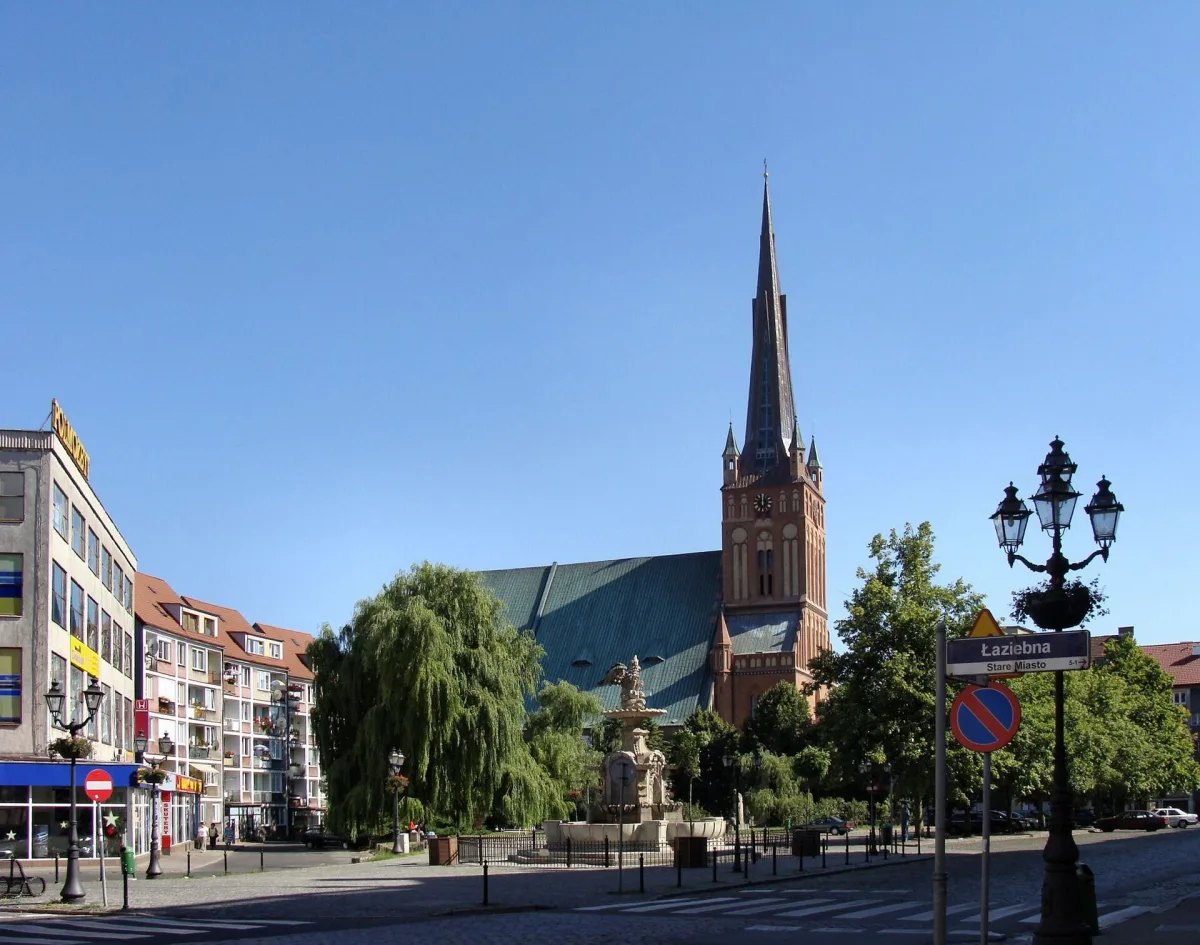
Square of the former Horse Market in the Szczecin Old Town, with a fountain of 1732 and the Palace Under the Globe.
White Eagle Square is one of the main squares of the Szczecin Old Town. Until 1945 it was called Roßmarkt, that is, the Horse Market, because horse fairs were held here. It is bounded on the north by Koński Kierat Street, on the south by Grodzka Street and on the west by Staromłyńska Street.
The square was the main market of the medieval Upper Town. A town hall and a cloth hall stood on it, and the market itself was already mentioned in 1306 and 1312. In the 16th century the cloth hall was demolished, and a horse-powered mill was built on the site of the town hall. After the destruction of the Thirty Years' War and the occupation of the town by Prussian troops in 1713, the buildings were erected anew, and on the western frontage the palace of the chief president of the province, Philip Otto von Grumbkow, was built. In its place, in 1890-1891, a Neo-Baroque building arose, known today as the Palace Under the Globe.
The focal point of the square is the White Eagle Fountain, put into operation on 15 August 1732 as the end of the newly laid waterworks. It survived the bombing because it was covered with sand for the duration of the war. On the green in the southern part of the square there is also the Statue of Flora, set up in 1991. War damage affected the tenement houses of the southern and eastern frontages, which is why the square is wider today than it was before 1945.
At the turn of the 20th and 21st centuries the square became one of the main car parks of the Old Town. In summer 2019 it was temporarily closed to traffic, temporary greenery and street furniture were added, and the city organised events to find out what users wanted. In 2020-2021 parking spaces were reduced, and planting in tubs and restaurant gardens were set up. In November 2023 the actual revalorisation of the square began, to a design by the Palmett studio. The excavations revealed the foundations of the horse-powered mill, early modern cellars and a wooden pipeline from the 18th century.

Be the first! Add a comment.
You need to log in to add a comment.
Log in