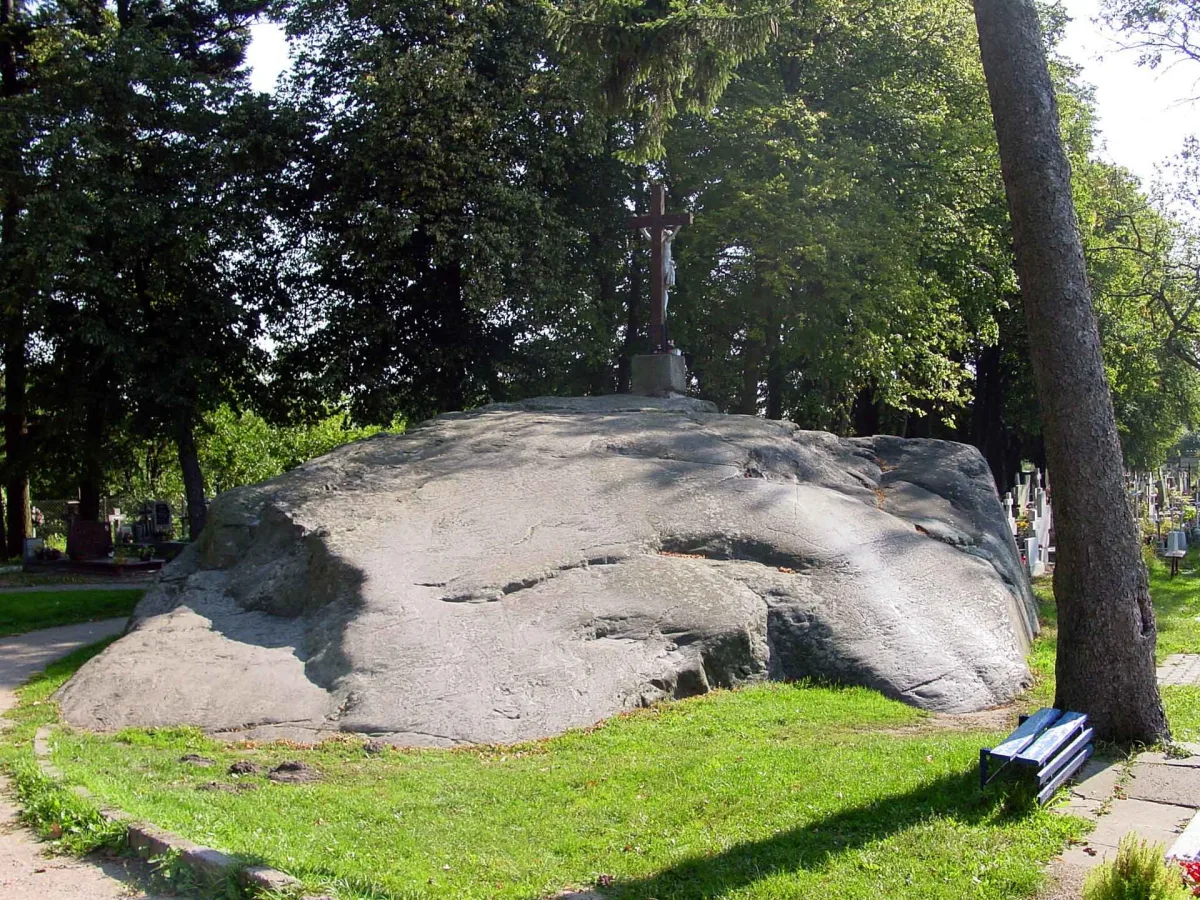
The largest erratic boulder in Poland, a natural monument in the cemetery in Tychowo, with glacial striations, a cross of 1874 and local legends.
Trygław is an erratic boulder in Tychowo in Białogard County, regarded as the largest in Poland. It lies in the middle of the cemetery on Bobolicka Street, has been a natural monument since 1954, and since 1996 has appeared in the coat of arms of Tychowo.
The dark grey gneiss was carried from Scandinavia by the ice sheet during the last glaciation. On its surface you can see glacial polish and striations, marks left by being dragged by the ice. The figures given vary. According to the Wikipedia entry, the boulder has a circumference of about 50 m, a length of 16 m, a width of 11 m and a height of 7.8 m (of which 4 m is underground), a volume of about 700 m³ and an estimated mass of about 2,000 tonnes. The Encyclopedia of West Pomerania gives a circumference of about 50 m, a height above ground of 3.8 m, a length of 13.7 m, a width of 9.3 m and a weight of about 200 thousand kilograms, that is about 200 tonnes. The same encyclopedia names Sweden as the boulder's country of origin.
Local legends are attached to the stone. The name refers to the Slavic Triglav, whose golden statue was said to be buried beneath the boulder. Another story says that one of the dukes of West Pomerania drove a coach and four up onto the stone and turned it round there. The boulder is also sometimes called the Devil's Stone or Triglav's Altar. These are folk tales, not confirmed facts.
On the first Sunday of 1874 the German residents set up a wooden cross on the boulder with a figure of the crucified Christ. The figure was made by the sculptor Wilhelm Theodor Achtermann and cast at the Moritz Geiß cast-iron foundry in Berlin. Today, on All Saints' Day every year, the stone serves as an altar at which Mass is celebrated.

Be the first! Add a comment.
You need to log in to add a comment.
Log in