
The ring from Pęzino and Black Jolka from the cellars of the Old Town Hall in Szczecin are two stories from two distant worlds: the village castle of the Borck family and the urban town hall with its prison. One thing links them: both have material traces today, and we know more about these than about the tales themselves. We give the legends as they were recorded in the Encyclopaedia of West Pomerania, and alongside them the facts.
The maiden of Pęzino and three golden rings
According to a legend that the Encyclopaedia of West Pomerania cites after Ulrich Jahn (the collection Volkssagen von Pommern und Rügen, Berlin 1889), one night a ghost appeared to a maiden of Pęzino Castle and told her to follow it to the church. There it told her to take burning coals from the altar, put them in her apron and return to the castle without looking back. The girl could not hold out and looked back, and all the coals fell from her apron except three. Only in the castle did she notice that she was holding three golden rings.
The legend added that whenever one of the rings was lost, misfortune would fall on the castle and its owners. This motif of a curse tied to an object recurs in tales from many countries, but the Pęzino version has one feature that most of them lack: the rings really existed.
The signet ring that survived into the museum
The Encyclopaedia of West Pomerania describes a golden medieval signet ring dated to the period from the 12th to the early 13th century, with the figure of a knight engraved on a large, rectangular bezel. The knight is shown frontally, in a long robe tied with a belt, with a triangular shield and a spear in his hands. Along the edges of the bezel runs an inscription of ten letters separated by two Greek crosses, which has not been deciphered to this day. The shank of the ring is decorated with silhouettes of two lying lions with their heads turned towards the bezel.
According to the same encyclopaedia, the ring was bought for the collection of the National Museum in Szczecin in 1998 by the Bosman Brewery. It was one of two identical signet rings, surrounded by legend, kept at Pęzino Castle until the end of the Second World War. Until 1703 the castle belonged to the Pomeranian Borck family, and later to the Puttkamers.
Black Jolka and the cellars of the town hall
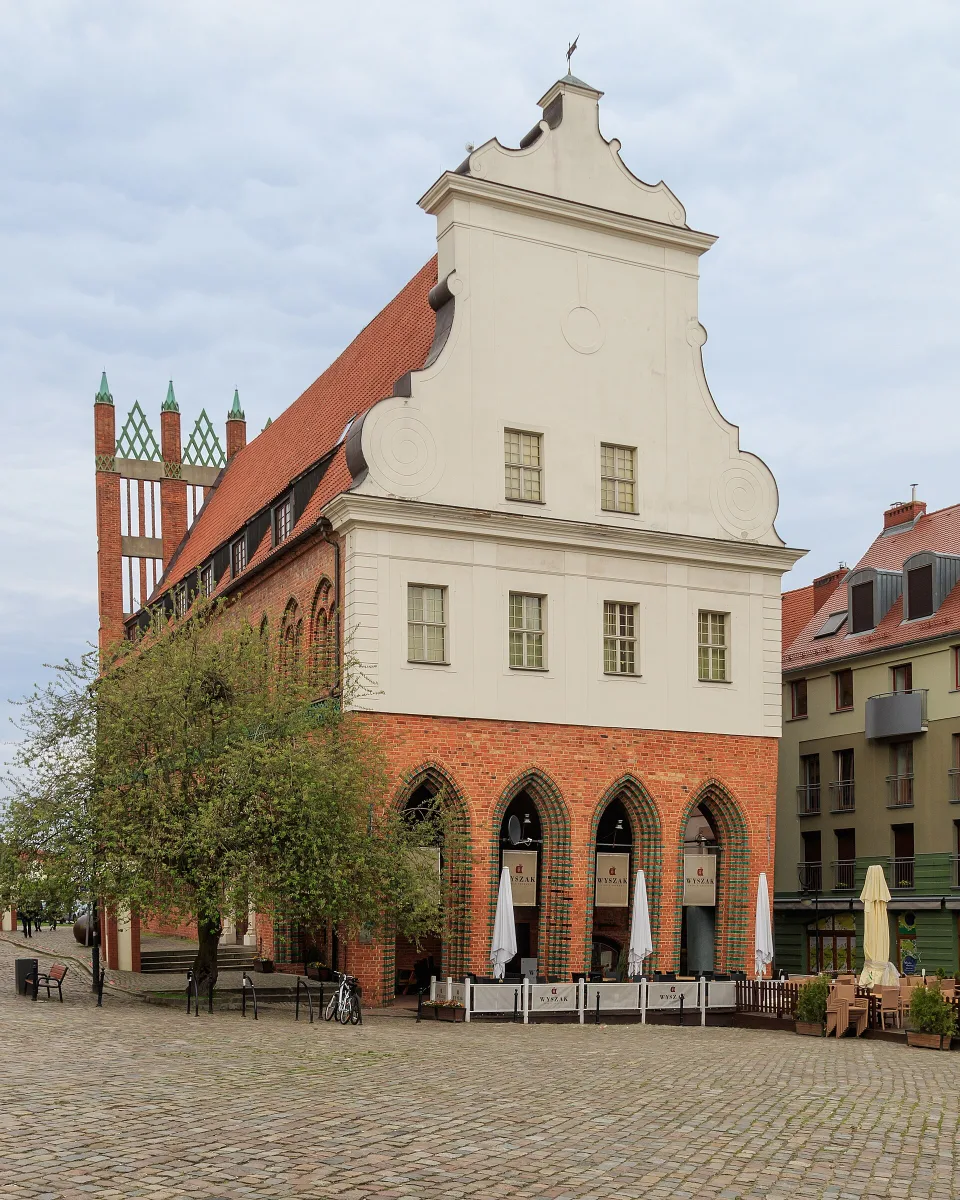
With the Old Town Hall in Szczecin, and more precisely with the part of its cellars used as a prison, is linked, according to the Encyclopaedia of West Pomerania, the legend of Black Jolka. She was a witch who made her own executioner fall in love with her and thereby escaped the stake. The encyclopaedia gives it in a single sentence, among the legends and curiosities of the building, without a date, without the executioner's name and without reference to an older record, so it is a short urban tale and not a documented event.
The setting really exists. According to the same source, in 1245 Duke Barnim I permitted the burghers to build a wooden merchants' hall in the market square. At the turn of the 13th and 14th centuries it was replaced by a brick building with a council chamber on the upper floor, a merchants' hall and a court arcade. The cellars were divided into three parts: a merchants' space, a storeroom and prison cells under the arcade, connected by a round staircase with the courtroom. Around the middle of the 15th century the town hall was demolished and a new, late Gothic building was raised on the old foundations, and its appearance is attributed to the school of Heinrich Brunsberg. Since 1975 it has housed the Museum of the History of Szczecin, a branch of the National Museum, and a restaurant.
Be the first! Add a comment.
You need to log in to add a comment.
Log in