
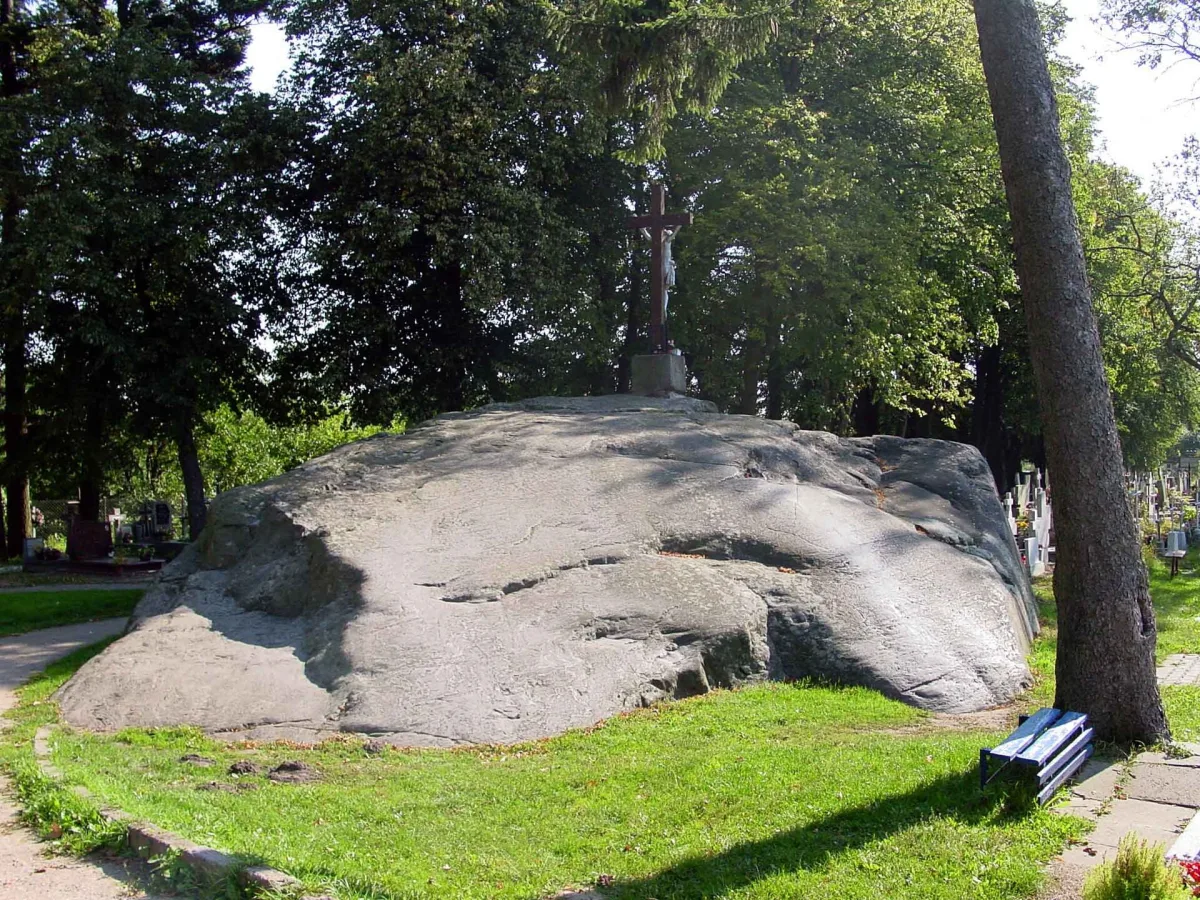
The ice sheet carried blocks of rock from the far north to West Pomerania and left them in fields, forests and cemeteries. People gave some of them names, crosses and legends. Two places in the region show this best: the cemetery in Tychowo with the Trygław boulder, and the Beech Hills near Szczecin.
Trygław in Tychowo: the largest, but how many metres?
The boulder lies in the middle of the cemetery on Bobolicka Street. According to Wikipedia it is the largest erratic boulder in Poland. The Encyclopaedia of West Pomerania says the same, adding that it is a metamorphic rock, garnet paragneiss, and that glacial polish and striations can be seen on its surface. Wikipedia describes a dark grey gneiss brought from Scandinavia.
The figures, however, differ. The Wikipedia entry on the boulder itself gives a circumference of about 50 metres, a length of 16 m, a width of 11 m and a total height of 7.8 m, of which 4 m is below ground. The volume is about 700 cubic metres and the mass about 2,000 tonnes. The entry on the village of Tychowo in the same Wikipedia speaks of a circumference of 44 m, a length of 13.7 m and a width of 9.3 m. The Encyclopaedia of West Pomerania gives a circumference of about 50 m, a height above ground of 3.8 m and a weight of about 200 thousand kilograms, that is, about 200 tonnes, ten times less than Wikipedia. Only the volume agrees, about 700 m³. The origin is also described differently: Wikipedia points to Scandinavia, the Encyclopaedia of West Pomerania to Sweden.
Wikipedia confirms the title of the largest by comparison. The second largest in Poland, according to it, is the Mszczonów Boulder in Zawady in Łódź Voivodeship, with a circumference of about 40 m. It is, however, a sandstone torn from the bedrock by the glacier, not a rock dragged from Scandinavia.
A three-headed god, a prince with a coach and a cross
The name refers to Trygław (Triglav), a Slavic god with three faces. According to legend the boulder was a place of his worship. The tale also says that a golden statue of the deity was buried under the stone. Another story says that one of the West Pomeranian princes drove a coach drawn by four horses onto the boulder and turned round on it. The boulder is also called the Devil's Stone or the Altar of Trygław. These are legends, not confirmed facts.
The cross is linked to a documented history, given by Wikipedia. On the first Sunday of 1874 the German residents set up on the boulder a wooden cross with a figure of Christ. The figure was made by the sculptor Wilhelm Theodor Achtermann and cast in the Berlin iron foundry of Moritz Geiß. Beneath the cross is a plaque with a four-line verse whose sense is: Christ shut Trygław under the stone. Today, on All Saints' Day, the boulder serves as an altar during Mass in the cemetery.
Since 1954 Trygław has been a natural monument, and since 1996 it has appeared in the coat of arms of Tychowo. Because it stands in an active cemetery, quiet and respect are expected here.
The Beech Hills: boulders with names
Near Szczecin the ice sheet left in the Beech Forest boulders that are smaller than Trygław but numerous. According to Wikipedia, 880 have been inventoried here, and several dozen have a circumference of more than 7 metres. Many of them have names and similar legends.
- The Boulder of the Sightseers (Głaz Krajoznawców), called the Giant, is a granite with a circumference of 17.5 m and a height of 2.7 m, the largest of the forest's boulders listed in the Wikipedia table. The yellow Bolesław the Wrymouth Trail passes it.
- The Cradle Boulder (Głaz Kołyska) has a circumference of 14.75 m and a height of 2 m.
- The Heart Boulder (Głaz Serce), or Millstone, is a gneiss with a circumference of 13.75 m and a height of 0.8 m.
- The Groński Boulder has a circumference of 12.3 m. Until 1957 it was called Bolek's Boulder, in honour of Bolesław the Wrymouth. In 1959 PTTK placed on it a plaque in memory of Stanisław Groński, a mountaineer and pioneer of tourism in the Szczecin region, who died in the Mont Blanc massif in 1957. A hole left by an explosive charge can be seen on the boulder.
- The Słupi Głaz, a granite with a circumference of 8.7 m and a height of 1.7 m, lies on the route of the red trail through the Słupi Głaz. According to Wikipedia, the Swedish Boulder and the Mossy Boulder are also natural monuments, among others.
Boulders that vanished into roads and walls
Wikipedia recalls that there used to be many more boulders in the forest, and the local population used them for walls and paved roads. According to one anecdote, a road to Kołowo was built from one huge boulder near Dobropole, and a boulder lying by Groński Road was supposed to have been used to build parts of the colonnade of the National Gallery in Berlin. These are anecdotes quoted in Wikipedia, without confirmation in documents. The boulders lie within the area of the Szczecin Landscape Park "Puszcza Bukowa".
Be the first! Add a comment.
You need to log in to add a comment.
Log in