
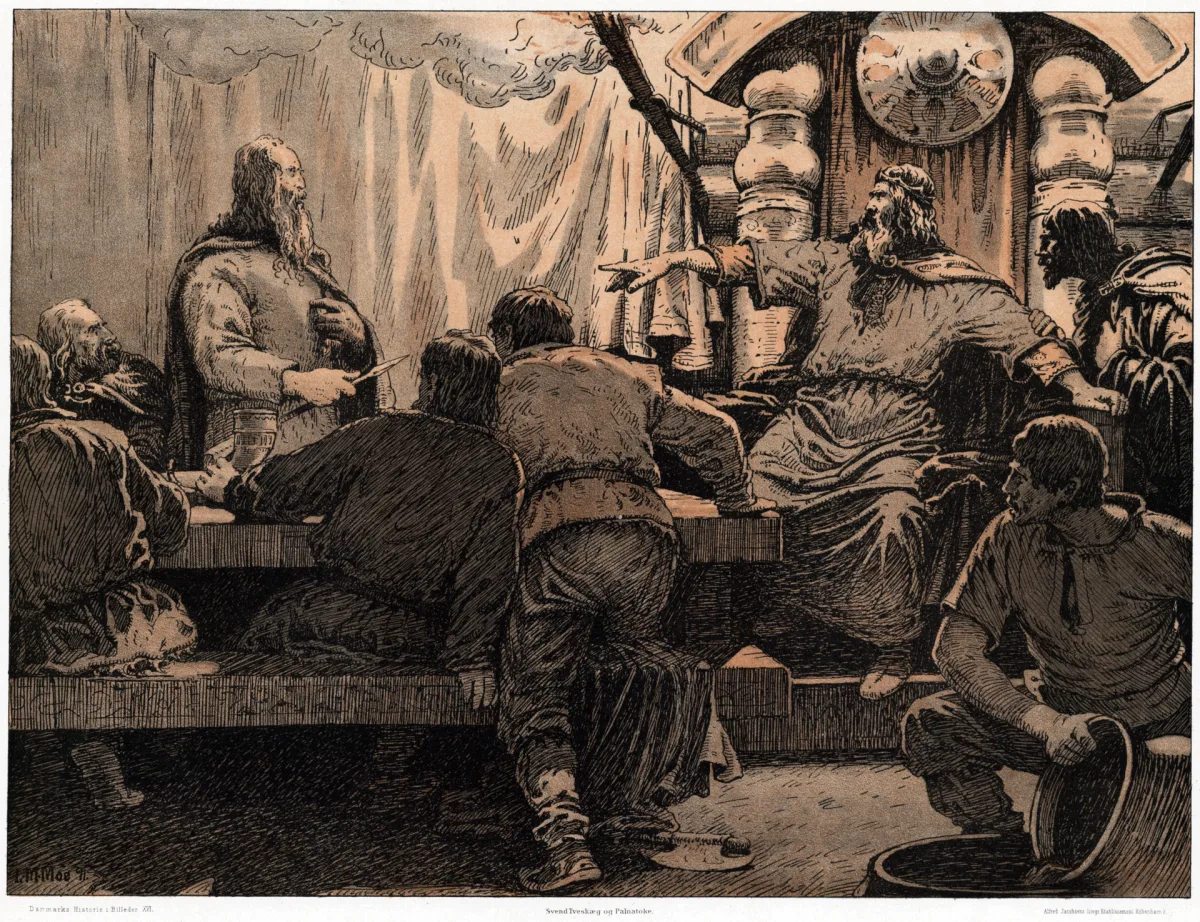
What the sagas say about the founding of Jomsborg
In the Scandinavian sagas, Jomsborg is a fortified Viking settlement at the mouth of the Oder. According to Wikipedia it appears in sources from the 12th and 13th centuries, and some historians question the reliability of the sagas as historical sources. The fullest account is contained in the anonymous Jómsvikingasaga from the early 13th century.
The sagas do not agree on who founded Jomsborg. Fagrskinna, Knýtlinga saga and Saxo Grammaticus name the Danish king Harald Bluetooth. Saxo wrote that Harald conquered the settlement of Julinum and gave it to the Swedish prince Styrbjörn, who at the head of his warriors tried to seize power in Sweden. According to the Jómsvikingasaga and several related texts, the founder was the jarl Palnatoki, who was said to have received the land from the Slavic ruler Burislav. Wikipedia explains this difference by the development of the tradition: the oldest, non-surviving version of the saga named Harald, and in later ones Palnatoki replaced him.
The sagas also describe the fortress itself. According to Wikipedia, Jomsborg had a spacious harbour and a stone tower with catapults, and the oldest accounts speak of a harbour for three ships, while later ones speak of 360 ships. The armed band of the Jomsvikings had, according to the sagas, its own code: men aged from 18 to 50 were admitted to it, and a fallen comrade had to be avenged.
When the sagas were written and what about the battles
One of the oldest traces of the tradition, the poem Jómsvikingadrápa by Bjarni Kolbeinsson, was composed according to Wikipedia probably in the second half of the 12th century. The Saga of Olaf Tryggvason and Eyrbyggja saga date from the second half of the 13th century. They are therefore separated from the events they describe by more than two hundred years of oral tradition and reworking.
According to the sagas, the fame of the Jomsvikings is linked with the battle in the Hjörungavágr bay, in which they lost to Jarl Haakon. The dates given by Wikipedia differ: the English entry on the Jomsvikings speaks of the year 986, and the entry on Jomsborg of about 990. According to the sagas, or more precisely according to Heimskringla, the end of the fortress was brought about by the Norwegian king Magnus the Good, who in 1043 invaded Wolin and destroyed Jomsborg. Alongside this date Wikipedia also gives the year 1042. These are events known from the tradition of the sagas and chronicles, not from excavations.
What has not been found in Wolin
Polish archaeologists, according to Wikipedia, discovered in Wolin an urban complex with a trading area, a harbour landing and a burial ground. Among the finds are pieces of weaponry, soapstone vessels, decorative amulets, a tablet with a runic inscription and fragments of boats. The Regional Museum in Wolin also displays a handle from the 11th century with ornament in the Borre style. These are evidence of contacts with Scandinavia, for example at the burial ground on Wzgórze Wisielców, where both cremation and inhumation burials were made, which researchers explain by Scandinavian and Christian influences.
What is missing, on the other hand, is anything that would match the fortified base of the sagas: a fortified Viking camp with a harbour for hundreds of ships. The historian Steven Fanning writes that all attempts to find Jomsborg or the camps of the Jomsvikings have failed and that many researchers doubt that they existed outside literature. Władysław Filipowiak, in turn, pointed to dated sources confirming the presence of a unit of armed Vikings in Wolin at the end of the 10th century, perhaps as mercenaries of the Polish king Bolesław the Brave. This is a hypothesis, not an established finding.
Where Jomsborg has been sought
The most common hypothesis identifies Jomsborg with Wolin. According to the English Wikipedia entry it is sometimes placed on Srebrne Wzgórze (Silver Hill) north of the town. In 1847 Robert Klempin put forward the thesis that Vineta, Jomsborg and Julin are names of one place, and in 1931 and 1932 Adolf Hofmeister drew a similar conclusion, comparing chronicles. Adolf Stubenrauch, who in 1897 analysed possible locations, considered Wolin the only place on the islands of Uznam and Wolin that met the conditions for Vineta. There is, however, no general agreement.
Other theories place Jomsborg in the north-west of the island of Uznam, in areas now flooded, for example around the islands of Ruden and Greifswalder Oie or the shoals of Peenemünde. According to T. D. Kendrick, ornaments from the Viking period were found there, but an archaeological assessment of these hypotheses is not yet possible.
One of the newest hypotheses points to the area of Paprotno. It is linked with the Swedish archaeologist Sven Rosborn, who cited the text of the alleged chronicle Gesta Wulinensis ecclesiae pontificum and the golden disc of Curmsun. The disc and the chronicle are, however, criticised by, among others, Jes Wienberg and Kurt Villads Jensen and Wojtek Jezierski, who regard them as forgeries, pointing to anachronisms. Until independent research is carried out, this location should not be treated as established.
Be the first! Add a comment.
You need to log in to add a comment.
Log in