
Góra Chełmska lies in the eastern part of Koszalin and combines geology, the history of worship and a view over the surrounding area on a single summit. According to Wikipedia, it is a terminal moraine ridge on the Koszalin Coastland, separating the Słupsk Plain from the Białogard Plain. It is about 8 km in a straight line from the Baltic. Below: how the hill was formed, what is known about the former place of worship, why a tower from 1888 stands here and what the sanctuary from the 1990s looks like.
The moraine ridge and three summits
Wikipedia describes Góra Chełmska as a terminal moraine piled up by glacial tectonics, containing rafts of Tertiary sands and clays (the entry cites Jerzy Kondracki's Geografia regionalna Polski here). According to the same entry, the ridge probably already existed while the southern shore of the Baltic was taking shape, about 12,500 years ago.
The ridge consists of several elevations. According to Wikipedia, the highest is Krzyżanka at 136.2 m above sea level, followed by Krzywogóra (133.0 m) and Leśnica (118.5 m). The tower, the chapel and the foundations of the medieval church stand on Krzyżanka, so in everyday usage Góra Chełmska usually means this summit.
The names changed with the era. The oldest mention, from 1214, gives the hill as Cholin, which according to Wikipedia was supposed to mean Chełm. German studies know it as Gollenberg or Gollen. The official name Gołogóra was introduced in 1949, and in the same year the name Krzyżanka was given to the summit that had previously been called Kreuz-Berg in German.
A place of worship: what archaeologists say
The question of whether a pagan place of worship stood on the summit before Christianity has no single answer. According to the entry on Krzyżanka, Henryk Janocha discovered traces of hearths and the remains of a wooden dwelling in the 1960s and took them for the remains of a pagan temple (kaciń) in use from the mid 9th to the end of the 12th century. Andrzej Kuczkowski doubts that such a structure existed and allows that these may have been auxiliary buildings or a meeting place of an assembly type. In turn, according to Wikipedia, the Monuments Protection Department of the Ministry of Culture stated in 2003 that the relics discovered in no way indicate a religious character of the hill before Christianity was introduced in West Pomerania.
The Christian phase is more certain. At the turn of the 12th and 13th centuries a chapel of the Blessed Virgin Mary was built on Krzyżanka. According to Wikipedia, the sources do not give the exact date of construction, but it is known that in 1263, before Koszalin received its town charter, a chapel with a parish priest existed here, described as a place of numerous pilgrimages. The same entry adds that the chapel had a tower lit at night, which served sailors in place of a lighthouse. This is, however, information from a single study, so it should be read as such.
In 1287 Herman von Gleichen, Bishop of Kamień, founded a convent of Cistercian nuns in Koszalin and entrusted them with the care of the chapel. In 1395 Bishop John of Kamień granted it the right to grant indulgences, confirmed several times afterwards, up to 1427. According to Wikipedia, pilgrimages were most intense in the years 1414-1485.
The sources describe the end of this phase somewhat differently. The entry on Krzyżanka states that the chapel was demolished and dismantled in 1532-1533 after the great fire of 1530. The entry on the sanctuary says that it flourished until 1533 and that, as a result of the Lutheran Reformation, the buildings on the hill were demolished and burnt. The entry on Góra Chełmska itself gives Christian worship until about 1530. From the fire of the chapel in 1533 a Gothic crucifix from the 14th century was saved, which according to Wikipedia now hangs on the rood arch of the cathedral in Koszalin.
Traces of the church were uncovered in the 20th century. In 1959-1962 and 1986-1987 archaeological research revealed the remains of the walls of a 13th-century chapel, a 15th-century church and an early medieval burial ground. Earlier, in 1829, numerous skeleton graves were found during work on the construction of a monument. According to Wikipedia, the monument, a cross designed by Karl Friedrich Schinkel in honour of soldiers killed in the Napoleonic wars, stood next to today's tower and was blown up at the end of the 1960s.
The viewing tower from 1888
A historic viewing tower stands on the summit of Krzyżanka. According to the sanctuary's website it was built in 1888 and is 31.5 m high; Wikipedia gives the same height and date. From the top, in good weather, there is a panorama of the surroundings reaching as far as the sea. According to Wikipedia, the tower is on the list of legally protected monuments.
Who built it and for what purpose is not stated by the sources we worked with, so there is no point in guessing. It is known, however, that a station transmitting a radio signal was placed on the tower, and nearby, on Słupska Street, there is a separate radio and television centre.
According to Wikipedia, the renovation begun on Krzyżanka in 2011 covered the refurbishment of the tower's façade, the replacement of the windows and the viewing terrace, and then the strengthening of the foundations with 55 reinforced concrete piles 12 m long. Whether and when the tower is open to visitors is determined by the sanctuary on its website, because the rules change with the weather and building work.
The Sanctuary of Our Lady Thrice Admirable
From 1977 Bishop Ignacy Jeż called for the sanctuary on the hill to be rebuilt, but according to Wikipedia the authorities rejected his application. In 1981 they agreed to the construction of a theological seminary near Koszalin, but not to restoring a sacred character to the hill. The location decision was issued only in 1990, and the curia received a building permit for the sacral complex in November of that year. The building site was blessed on 30 December 1990, and the foundation stone was laid on 14 April 1991.
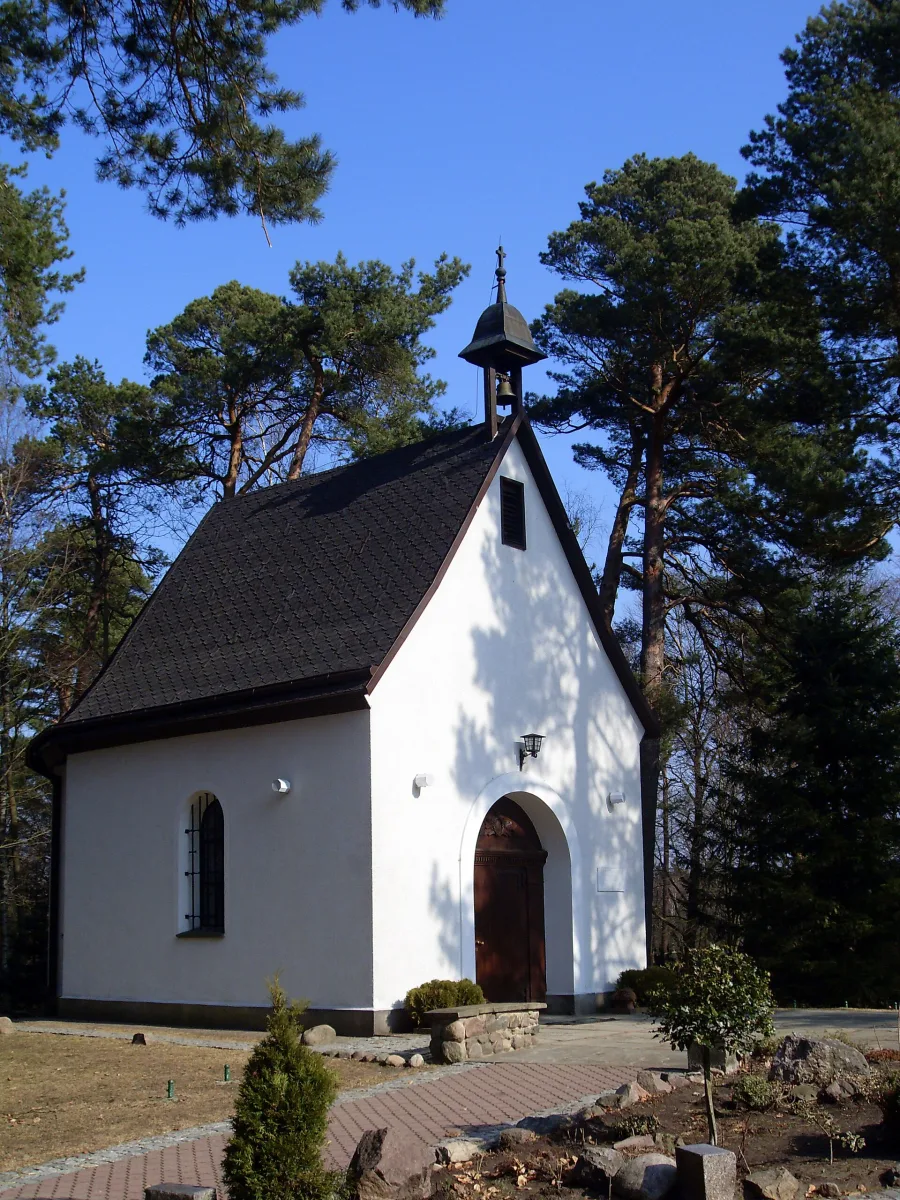
The Sanctuary of Our Lady Thrice Admirable is a small chapel of brick and concrete. According to Wikipedia, it is an exact copy of the chapel in Otwock-Świder and serves as the centre of the Marian Apostolic Movement in the Koszalin-Kołobrzeg diocese. Inside hangs a copy of the image of Our Lady Thrice Admirable from Schönstatt. The same Wikipedia states that the chapel was consecrated on 1 June 1991 by Pope John Paul II, while the entry on Krzyżanka speaks of its blessing on that day. Right next to it are the foundations of the chapel from the turn of the 12th and 13th centuries.
Several monuments have been placed around the chapel. At the foot of the hill stands a stone dedicated to Polish soldiers, insurgents of the November Uprising interned by the Prussian authorities in 1831, who built a road across Góra Chełmska. By the gate stands a monument commemorating the Pope's pilgrimage in 1991, and on the summit a plaque with his question whether the words of God spoken on Sinai had not also found a distant echo on this mountain. Beside one of the paths stands a six-tonne boulder in memory of the presidents Ryszard Kaczorowski and Lech Kaczyński, pilgrims to the sanctuary.
Trails and activity on the hill
A junction of marked trails meets on the summit. According to Wikipedia, from here lead the John Paul II Pilgrimage Trail to Polanów, the Józef Chrząszczyński Trail to Tychowo, the Trail of the Abducted Prince to Sianów and the Pomeranian Way of St James from Gdańsk towards Szczecin. The same entry states that the summit can be reached in about 40 minutes on foot from the Gwardia stadium in the Przylesie estate.
In the forest on the hill there is also the Na Linie rope park, with courses from children's to high ones, ending in a 110 m zip line. It is a good addition to a walk up the hill if there are children in the group, but the park operates seasonally and not in bad weather, so plans should be checked on its website.


Be the first! Add a comment.
You need to log in to add a comment.
Log in