

Berlinchen, 1868: the home of a world champion
Emanuel Lasker was born on 24 December 1868 in Barlinek, then the German town of Berlinchen. According to Wikipedia, he was the second world chess champion in history. He won the title in 1894 by defeating Wilhelm Steinitz in a match in which he won 10 games, drew 4 and lost 5. He held it for 27 years, until 1921, when he lost a match to José Raúl Capablanca. The West Pomeranian Landscape Parks Complex, which manages the landscape park around the town, states plainly that Lasker held the title longer than anyone in history. Wikipedia adds that he was also a mathematician and philosopher, was a friend of Albert Einstein and invented the board game Lasca, based on draughts. The entry on Barlinek lists him as a doctor of mathematics and philosophy.
The chess player's fate was tied to the history of Europe. Lasker and his wife Martha Cohn, both of Jewish descent, had to leave Germany in 1933. They went to England, then to the Soviet Union, and at the end of 1937 settled in New York. Lasker died there on 11 January 1941.
In his home town the memory of him is written into the calendar and the landscape. According to Wikipedia, chess festivals named after him are held here, the Lasker chess club operates, and one of the parks bears his name. A commemorative plaque hangs where Lasker lived. The fullest account of him is held by the Regional Museum in Barlinek, which is housed in Gutenberg House, a former printing works from the mid-19th century. The exhibition has four parts, and the first, biographical one is devoted to Lasker and his family. The others show archaeology from the Neolithic to the Iron Age, the history of the town in the 19th and 20th centuries, and the daily life of the surrounding villages. The museum grew out of a Memorabilia Room established in 1961 on the basis of the private collection of the local historian Czesław Paśnik.
From the town charter of 1278 to the market square fire
The town has older roots than its municipal rights. According to Wikipedia, a Slavic stronghold stood on the site of the Gothic Church of the Immaculate Heart of the Blessed Virgin Mary. At the end of the 13th century the area was taken over by the Margraviate of Brandenburg. The margraves Otto V and Albrecht III permitted Heinrich Toyte to found a town called Nova Beryn, and in 1278 the Brandenburgers granted the settlement town rights. The town became a fortified border stronghold. In the mid-14th century it received walls with two gates, the Myślibórz Gate (Soldiner Tor) and the Mill Gate (Mühlentor). Wikipedia also lists disasters: plagues and as many as seven fires. The largest of them, in 1852, destroyed the buildings around the market square, the town hall and the church tower.
The church in question was begun in the 13th century as a Romanesque building of granite ashlar, extended in the Gothic style in the 14th century, and rebuilt after the fire of 1852 with Neo-Gothic elements. In the porch under the tower stands a granite Romanesque font. After the war, on 1 December 1946, it was consecrated as a Catholic church. The brick St Boniface's Church is much younger: it was consecrated on 19 December 1923 and built from donations of Polish farm workers and from the Bonifatiusverein fund for the local Catholic congregation. The Orthodox Church of the Dormition of the Blessed Virgin Mary, in turn, is a former Protestant church. According to the heritage register, the Neo-Gothic building dates from 1873, while Wikipedia says only the 19th century. In 1947 it was handed over to the Orthodox Church, and after renovation it was consecrated on 5 June 2021.
Barlinek went through the Second World War as a front-line town. According to Wikipedia, it was taken on 31 January 1945 by the 12th Tank Corps of the Red Army, and as a result of fighting and deliberate arson more than 50 per cent of its buildings were destroyed. The remaining German population was forcibly expelled beyond the Oder, and Polish settlers were brought to the town.
Traces of former residents
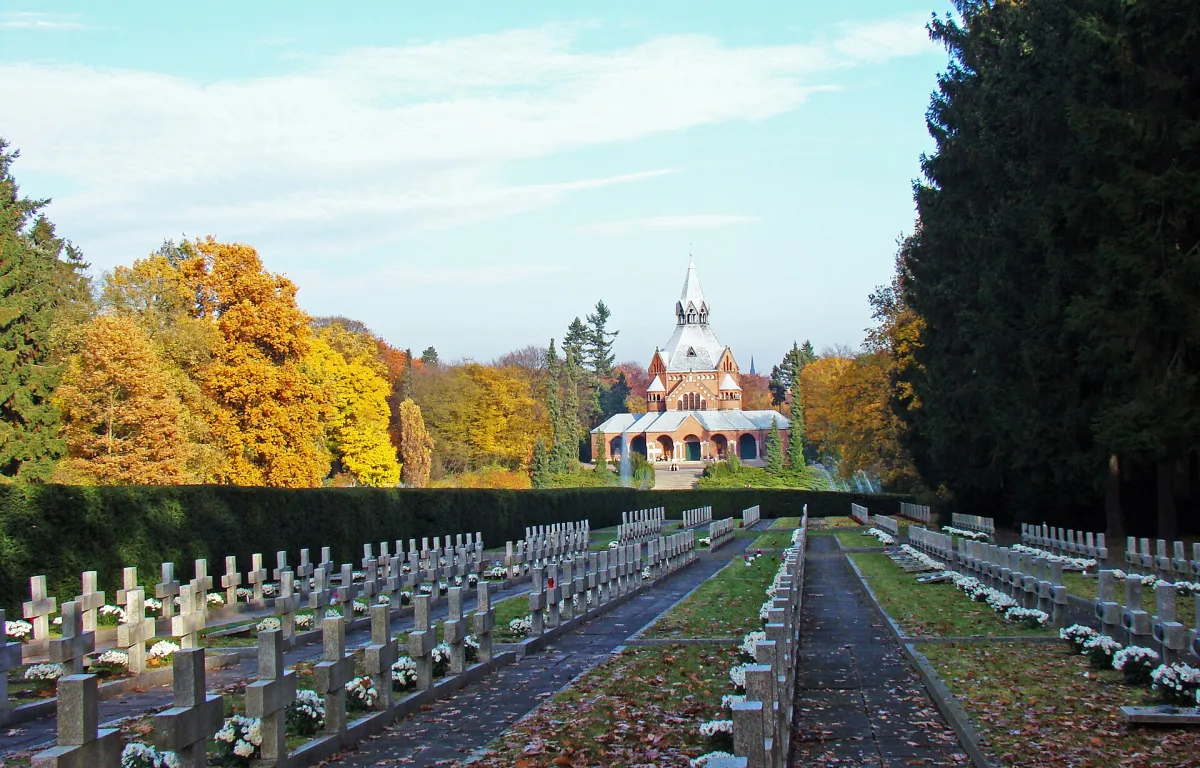
Traces remain of the former Protestant and Jewish communities, and one has to know how to read them. The Protestant cemetery was founded in the 19th century and was in use until 1945. At the turn of the 1960s and 1970s the site, together with the so-called Old Cemetery, was levelled and turned into a town park. The former burials are commemorated by a boulder with a plaque, unveiled on 10 June 1992.
Not far away lies the Jewish cemetery, established at the turn of the 18th and 19th centuries on a rise known as Żydowska Góra (Jewish Hill). It was not destroyed during the war and was devastated only in the post-war years. Fragments of individual gravestones have survived. It is a place of remembrance, where silence and respect for the gravestones are expected. The Landscape Parks Complex lists this cemetery among the historic monuments of the region.
Lake, beach and forest
Lake Barlinek lies within the town limits, surrounded by hills covered with forest and cut by ravines. The shores are high and in places steep. The water surface covers from about 250 to 268 hectares, because measurements differ. The average depth is 7.1 metres and the greatest 18 metres. The current name was introduced officially in 1950, replacing the German Berlinchener See. The lake has the islands Łabędzia (Swan), Sowia (Owl), Nadziei (Hope) and Zielona (Green). Wikipedia calls the Boży Dar spring by Polana Lecha the most attractive of the lake's many springs. A green hiking trail runs all the way round. The town beach was built in 1927 in the Alpine style, described by Wikipedia as unique in Pomerania.
Around the lake extends Barlinek Landscape Park, the youngest landscape park in the region. In its present form it was established by a resolution of 21 September 2020, covers 11,694.29 hectares and includes part of the Barlinek Forest. The forest itself is covered in a separate article; here it is enough to note that the park is the town's natural hinterland. According to the manager, the park names among its technical monuments the Paper Mill (Młyn Papiernia), open to visitors and considered the best preserved of the local watermills.
The town's promotional slogan reads: Barlinek - To mnie rusza (Barlinek - It moves me). Barlinek is also sometimes promoted as the European Capital of Nordic Walking. According to Wikipedia, 7 routes of varying difficulty have been marked out around the town, 54 kilometres in total, and the park's manager states that six of them run within the park. It is the town's promotional slogan.

Be the first! Add a comment.
You need to log in to add a comment.
Log in