
Koszalin has more than seven centuries of urban history behind it, but visitors will mainly see what survived the fires and the war: a brick cathedral, fragments of the walls, several Gothic and Baroque townhouses and a modernist town hall from the 1960s. Below: how the town came into being, who ruled it and which places in the centre tell its story, in order from the town charter to the post-war period.
The charter of 1266 and the town of the Bishops of Kamień
According to Wikipedia, the town was founded in 1188 by Slavs, citing the chronicle of Wendland. The village of Koszalin was granted in 1214 by Duke Bogislaw II to the monastery in Białoboki. In 1248 the eastern part of the Kołobrzeg land with Koszalin passed into the ownership of the Bishops of Kamień. The town charter was granted on 23 May 1266: Bishop Herman von Gleichen gave the town Lübeck law, the surrounding villages and numerous privileges, and established here his main residence and the capital of the episcopal Duchy of Kamień.
A few decades later the town was surrounded by walls. According to Wikipedia, fragments of the defensive walls, entered in the heritage register, date from around 1320, and the medieval layout of the town included the New, Mill and High Gates. After the walls were demolished in the 1820s, the town began to expand eastwards. A fragment of the walls still stands today in the Pomeranian Dukes Park, in its southern part, between Słowackiego and 1 Maja Streets. The heritage register dates the park on the Dzierżęcinka to 1817-1887.
Access to the sea came to the town with the purchase of the village of Jamno in 1331 and of part of Lake Jamno, with the spit and the stronghold of Unieście, in 1353. Koszalin took part in maritime trade as a member of the Hanseatic League, which led to disputes with Kołobrzeg and Darłowo. In 1535, as Wikipedia states, 1,500 of 2,500 inhabitants died of the plague. The castle residence of the Pomeranian dukes was completed in 1582. According to the entry on the castle, it was built in 1569-1582 on the site of an earlier Cistercian convent and after the fire of 1718 it was never rebuilt; law court buildings later stood on its foundations, and fragments of a Gothic portal and of the convent chapel survive. In 1690, according to Wikipedia, a great storm silted up the Jamno Channel, which ended Koszalin's operation as a seaport.
The cathedral: brick Gothic
The most important monument of the town, as Wikipedia writes, is the Cathedral of the Immaculate Conception of the Blessed Virgin Mary, a former parish church. The dates given differ slightly: the entry on the cathedral gives 1300-1333, while the list of monuments in the entry on the town simply shows the year 1333. The three-aisled basilica has on the west side a massive four-storey tower 56 metres high, with a clock placed under the roof in 1754. The star vaults have ribs of brick shaped into a trefoil, and twelve octagonal pillars, six in each of two rows, symbolise, according to Wikipedia, the twelve apostles.
From 1534 to 1945 it was a Protestant church, and since 1972 it has been the cathedral of the Koszalin-Kołobrzeg diocese. Inside are preserved a Gothic crucifix from the 14th century, saved from the fire of the chapel on Góra Chełmska in 1533, and an early Gothic font from the 13th century, carved according to Wikipedia by Gotland sculptors. The Gothic high altar of 1512, the work of Andreas Wenzel of Iwięcino, was dismantled in the mid 19th century, and some of the figures returned to the new altar in 2012. The monuments of Koszalin lie on the European Route of Brick Gothic.
Not far from the cathedral stands the neo-Gothic St Joseph's Church, built in 1869-1870. According to the entry on it, it was the first Catholic church in the town after the Reformation and until 1945 the only one. A little further on is St Gertrude's Chapel, an octagonal brick building from 1383, erected outside the walls as a cemetery chapel. From 1534 it belonged to the Protestant church, in the 18th century it was turned into an ammunition store, and in 2000 it was consecrated as a church of the Evangelical-Augsburg parish.
The former castle church, today the Orthodox Church of the Dormition of the Blessed Virgin Mary on Mickiewicza Street, has a complicated history. According to Wikipedia it was built around 1300 as the church of the Cistercian convent, was abandoned during the Reformation, and Duke Francis I rebuilt it in 1602-1609. The heritage register dates the building to the 14th century and calls it a chapel. The Orthodox parish received it, according to the entry on the town, in 1953, and according to the entry on the church in 1954.
The Market Square and the town hall: the sixth building
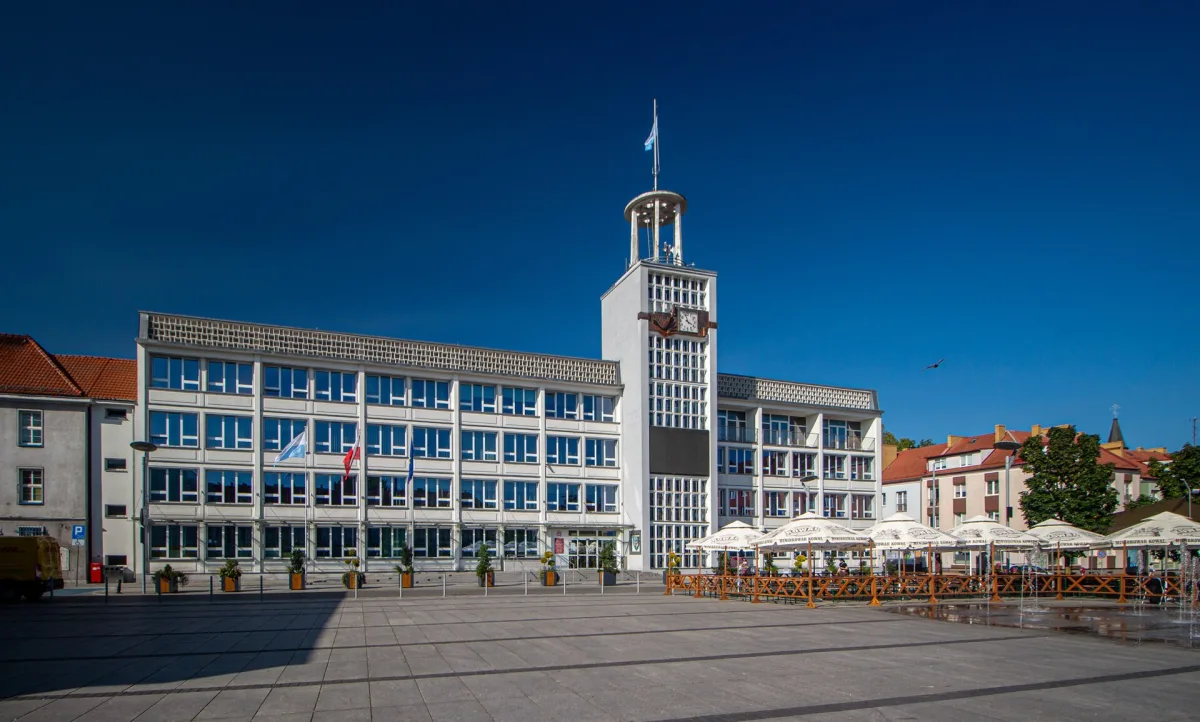
The Old Town Market Square in its present form is the work of the fire of 1718, which consumed most of the town's buildings. During the reconstruction the square was enlarged, and in its centre the townspeople put up a monument to the Prussian king Frederick William I, in gratitude for financial help. Wikipedia gives two dates: 1724 in the entry on the square and 1720 in the entry on the town hall. The monument stood until February 1945, and in 2008 archaeologists discovered fragments of its brick foundation under the paving of the square. The square was rebuilt in 2014, and the monument was moved to the amphitheatre.
The present town hall is the sixth in the town's history. The first was built probably around 1308 and burnt down in 1504. The next, from 1609, with a clock tower and a tavern in the cellars, was destroyed by the fire in 1718. The following one, demolished in 1827, gave way to a building that was destroyed in March 1945 by Soviet artillery fire. The modernist building, designed by Władysław and Maria Michałowski, was built from 1958 and opened on 15 December 1962. A projection with a staircase juts out of the brick façade, containing a clock, part of a metalwork composition with the town's coat of arms from 1959. The building is entered in the heritage register.
After the war the town was 40 per cent destroyed, as Wikipedia states. The Red Army took it on 4 March 1945, and the Germans were expelled by the end of 1947. From 1950 to 1975 Koszalin was the capital of the large Koszalin voivodeship, and then, until 1998, of a smaller one.
Museums and townhouses in the centre
The Museum in Koszalin has operated since 1947 and has exhibitions spread over several places in the town. Its beginnings go back to 1912, when a German local history society organised the first exhibition in the town hall. Next to the museum stands the open-air museum of Jamno culture, established in 1982 on Młyńska Street: a fisherman's cottage from 1869, a shoemaker's workshop and a barn with a forge, with reed-thatched roofs. According to Wikipedia, the buildings were moved from the village of Dąbki in 1983.
Another way into the town's history is the Water Museum in the former filter house on Żwirowa Street, with maps of the water supply network and a section of pipe from 1726.
At number 3 Grodzka Street stands the Executioner's House (Domek Kata), which since 1964 has housed the Dialog Theatre of Propositions. The dates of the townhouse differ: Wikipedia gives the 15th century, the heritage register the 17th century, and the description of the theatre points to the year 1464, from which the town executioner lived here. The monuments of the centre also include, according to Wikipedia, a Gothic townhouse from the 14th century at Chrobrego 6, the Palace of Weddings (Pałac Ślubów) from the 16th century and the neo-Gothic post office complex of 1884.
A synagogue stood on the site of today's park on the Dzierżęcinka. It was burnt down on the night of 9 to 10 November 1938, and in 1999 a boulder with a commemorative plaque in three languages was unveiled on the spot.


Be the first! Add a comment.
You need to log in to add a comment.
Log in