
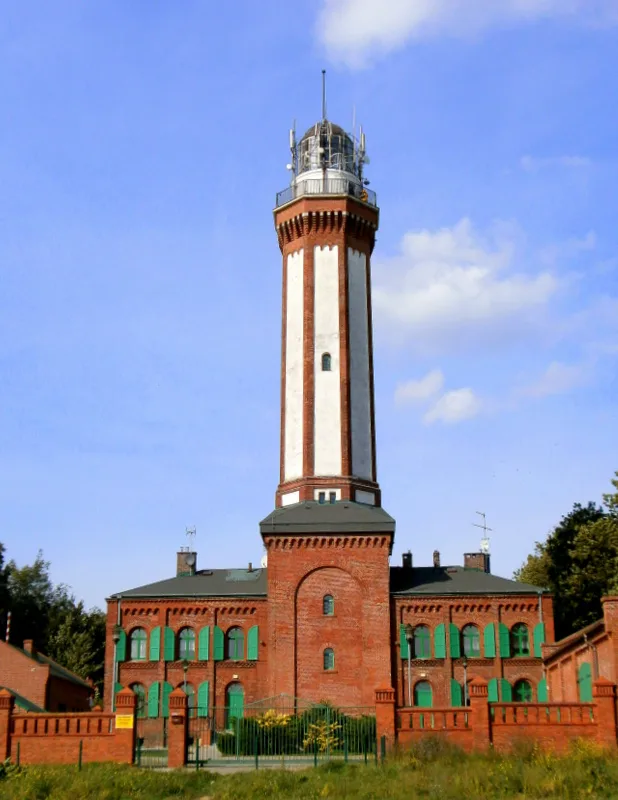
Niechorze is associated with its lighthouse, and the lighthouse of 1866 stands on a high cliff in the western part of the village. Around it and further on, towards Pogorzelica, there is however more to see: a fishing museum, an open-air museum, a nature reserve with a lake just behind the dunes and a few places for a rainy day. According to Wikipedia the shore of the village is formed by a sandy beach with dunes in the eastern part and a cliff in the western part.
From fishing village to resort
According to Wikipedia, Niechorze was at the beginning a typical fishing village. The development of the bathing resort dates from the 19th century, and its real flowering from 1870. In 1889, 700 summer visitors were registered here, in 1910 1,873 holidaymakers, and in 1923 3,000 came. Right by the beach, on piles, a bathing pavilion with a slide was built, which according to Wikipedia still stood in 1947.
After the war the village again became a holiday resort. Accommodation developed in former German villas and guesthouses, and at the end of the 1960s the Workers' Holiday Fund had five centres here. Visitors arrived by narrow-gauge railway from Gryfice or Trzebiatów. The Horst Seebad station by the lake, opened in 1913, is according to Wikipedia still in use, and Pogorzelica, at the eastern end of the route, is the last stop of the railway in this direction.
The Sea Fishing Museum
The Sea Fishing Museum has operated since 11 June 1994. According to Wikipedia it was created on the initiative of the local community, brought together in the Association of Friends of the Baltic Fishing Tradition. Since 2003 it has been housed in a former German villa from the 1930s on Bursztynowa Avenue, the main street of Niechorze, and since 2017 it has been a local government cultural institution. The permanent exhibition shows the profession of the fisherman, fishing and navigation equipment and a collection of amber, and boats donated by local fishermen stand on the grounds. Wikipedia calls the museum one of the few centres in Poland that cultivate the traditions of small-scale fishing.
The Ethnographic Park and the Kosiński farmstead
The open-air museum on Ludna Street, at the foot of the lighthouse, is the Ethnographic Park. According to Wikipedia it was created in 2024 within a project co-financed by a grant, and its beneficiary and implementer was the same Association of Friends of the Baltic Fishing Tradition that founded the museum. The display includes reconstructions of fishermen's cottages from the settlements of Kępa and Niechorze with the interiors of the rooms, a post windmill of 1843, a fishing boat, nets for catching herring, flounder, cod and salmon, and agricultural equipment. Two educational paths guide the visit, the Fish Road and the Bread Road.
On the same Ludna Street, at the corner with Pomorska, stands the Kosiński House. The farmstead from the turn of the 18th and 19th centuries is an example of an agricultural rather than a fishing homestead, of the kind most numerous on the coast. The buildings form a closed quadrangle under a common hipped roof, part built of brick and part in half-timbered technique. Today it is used for exhibitions of Slavic crafts.
Liwia Łuża and the trail around the lake
The Lake Liwia Łuża nature reserve is according to Wikipedia a faunal reserve established on 8 July 1959, with an area of 239.74 ha. It lies 0.5-1 km from the Baltic shore and coincides with the shoreline of a shallow, lagoon-type lake affected by sea backflow. 162.52 ha are under strict protection. The lighthouse is separated from the lake, according to Wikipedia, by 2.3 km.
The reserve protects wetland birds and rare salt-loving plants. Formerly great crested grebe, mute swan and greylag goose nested here, among others, and about 100 greylag geese moult in the lake. The colony of black-headed gulls has moved to the nearby Lake Konarzewo. Around the lake runs the circular Liwia Łuża Trail, 9.3 km long, which begins and ends in Niechorze, where it joins the coastal E-9 trail. There are three jetties on it, two on the Niechorze side and one on the Skalno side.
For a rainy day and for a Sunday
Next to the lighthouse, on Polna Street, is the Butterfly House, where exotic butterflies fly freely. According to the site's website it is also an idea for rainy weather, and it operates seasonally. Two hundred metres from the lighthouse is the Lighthouse Miniatures Park: according to Wikipedia it was opened on 19 May 2012, and it contains 29 lighthouses at a scale of 1:10, including all those operating on the Polish coast.
Among newer buildings the Church of Our Lady of Mercy on Krakowska Street stands out. It is a postmodernist building designed by Halina Rutyna: construction began in 1998, and the first Mass was celebrated on 17 April 2002. The parish was established on 31 December 1986 and covers Niechorze, Pogorzelica and Lędzin.
According to Wikipedia, from autumn 2013 to autumn 2014 the Maritime Office in Szczecin carried out work in Niechorze to strengthen the cliff shore.


Be the first! Add a comment.
You need to log in to add a comment.
Log in