
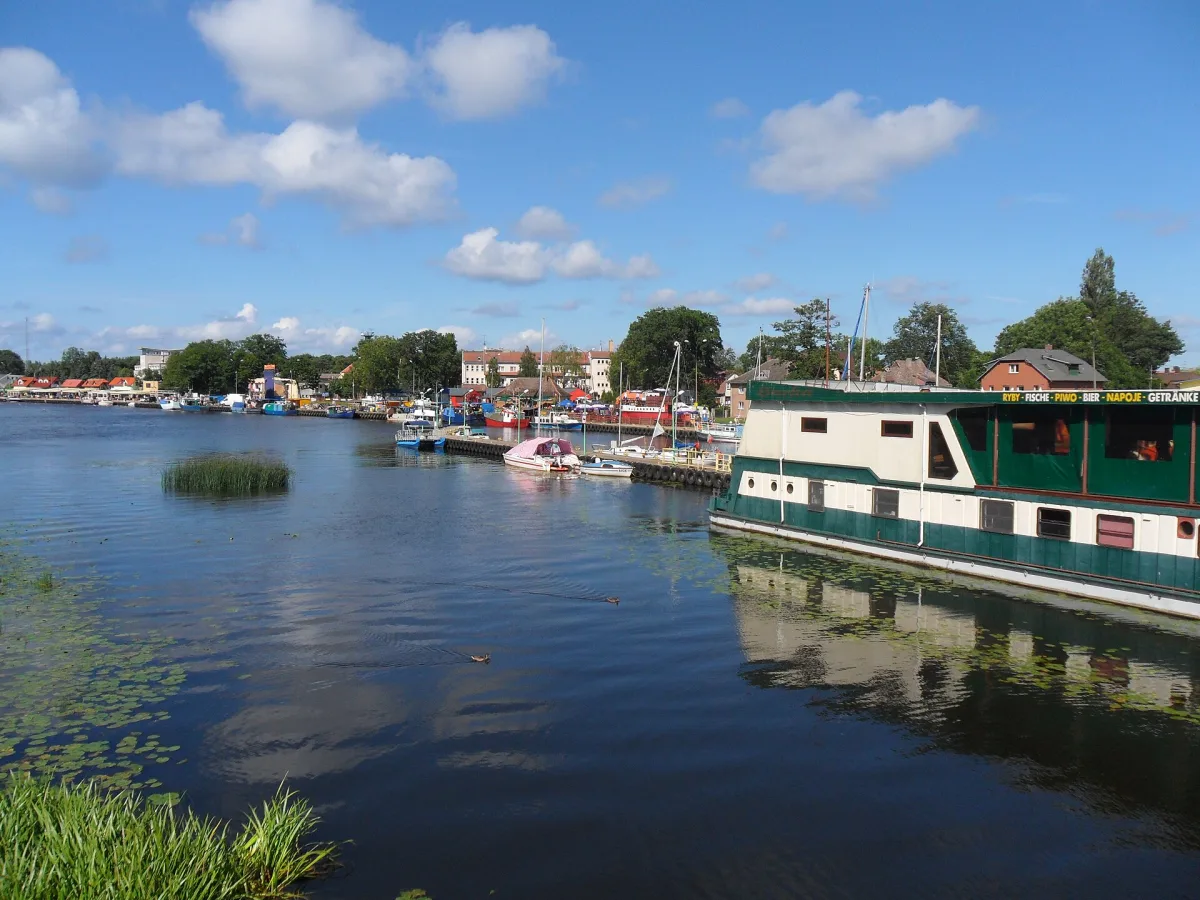
The Rega is one of the larger rivers of the coastal belt, yet there is no single figure for its length. It flows through three counties, six towns and two artificial lakes, has eight small hydropower plants and a canoe route all the way to the sea. It also has an old channel that shows how people moved its mouth in the 15th century.
How many kilometres and where it rises
Wikipedia gives the length of the Rega as anything from 167.8 km, through 172 km, to 199 km. According to the article the cause of the discrepancy is the strong meandering: the result depends on whether one measures the channel itself or the valley floor. The first figures are quoted from a report on the state of the environment in the voivodeship, the last from a scientific study of the Rega valley near Łobez. According to Wikipedia the catchment area is between 2723.3 and 2724.9 km², and the mean annual flow at the mouth in 1997 was 21.8 m³/s. The article ranks the Rega 24th among Polish rivers by length and second in the West Pomeranian Voivodeship by flow.
According to the most recent publications the source lies at an altitude of 177.5 m above sea level, about 0.3 km south-east of the hamlet of Imienko in the municipality of Połczyn-Zdrój. This was not always the accepted view. Lake Resko Górne used to be regarded as the source lake, and a regulation of 1948 still shows it as the start of the river. On a German map of 1936 both watercourses are named Rega. The first written mention of the river dates from 1180, when Duke Casimir I of Demmin granted the monastery in Lund estates on the Rega (Regam fluvium). According to the Encyclopedia of West Pomerania the name is the same in Polish and German, which is an exception among the rivers of this region. In 1948, when rivers were being renamed, it was left unchanged.
Towns on the Rega
The river passes six towns. The first is Świdwin, where by the castle the Rega runs over a weir beneath a bridge. Further on lie Łobez, with one of the power plants, and Resko, where according to the Encyclopedia of West Pomerania stand the ruins of the Borck castle, and where an old mill now works as a power plant. In Płoty two castles were built by the river, an old one and a new one, and the Old Castle is one of them; the old part of the town lies in a bend of the Rega. In Gryfice the Gunpowder Tower stands on the left bank, and the last town is Trzebiatów, with its historic bridge.
From the Middle Ages Gryfice and Trzebiatów had guaranteed rights to fishing and river trade: Gryfice in its town charter of 1262, Trzebiatów from 1287. According to Wikipedia access to the sea accelerated the growth of both towns, but it also led to disputes. In 1317 the Premonstratensians of Białoboki dammed the river, which cut off navigation, and Gryfice won the case against them in the court in Szczecin (1326-1328). In the 15th century the town argued with Trzebiatów over tolls, and in 1449 Trzebiatów tried to block the river with piles and an earth embankment.
Hydropower plants and two reservoirs
According to Wikipedia eight small hydropower plants operate on the Rega, with a total capacity of about 2.6 MW, and a ninth stands on a side arm, the Młynówka, in Trzebiatów. It lists them as Prusinowo, Łobez, Resko, Żerzyno, Likowo, Płoty, Rejowice and Trzebiatów. Some use former mills, as in Resko and Łobez. The table in that article gives the years of commissioning: Prusinowo 1900, Płoty 1905, Likowo 1923, Rejowice 1925, Trzebiatów (the older one) 1927, Trzebiatów II 2002. For Łobez, Resko and Żerzyno no years are given.
Two of the plants have earth dams, with reservoirs behind them. In Lisowo the construction of the Likowo plant took place, according to Wikipedia, in 1922-1924 and created Lake Lisowskie, with a volume of 1.5 million m³. In 1925 the Rejowice plant was commissioned near Smolęcin, and the larger Lake Rejowickie, of 4.6 million m³, formed above it. Rejowice is the largest plant on the Rega, with a capacity of 1.6 MW.
The power plants come at a price in fish. According to Wikipedia salmon and sea trout swim up the Rega to spawn, but salmon reach only the area of Lake Rejowickie, because the dams stop them further upstream. A study from 1994 recorded fish losses on the turbines: in Rejowice 47.2-55.4 per cent, in Trzebiatów 48.6-56.8 per cent, and on the large turbine in Płoty 5.4-6.4 per cent. A higher head and faster rotation meant greater losses.
The old channel and the mouth at Mrzeżyno
The present mouth is young. According to Wikipedia, in 1457 the people of Trzebiatów, in cooperation with the monastery in Białoboki, dug a new, shorter channel through the coastal dunes and founded a new port there. Before that the river turned and ran parallel to the shore as far as Lake Resko Przymorskie. The old course is the Stara Rega (Old Rega), today a watercourse with standing water, regulated by embankments and pumping stations. It begins just before Mrzeżyno, and water from the old channel is pumped into the river. Wikipedia also mentions another stream called Stara Rega, a left tributary near Świdwin, and the two should not be confused.
The Rega ends its course between two breakwaters, and its final stretch is the water area of Mrzeżyno harbour, used by fishing boats and small yachts. According to the same article the lower course is heavily altered by land drainage, and the river runs here between flood embankments. At the mouth stands the port in Mrzeżyno. In April 2008 the Rega rose above four metres in Trzebiatów, and within a week the flow increased from 38.1 to 91.1 m³/s.
Canoe route to the sea
According to Wikipedia, a PTTK and PZKaj guidebook rates the Rega route as one of the nicest in Poland. The route is easy, though in places arduous in the upper and middle course. From Sława to the mouth there are ten unavoidable portages, caused by the power plants and low-hanging bridges. The canoe trip down the Rega to the sea, organised by PTTK in July, had reached forty editions by 2007, over a distance of 147 km. Canoe landing stages have also appeared along the route in Płoty, Gryfice, Trzebiatów and Mrzeżyno.


Be the first! Add a comment.
You need to log in to add a comment.
Log in