
Colleoni from Geislingen, who returned from Warsaw
The longest journey in Szczecin's city centre was made by the monument to Bartolomeo Colleoni on Lotników Square. It is an equestrian statue of the condottiere, a historic copy of the Renaissance monument carved by Andrea del Verrocchio, unveiled in Venice on 21 March 1496. According to Wikipedia the Szczecin copy was made by the galvanoplastic method in 1909 at the Wuerttembergische Metallwarenfabrik factory in Geislingen. It was intended for the Szczecin city museum, which according to the same entry was established in 1913. The statue was the central point of a collection of copies of famous works of antiquity and the Renaissance, set up in the domed hall of the museum building.
The monument survived the Second World War unscathed. According to Wikipedia, on 15 January 1948 it was taken to Warsaw: first it went to the National Museum, then for several years it lay in a store of the Polish Army Museum, and in spring 1950 it was placed in the courtyard of the Academy of Fine Arts. In 1989 it was entered in the heritage register. Efforts to have it returned began in early 1992, and at the end of 2001 the Warsaw authorities gave their consent. The statue was set up in Szczecin on 21 August 2002, and the ceremonial unveiling took place on 31 August, in the presence of the city's mayor and a descendant of the condottiere. In 2009 the monument was thoroughly renovated, and Colleoni then regained the weapon in his right hand, recreated on the model of the original.
Baroque and Wilhelmine statues
On White Eagle Square stands the statue of Flora, a Baroque figural group of Saxon sandstone: the Roman goddess of abundance and spring holds a basket of flowers, and on both sides of her are two putti, one climbing a cornucopia, the other arranging flowers in a basket. According to Wikipedia the sculpture was made by Johann Georg Glume to a design by Johann Konrad Koch around 1730, although some sources point to the 1780s. The figure first crowned the attic of the Grumbkow Palace, that is, the Palace Under the Globe, then stood in the palace garden, and in 1906 it went to Żeromski Park. In autumn 1945 it was found among the rubble in the museum courtyard, without its head, arms and cupids. After renovation in 1953 it stood at the edge of the park, in the 1970s it was moved near the Royal Gate, and it reached White Eagle Square in 1991 after thorough conservation.
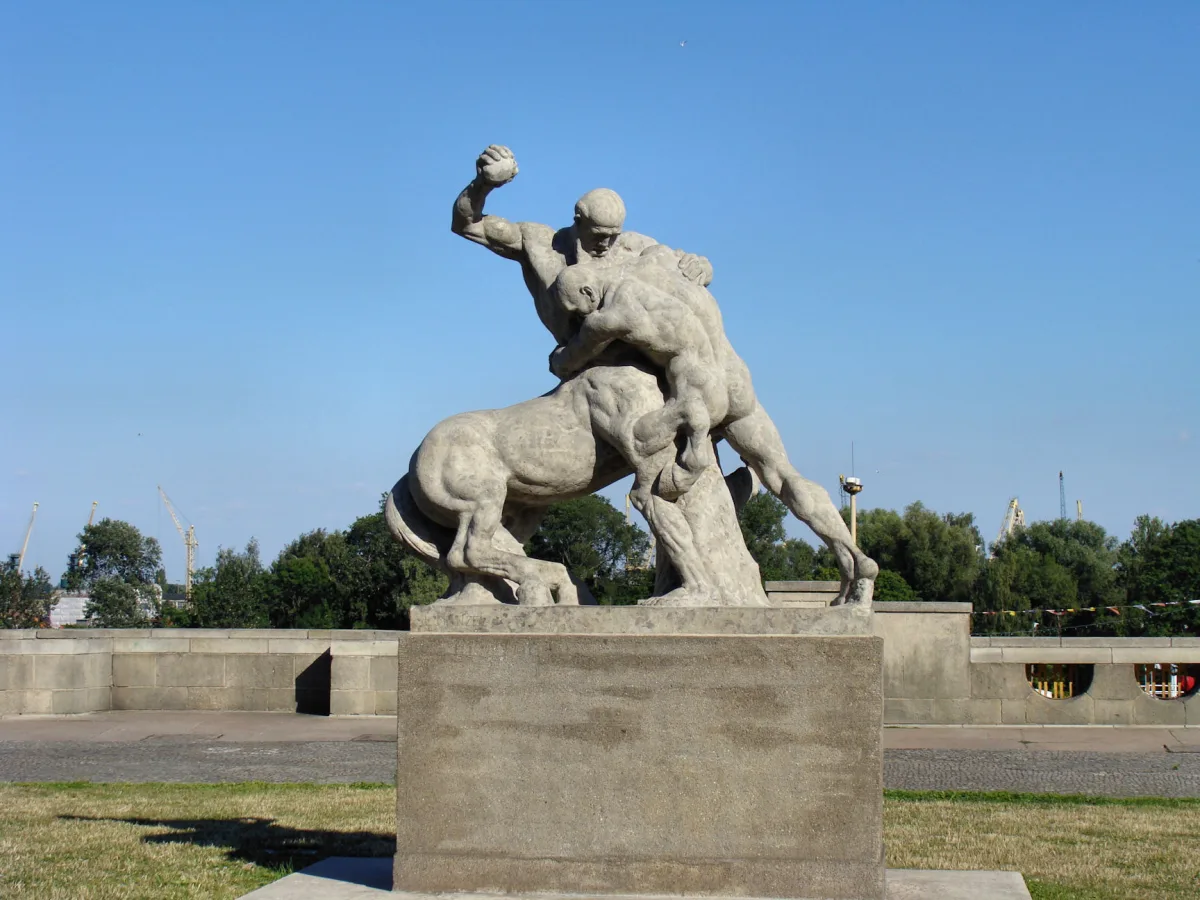
Along the Chrobry Embankment stands a sculpture by Ludwig Manzel from 1916, showing a naked man fighting a centaur. The identity of the figure is not certain: according to one interpretation he is a Lapith, according to another Hercules. The monument to Frederick II the Great has a completely different pedigree. According to Wikipedia it was designed by Johann Gottfried Schadow, and the sculpture of white Carrara marble was unveiled on 10 October 1793 at Biały Plac Parad. In 1877, because of the effect of the weather on the marble, it was moved to the building of the Palace of the Pomeranian Estates' Diet, and a bronze copy was placed on the square. In 1942 the sculpture was evacuated to the castle in Swobnica and broke into three parts during transport. Since 2015, after renovation, it has stood in the courtyard of the National Museum on Staromłyńska Street.
The monument to Duke Bogislaw X and Princess Anna Jagiellon by the Ducal Castle belongs to the same family, although it was created much later. It was unveiled on 22 July 1974 and made of yellow sandstone by two Szczecin sculptors, Leonia Chmielnik and Anna Paszkiewicz. According to Wikipedia the duchess stands one step higher than her husband, which makes the two seem of similar height, although the duke was said to have been a very tall man.
Poets, a sailor and a hero of a book
On Mickiewicz Square stands the monument to Adam Mickiewicz by Sławomir Lewiński, unveiled on 3 May 1960 as part of the celebrations of the Millennium of the Polish State. A pensive pilgrim with a book, facing the Oder, was made of artificial stone. According to Wikipedia, before 1945 a monument to Emperor Frederick III stood on this spot.
A journey from Lviv to Szczecin was also made by the monument to Kornel Ujejski, a bronze bust by Antoni Popiel on the square by the Port Gate. According to Wikipedia it was unveiled on 8 December 1901 in Lviv. After the entry of Soviet troops in July 1944 it was removed, in 1950 it was handed over to Poland, and on 27 November 1956 it was moved to Szczecin. The official unveiling took place only on 9 December 2006.
By Grunwaldzki Square, in the axis of Jana Pawła II Avenue, stands the Sailor Monument. It is a sculpture by Ryszard Chachulski unveiled on 19 June 1980, made of copper sheet on a concrete plinth clad in grey granite. It shows a helmsman in a cap and with a scarf blowing in the wind, standing at the ship's wheel. According to Wikipedia the sculpture measures 3.85 by 2.30 by 1.60 m and was renovated in 2007.
On Rayskiego Street you will find the monument to King Matt the First, a 145-centimetre figure of pink granite commemorating Janusz Korczak. It was designed by Mieczysław Welter and unveiled on 1 June 1961, on Children's Day. It originally stood in front of a school on today's Bałuki Street, and in 2013 it was unveiled in a new place. The youngest in this set is a bronze monument in the form of a bench, the Michał Doliwo-Dobrowolski bench in Turzyn, unveiled on 10 June 2022. According to Wikipedia it is the world's first monument to an inventor who in 1888 constructed a three-phase alternating current generator.
Be the first! Add a comment.
You need to log in to add a comment.
Log in