
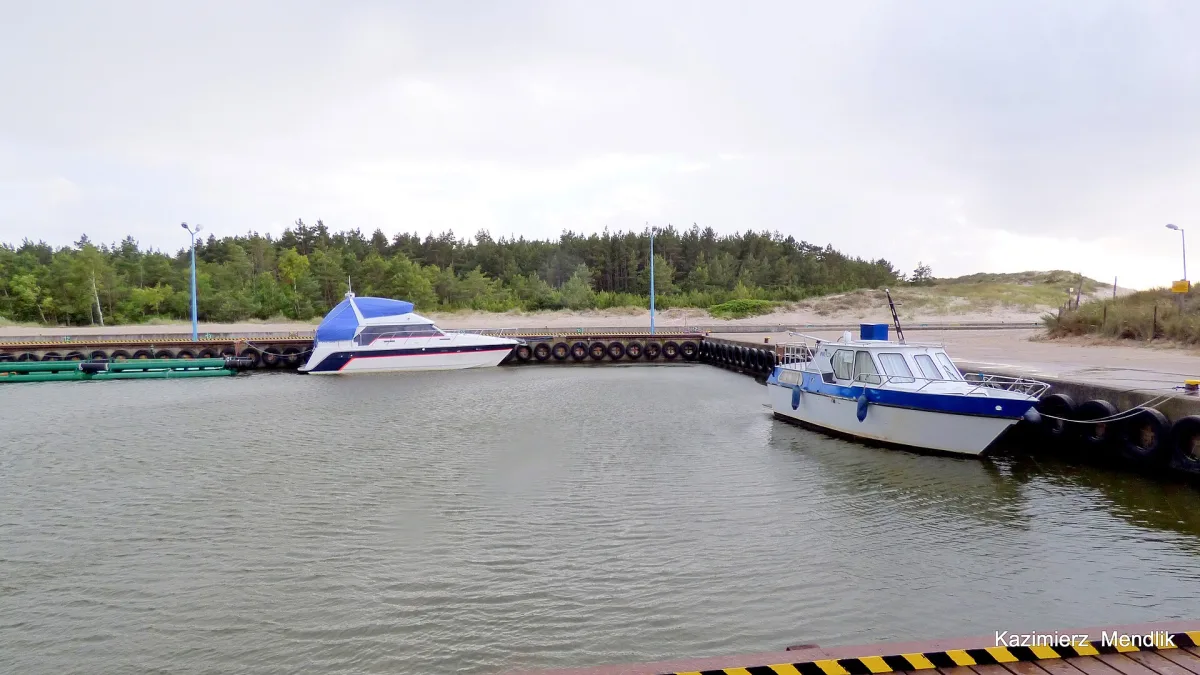
On part of the Polish coast there is no harbour, and yet fishing boats stand there. The fishermen haul them onto the sand, the fish goes straight to the fishing stalls and smokehouses, and the beach is both a workplace and a place for a walk. According to Wikipedia this is how the landings work in Chłopy, Unieście and Dąbki, three seaside villages on the Słowiński Coast.
A landing is a beach, a hauling dolphin and a strip of water
Wikipedia defines a sea landing (przystań morska) as a legally designated place by the sea, adapted for small vessels. In Poland the boundaries of a landing are set by order of the director of a maritime office. In Chłopy, Unieście and Dąbki this was done in 1994 by the Maritime Office in Słupsk. According to Wikipedia each of these landings consists of a hauling dolphin, a beach for basing the boats and a water area 100 m wide, measured from the shoreline. Access and supervision are provided by the same office.
Why the fishermen have no harbour here is not explained in the sources at all. The only mention concerns Unieście: according to Wikipedia, citing a guidebook by Czesław Piskorski from 1980, merchants from Koszalin built a harbour there in the Middle Ages, but it was destroyed by storms. This is a single source, so treat it as the opinion of one publication, not as an established fact.
Chłopy: a settlement where the layout of a fishing village is still visible
According to Wikipedia the present village stands on the site of the 13th-century Slavic settlement of Borowo. Until 1945 it was called Bauerhufen, and the Polish name Chłopy was introduced officially in 1948. The traditional layout of a fishing settlement has been preserved, with nine streets and 19th-century houses decorated with folk paintings.
The fishing landing in Chłopy lies by the beach in the centre of the village. Wikipedia writes that the boats are hauled up onto the shore and fish is sold in the fishing stalls. According to the Chłopy tourist website, 12 fishing boats were moored on the beach in 2021. The fishermen also organise fishing trips, and there are smokehouses by the beach. The sides of the boats carry the registration CHY, from the name of the village. Wikipedia mentions that boats with such markings appeared in the film “Ode to Joy”, whose footage for the “Sea” part was shot here in 2005.
Less than a kilometre further on is the Treasury of the Fishing Village Museum. According to Wikipedia it was established in 2019 and presents keepsakes connected with the community, especially the fishing community, that once lived in the Chłopy area.
Unieście: a spit between the sea and Lake Jamno
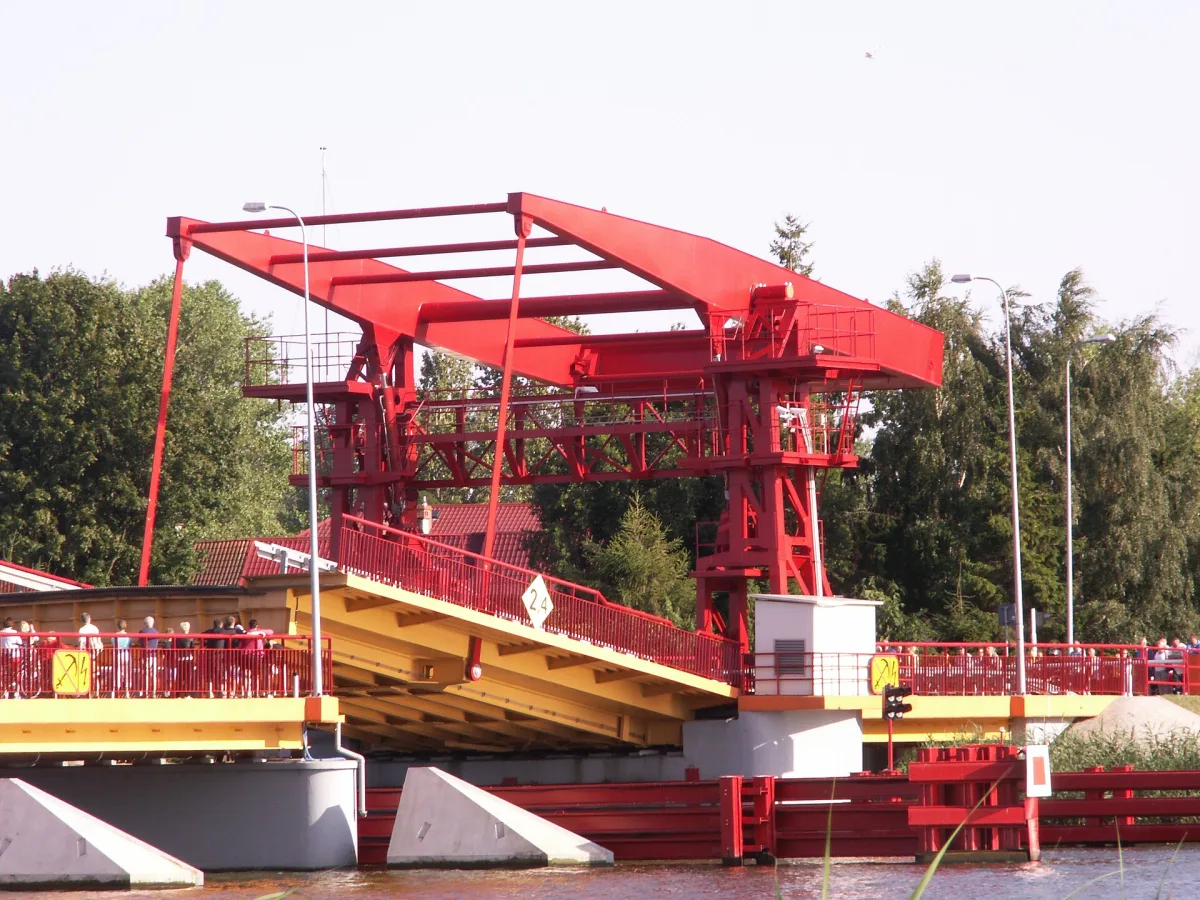
The landing in Unieście lies on a spit that separates the Baltic from Lake Jamno. Wikipedia calls Unieście a very old fishing settlement and states that until 1945 the village bore the German name Nest. The boats of the local fishermen sail with the registration UNI. The boats stand directly on the beach, so one can watch the fishermen at work and buy freshly caught fish, though the availability of the catch depends on the day and the weather. Nearby runs the Jamno Channel, a short channel linking the lake with the sea, with a bridge between Unieście and Łazy.
Dąbki: cottages built by people of the sea
In Dąbki, called Neuwasser until 1945, Wikipedia describes the same kind of sea landing as in Chłopy and Unieście, with a hauling dolphin and a beach for basing the boats. In the village, which has had spa status since 2007, there stand, according to Wikipedia, four historic cottages from the 19th century, at numbers 18, 21, 24 and 33. Fishermen's cottage no. 21 dates from 1855. It has a half-timbered oak frame, whitewashed walls, black beams and a reed-thatched roof. It was entered in the heritage register in 1974. The interiors are not always accessible, so it is best viewed from the road, bearing in mind that this is part of a living village.
A harbour where there is a channel or a bay
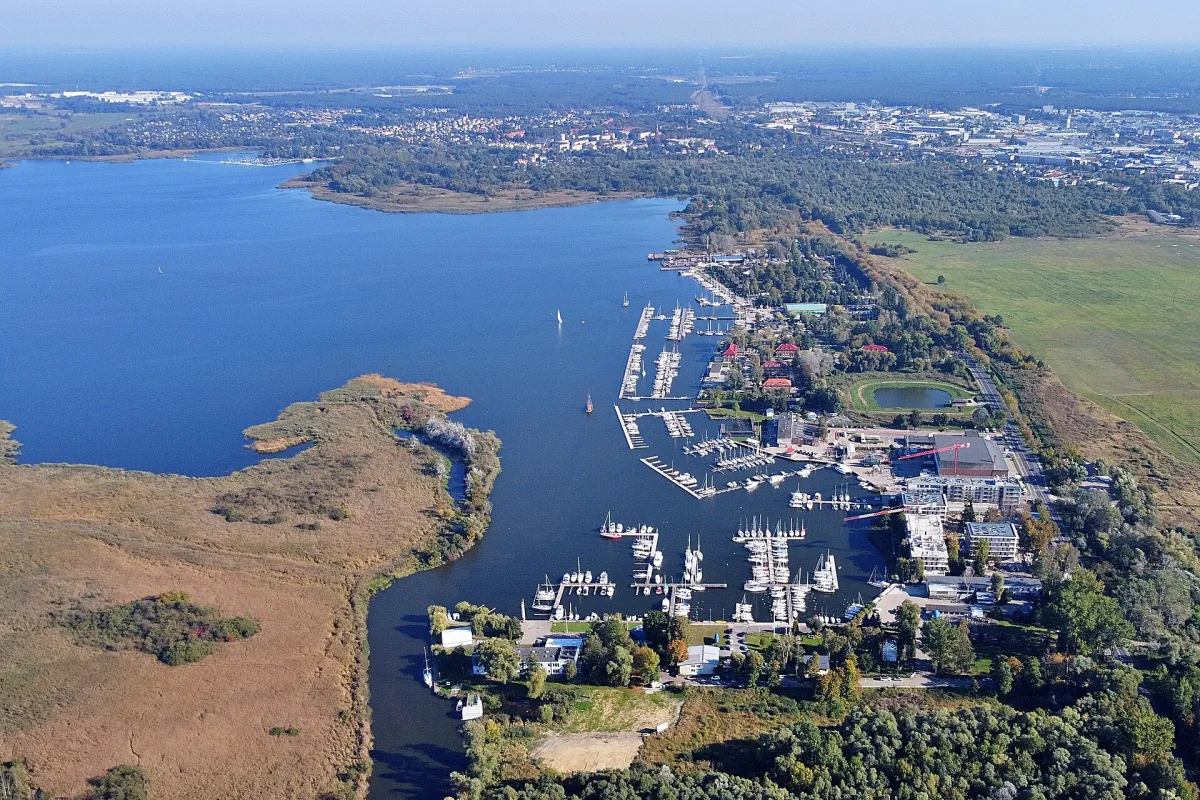
Where nature has provided a sheltered body of water, the fishermen have a proper harbour. The Dźwirzyno sea harbour is, according to Wikipedia, a fishing harbour on the Baltic at the mouth section of the Błotnica River, commonly called the Resko Channel, which begins in Lake Resko Przymorskie. The width between the breakwater heads there is 19 m, and that of the harbour channel 10 m, the fishing warehouses stand beyond the bridge, and since 1997 there has also been a yacht basin. The Stepnica harbour on the Szczecin Lagoon has a Fishing Basin where boats are moored, and was established by the Minister of Shipping in 1963. Stepnica itself is, according to Wikipedia, a former Slavic fishing settlement and, in the interwar period, a holiday resort for the people of Szczecin, to which ships of the White Fleet sailed.
Where to see the history of fishing
The Sea Fishing Museum in Niechorze has operated since 11 June 1994. According to Wikipedia it was founded on the initiative of the Association of Friends of the Baltic Fishing Tradition, and since 2003 it has been housed in a former German villa from the 1930s. The exhibition shows fishing and navigation equipment, and boats donated by local fishermen stand in the grounds. The article describes it as one of the few centres in Poland that cultivate the traditions of small-scale fishing. Nearby, at the foot of the lighthouse, the Ethnographic Park has gathered fishermen's huts from the settlements of Kępa and Niechorze, a fishing boat and nets for catching herring, flounder, cod and salmon.
In Świnoujście, on Fisherman's Square (Plac Rybaka), stands the former town hall, which houses the Sea Fishing Museum. Wikipedia states that the building was erected in 1805-1809, while the museum's website speaks of construction from spring 1805 to summer 1806. According to both sources the exhibition has three sections: natural history, maritime, with fishing tools and ship models, and historical.
Steel cutters and fishing on a larger scale
After 1945 the boats on the coast changed. The Encyclopedia of West Pomerania writes that in the early period the Szczecin Shipyard built steel cutters alongside tramp steamers. According to the article, unlike wooden ones they gave high catches, could stay longer on the fishing grounds even in bad weather, and rarely broke down. Assembly of the hull began with an inverted deck in a special turntable, and on this equipment a total of 400 cutters were produced, according to the source. In 1957 the Szczecin Shipyard signed a contract for 50 steel cutters 17 metres long for the Barka enterprise in Kołobrzeg. In 1952-1958 it built the KS and K15 types for a crew of no more than five.
Alongside inshore fishing, deep-sea fishing developed. According to Wikipedia the Szczecin enterprise “Gryf” Deep-Sea Fishing and Fishery Services was established in 1957, and in 1970 it employed 5500 people. Wikipedia states that the enterprise was wound up in 2001-2004. The smaller boats from Chłopy, Unieście or Niechorze fish on a different scale, close to the shore and on short trips.
Be the first! Add a comment.
You need to log in to add a comment.
Log in