
A lake that was a bay
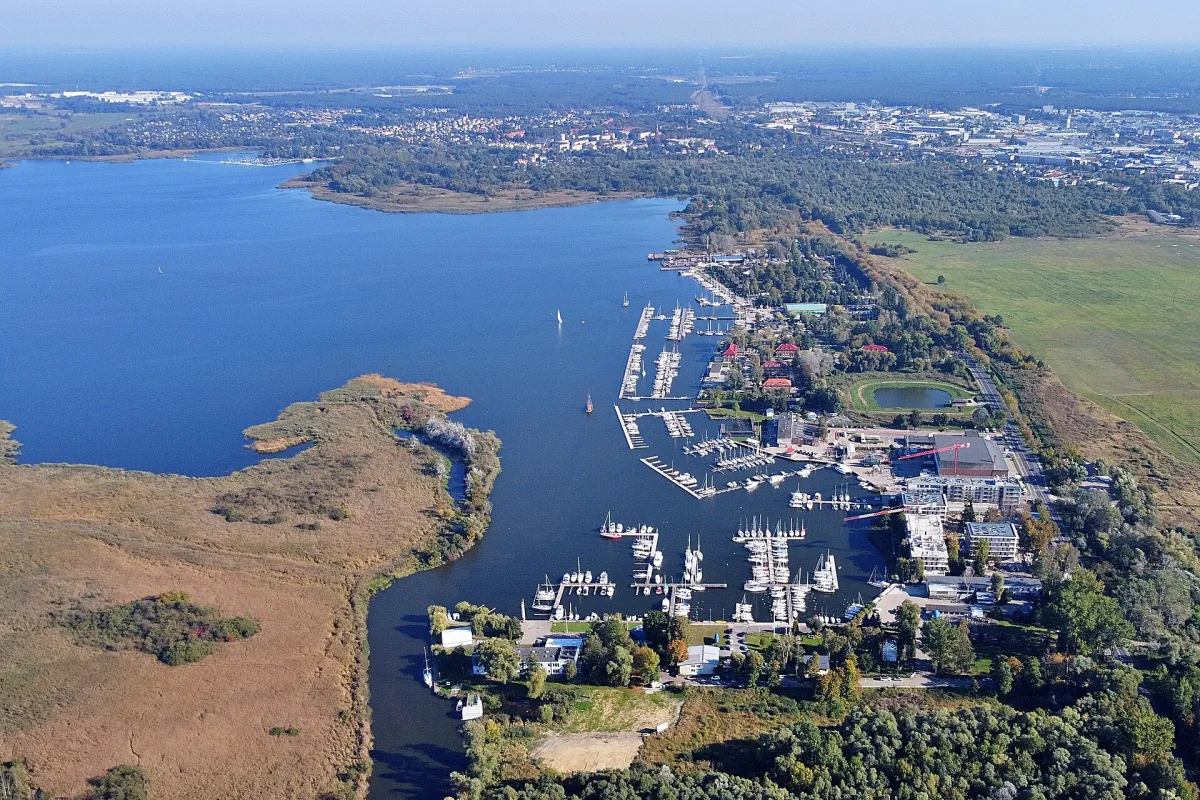
Jamno is a coastal lake on the Koszalin Coast, cut off from the Baltic by a spit. According to Wikipedia it arose from a former sea bay. The water surface covers, according to Wikipedia, from 2,205.2 to 2,239.6 ha, depending on the measurement, which makes it 9th in Poland by area and 3rd in the West Pomeranian Voivodeship. The body of water is shallow: the average depth is 1.4 m and the greatest 3.9 m. The water surface lies at a height of only 0.1 m above sea level, and the lake basin narrows from the west and widens towards the east.
The Dzierżęcinka, the Unieść and the Strzeżenica stream flow into the lake, along with two canals, the Dobiesławiec and the Łabusz. The catchment area is, according to Wikipedia, 502.8 square kilometres. The whole lake lies within the boundaries of the town of Mielno and makes up 67 per cent of its area, that is, about 22.4 square kilometres. In terms of fishing, Jamno belongs to the pikeperch type: bream, pikeperch and European eel dominate, and the waters are also home to the river lamprey, a species under strict protection in Poland. According to an assessment from 2006 the water belonged to purity class III, and ten years earlier the lake had been below classification.
The name has its own history. On a map of 1789 the lake was recorded as Jamundsche See, and the name Jamno was introduced officially in 1948 in place of the German Jamunder See. The names commission referred to the word “jama” (pit). Today there are many sailing marinas on the water, and in season the tourist boats “Mila”, “Koszałek” and “Parostatek” sail. According to the Koszalin city leaflet, the boat “Julek” carries 110 people and sails from the Jamno marina to Unieście in about 50 minutes, including the journey from the centre of Koszalin. Sightseeing flights by seaplane also take off from the lake, described by WodnoSamolotem.pl: the route runs along the canal to the sea and over the beaches of Unieście and Mielno.
The Jamieński Nurt and the storm gates
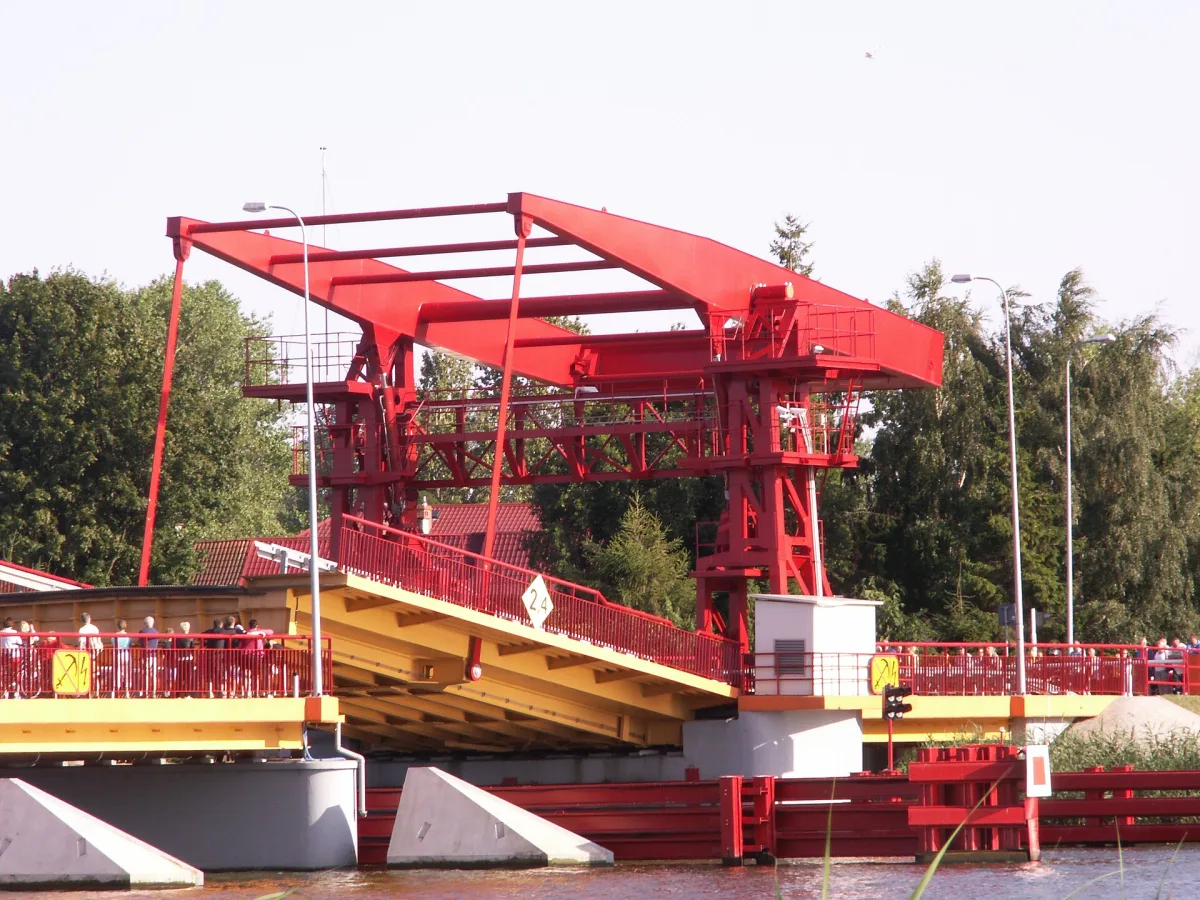
The lake is connected to the sea by the Jamieński Nurt canal, also called the Jamno Canal. According to Wikipedia it is about 0.7 km long and cuts through the spit like a channel. The name Jamieński Nurt was introduced in 1949, replacing the German Jamunder Tief. A bridge linking Unieście with Łazy stands over the canal, and the canal itself marks the eastern boundary of the town. At its mouth on the sea a protective zone with a radius of 500 m has been established, in which the catching of marine organisms is prohibited.
The mouth used to be silted up during storms, and sea water poured into the lake. Wikipedia states that during a storm the inflow to the lake could reach as much as 25 million cubic metres a year. For this reason, in 2013 storm gates that close automatically were built, and in 2015 a concrete-and-steel protective breakwater 200 m long and 5 m high was set up in the sea. The trade website Inżynier Budownictwa had earlier described the start of this work: the rebuilding covered a stretch of the canal 366 m long, and the gates have six spans with separate leaves, which according to the design close at a sea state of 6 on the Beaufort scale. The project was planned by ZMiUW, that is, the land improvement and water facilities authority. The same website stated that the aim is to protect the built-up areas of Koszalin against rising water in the lake.
Jamno culture and the old village
On the southern shore of the lake lie two districts of Koszalin today: Jamno and Łabusz, incorporated into the town on 1 January 2010. The oldest recorded mention of the village of Jamno dates, according to Wikipedia, from 1224, and in 1331 the Bishop of Kamień gave it to the Koszalin town council. Łabusz was first mentioned in 1337. Koszalin gained access to the sea by purchasing villages and part of the lake: according to Wikipedia, in 1353 it acquired part of the lake with the spit and the stronghold of Unieście. The first paved road from Jamno to Koszalin was laid only in 1899.
Its position among marshes meant that for most of the year the village was cut off from the world. According to a leaflet of the Koszalin City Office, this isolation led to the emergence of its own culture. It drew the attention of German researchers in the 18th century, and its heyday came in the 19th century, when the results of ethnographic research, mainly on furniture and costumes, were printed in Berlin periodicals. The leaflet describes painted armchairs and chairs in blue, green, red, yellow and white, with motifs of tulips, wild flowers, rosettes and hearts.
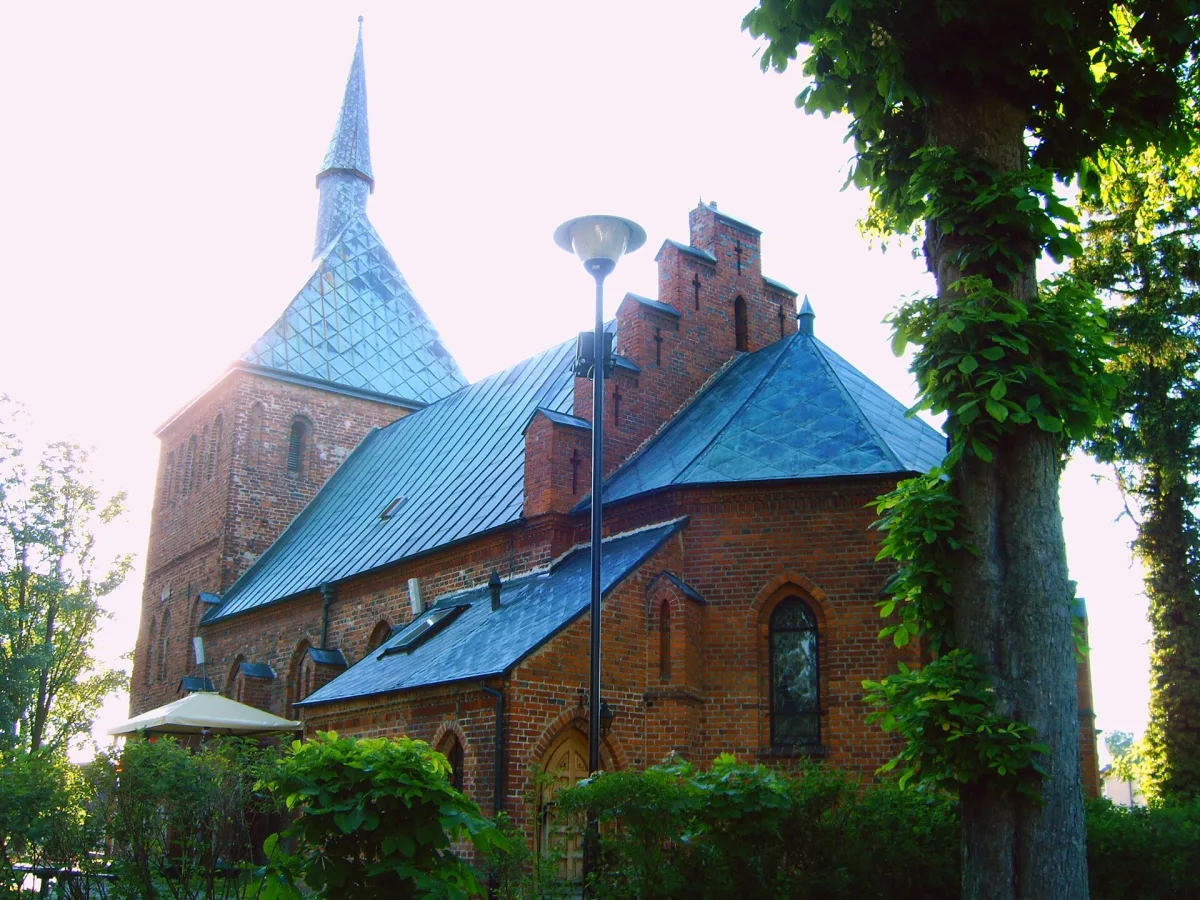
Traces of this culture can be seen in several places. The Jamno Farmstead in Jamno is a reconstruction of a 19th-century farmstead: the cottage is a replica of a house from 1853, and the barn has a prototype from 1765, according to the farmstead's website. Since 2004 the museum has organised the Jamno Fair there. In the Gothic Church of Our Lady of the Rosary the ceiling is decorated with a polychrome with Jamno motifs, which according to Wikipedia was made in 1923-1927. The Ethnographic Department of the Museum in Koszalin, called the Jamno Culture Open-Air Museum, was created in 1982 on Młyńska Street in the town centre. A fisherman's cottage from 1869, a shoemaker's workshop and a barn with a forge were moved there from Dąbki in 1983. Since 2001 it has hosted the exhibition “A Cultural Island. The Village of Jamno near Koszalin”.
The lake is also linked with a local legend of the Julek gnomes, who according to the town leaflet lived in a burial mound on the shore. By the Jamno marina stands a monument of a gnome with a loaf of bread, carved by the Koszalin sculptor Zygmunt Wujek.
The port that was not built
According to Wikipedia, in the 1970s the building of a sea port in Mielno using Lake Jamno was considered. The port was to exceed the Kołobrzeg one in size, but these plans were not carried out. The entry gives neither the exact year of the plan nor the reason for abandoning it. The idea had a tradition behind it: according to Wikipedia, in the Middle Ages Koszalin merchants built a port in Unieście, which was destroyed during storms.
Today the function of a port is performed in Unieście by a fishing harbour. According to Wikipedia it was designated in 1994, and supervision of it is exercised by the Maritime Office in Słupsk. The boats stand on the beach, and their sides bear the mark UNI. The Fishing Harbour in Unieście is open all year round, and a summer bathing area is marked out by the beach.
Mielno and Unieście as bathing resorts
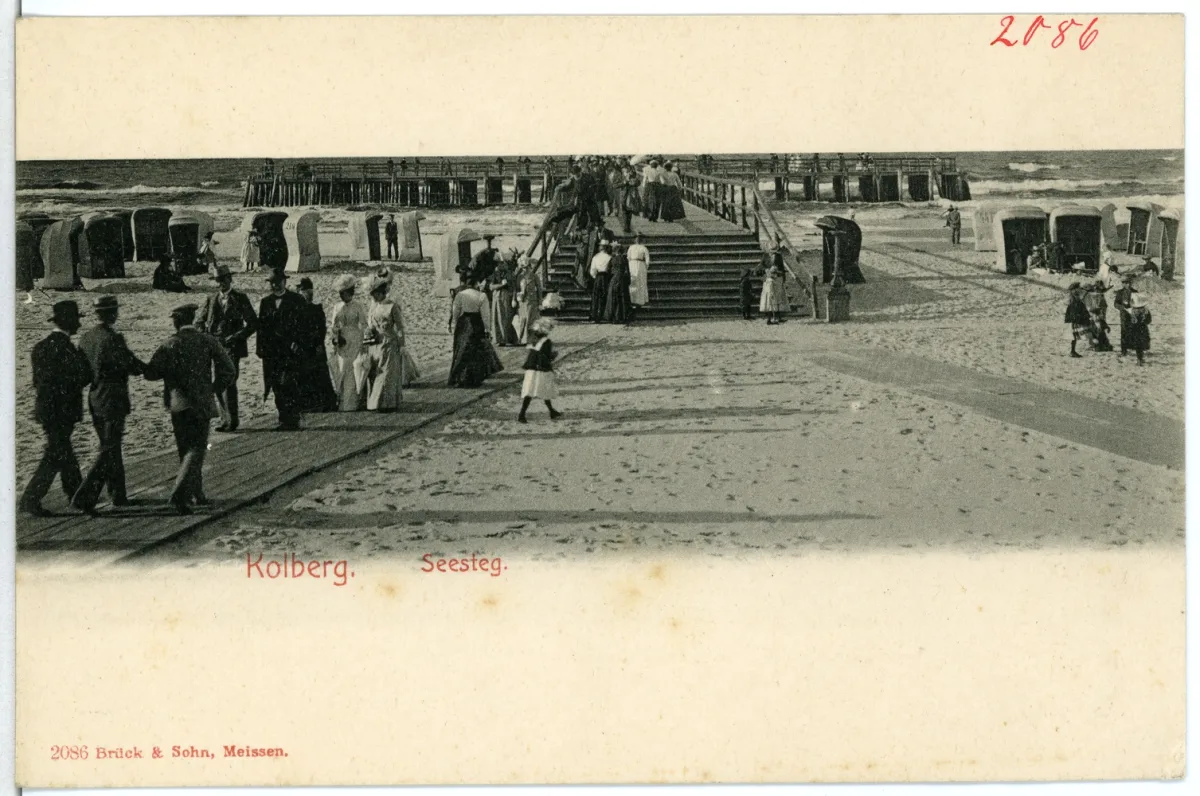
After the war Mielno gained a reputation as a holiday resort thanks to its position at the base of the spit and its rail link with Koszalin. According to Wikipedia, a regional tram reached here until the end of September 1938, and at the end of the 1960s four large holiday centres of the Workers' Holiday Fund operated, with about 770 places in total. Two summer bathing areas were designated by the sea, Mielno and Unieście, each 100 m long. The name Mielno derives, according to the names commission, from the word “mielizna” (shoal) and the Kashubian “miałki”, that is, shallow.
In Mielno itself stands the Gothic Church of the Transfiguration from the 15th century, and nearby on Kościuszki Street is the Upside-Down House, a place for families. For visitors to the lake and the sea, one place complements the other: from the beach in Unieście it is close to the Jamieński Nurt, and the boat from Koszalin reaches the landing stages in Unieście and Mielno across the lake.
Be the first! Add a comment.
You need to log in to add a comment.
Log in