
From a bonfire in Chorzelin to a steel lighthouse
Before a brick tower stood in Świnoujście, the mouth of the Świna was marked far more modestly. According to Wikipedia, which bases this part of the history on a master's thesis about Polish lighthouses, in the 17th century the function of a lighthouse was served by a large bonfire burnt on a rise in Chorzelin. The first real lighthouse was built in 1805 on the head of the breakwater and was made of planks and mirrors. In 1828 a new one, this time of steel, was put up in its place.
The wooden lighthouse with mirrors is mentioned in this respect by one study, cited by Wikipedia, so the year 1805 is worth treating as a date from this particular source.
The tower of 1857 and the round casing of 1903
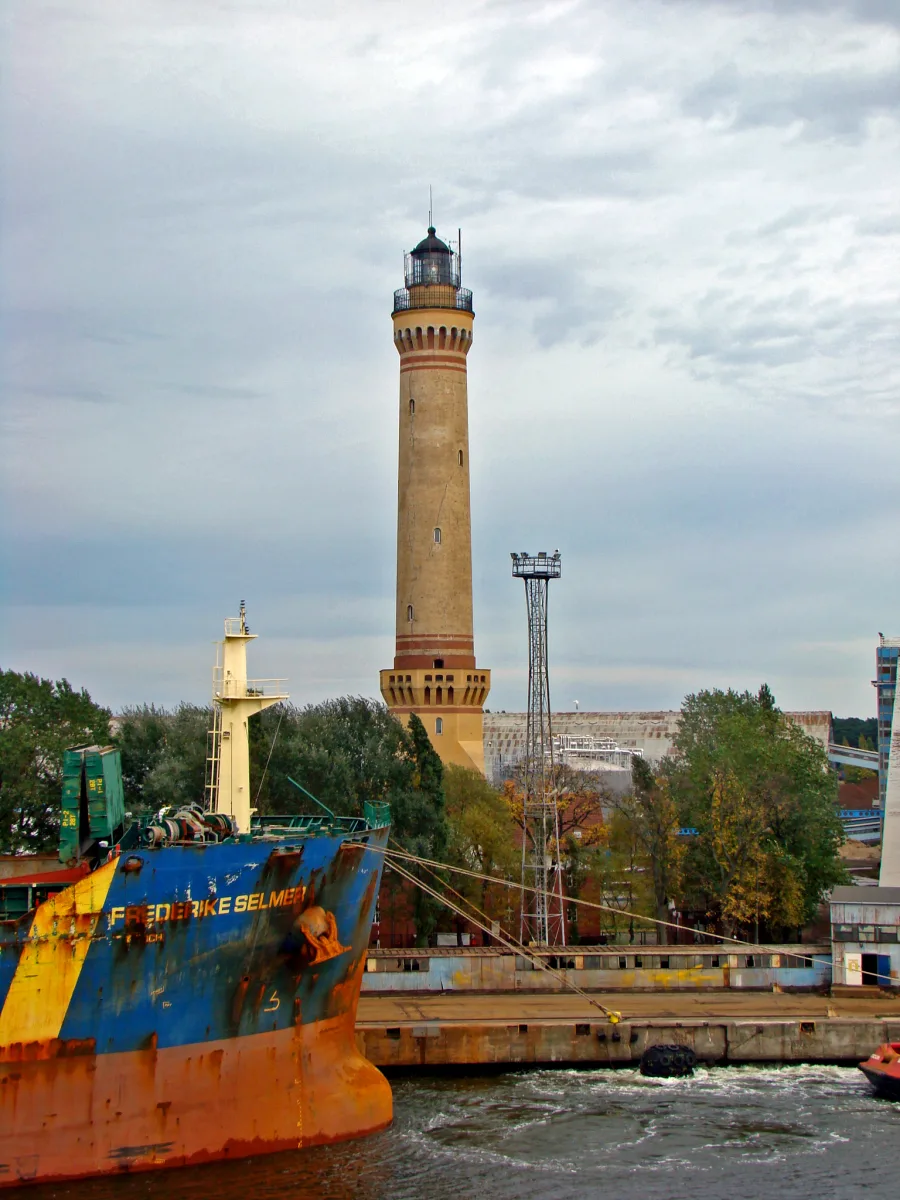
Construction of the present lighthouse began in 1854 and took under three years. The light was first lit on 1 December 1857. According to Wikipedia, which gives these dates after Apoloniusz Łysejko's book on Polish lighthouses, the tower then had a different shape from today's: from the lower gallery to the upper one it was an octagon tapering upwards, of yellow facing brick, with walls from 1.7 m thick at the bottom to 1.3 m at the upper gallery. Until 1945 it was, according to a German lexicon of lighthouses cited by Wikipedia, the tallest lighthouse on the territory of Germany.
The severe weather conditions in Świnoujście, however, caused considerable losses of brick. In 1902-1903 a major renovation was carried out. It turned out that the bricks on the edges of the octagon were the most damaged, so it was decided to change the shape of the tower to round. A strong wooden scaffolding was erected around the whole height, the old cladding was removed from the top, and the new casing of clinker brick was laid in reverse, from the bottom up. The lighthouse has stood in this form to this day.
How tall it is and why it counts as a record
Wikipedia gives the height of the tower as 67.7 m and of the light as 65 m above sea level, and describes the lighthouse as the tallest on the Polish coast of the Baltic Sea. It adds that it is the tallest in the world among lighthouses built of brick, citing a list of the tallest lighthouses in The Lighthouse Directory, run at the University of North Carolina at Chapel Hill. Exactly 308 steps lead to the top. These sources, however, contain no comparison with lighthouses around the whole Baltic, so the title of tallest on the Baltic does not appear here as a fact: the record concerns the Polish coast and brick structures.
The lighthouse is administered by the Maritime Office in Szczecin. Around the tower stand two two-storey buildings of red brick, to the north and to the south. Formerly the lighthouse keepers lived in them with their families, and their task was to make sure the light never went out.
12 March 1945: bombs, not artillery
The most dramatic chapter is the end of the Second World War. Wikipedia writes that on 12 March 1945, during an Allied air bombardment, bombs exploding near the lighthouse caused cracks in the body of the tower. This is an important distinction: the source speaks of the effect of bomb explosions in the vicinity, not of a hit on the tower, shelling from land or deliberate demolition. The tower survived, but with cracks.
The repair came late. Only after fourteen years, in 1959, were the walls strengthened with injections binding the cracked parts of the body. From 1958 the lighthouse also served as a radio beacon, and the transmitter was switched off on 10 November 1999.
The renovation at the turn of the century and the sector light
Dust in the air from chemicals handled in the neighbouring port meant that the cladding of the tower again suffered badly. From November 1998 until spring 2000 the whole structure was renovated, that is, the tower together with the adjoining buildings. The lighthouse was opened to visitors on 5 August 2000.
A first-order Fresnel apparatus operates in the lantern. The light is occulting and sectoral: the white part has a nominal range of 25 nautical miles, the red 9. According to Wikipedia the red light is visible in bearing from 029 to 057 degrees, and the white from 057 to 280 degrees. A second mark also leads to the port: the white Stawa Młyny in the shape of a windmill at the end of the breakwater, which together with the neighbouring Galeriowa beacon marks the leading line of the fairway. It is a navigation mark, not a lighthouse. The tower this text is about, open to visitors, is the Świnoujście Lighthouse in the Warszów district.
Be the first! Add a comment.
You need to log in to add a comment.
Log in