
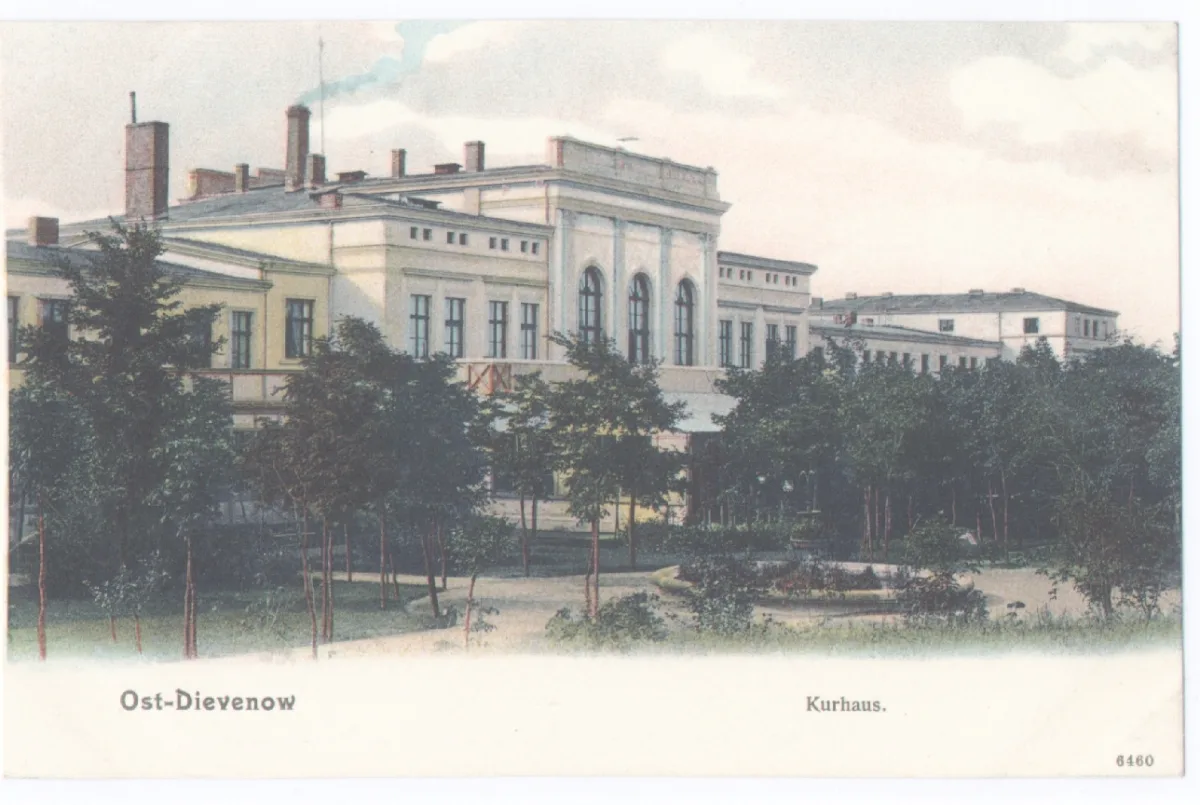
New Year's Eve 1913 in Dziwnów
Dziwnów suffered the greatest loss. According to Wikipedia, a powerful storm on the night of 30 to 31 December 1913 completely destroyed the local spa house, that is, the Kurhaus Ost-Dievenow hotel, which was 117 metres long and had 140 rooms. Wikipedia cites here Marian Klasik's guide to the monuments of Kamień county. The same building is mentioned in the programme of a field session of the University of Szczecin devoted to the Dziwnów Spit: according to it, the extreme storm of 1913 destroyed the Kurhaus, one of the largest spa houses on the Baltic.
The dates differ in detail. The Nasza Historia portal, relying on material from Dziennik Bałtycki, writes of New Year's Eve 1913/1914 and of a storm that lasted seven days and was later called the storm of the century. The water level was said to be a record: 637 cm in Trzebież. The year the hotel was built is also not clear: the article on Dziwnów gives 1895 in one place and 1890 in another, in agreement with Nasza Historia. The portal adds that the storm ended the life of the complex, which was never rebuilt, and that many people celebrating the New Year there lost their lives. The damage also affected a school and other buildings.
According to Wikipedia, bricks from the destroyed hotel were used in 1921 to build the seat of the county authorities in Kamień Pomorski. Before the Kurhaus collapsed it had a short history: according to the same article the hotel could accommodate 240 guests, and in 1896 a brine spring named in honour of Prince Bismarck was discovered on its grounds.
The rescue station and ice in the winter of 1912/13
The sea did not spare Dziwnów earlier either. In 1886 the German Society for the Rescue of the Shipwrecked established a coastal rescue station there with a rowing and sailing lifeboat and a rocket-and-line apparatus for rescuing people from stranded ships. According to Wikipedia, in the winter of 1912/13 pressure from ice destroyed the station building, and it was rebuilt in 1914, somewhat further from the shore.
Kołobrzeg: a dune promenade in the sea
Nasza Historia describes how great destruction also occurred in Kołobrzeg: the dune promenade slid into the sea, and the storm completely destroyed the family bathing area that was on the beach. Many buildings suffered, and trees snapped, as the author writes, like matchsticks. Wikipedia does not describe what the Kołobrzeg piers looked like then: it says only that the first wooden T-shaped pier, about a hundred metres long, was built by the Strandschloss sanatorium in 1881 and that it was destroyed during the Second World War. Today's pier in Kołobrzeg is a reinforced concrete structure opened on 19 June 1971, 220 metres long and 9 metres wide.
Międzyzdroje: the pier destroyed and rebuilt
In Międzyzdroje the sources do not agree on the beginnings of the pier. Wikipedia in its article on the town writes that on 1 July 1895 a wooden pier 300 metres long was put into use. The article on the pier speaks instead of a small wooden jetty from 1884, which the residents named after Emperor Frederick III, and of a pier opened on 1 July 1906 thanks to a donation of 250 thousand marks from Councillor Bötker. The municipality also gives the year 1906. That structure was more than 300 metres long, although the length most often given is 370 metres, and at its end stood a glazed restaurant. For years the pier was a landing stage for passenger ships from Szczecin and Świnoujście.
According to the article on the pier, in 1913 a strong storm destroyed a large part of the structure, but after a year the residents rebuilt it. The reconstruction did not last long: in 1914 sappers from Świnoujście blew up the pier for fear of a landing by Russian troops. After being rebuilt in 1920 it was 200 metres long. Later the sea returned: in 1954 a storm destroyed almost the entire wooden jetty, in 1961 a fire consumed the Art Nouveau arcade leading to the pier, and in 1985 wind and icing damaged the structure and the pier was closed. It was dismantled by 1989, leaving only two small towers. Construction of a new, reinforced concrete pier began in 1994, and the first part, 120 metres long, was opened in 1996. In the same town there is also the Walk of Fame.
Be the first! Add a comment.
You need to log in to add a comment.
Log in