
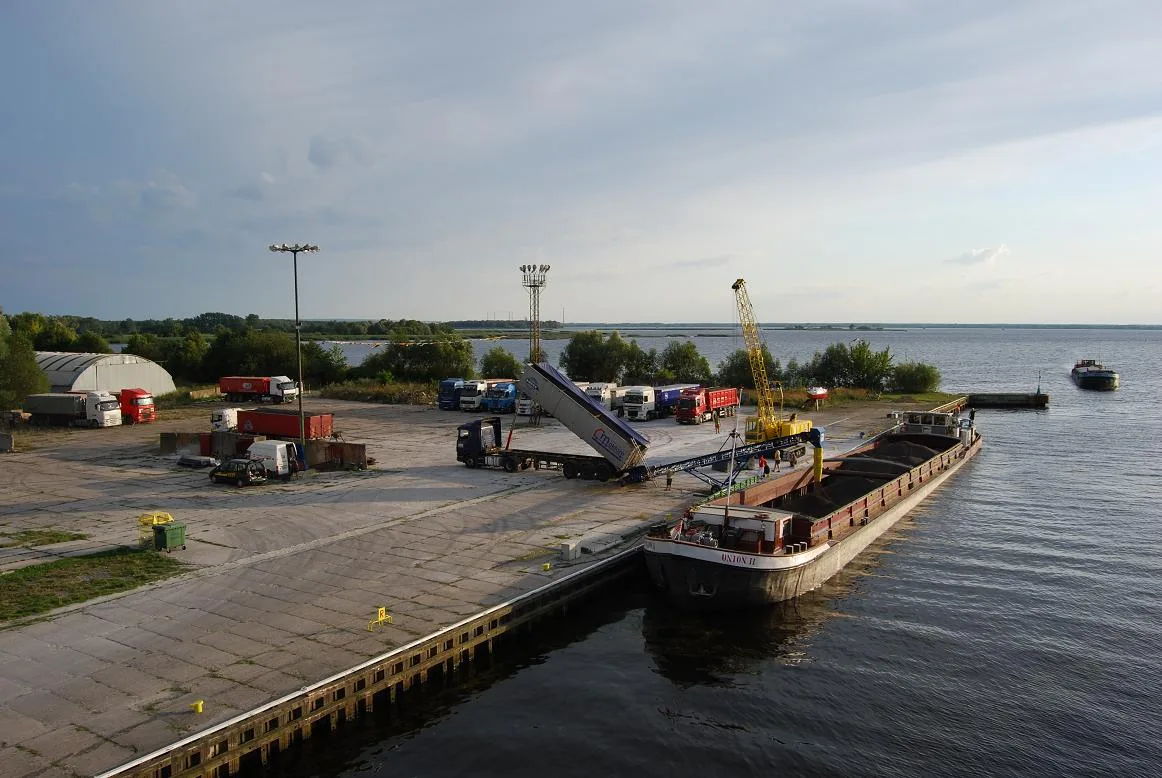
The Polish shore of the Szczecin Lagoon is short and flat, and yet according to the Encyclopedia of West Pomerania it has three seaports: Trzebież, Stepnica and Nowe Warpno. In the neighbouring waters, on the Świna, Wicko Wielkie, the Dziwna and the Oder, the encyclopedia lists eleven other seaports. They are not large cargo-handling ports, but each of the three has its own character: Trzebież is associated with fishing and sailing, Stepnica with marinas and a former holiday resort, and Nowe Warpno with the water border crossing and trips to the German Altwarp.
Trzebież: a fishing, commercial and yachting port
Wikipedia calls the port in Trzebież the largest Polish port on the Szczecin Lagoon. It describes it as mainly a fishing port, but also a commercial, passenger and yachting port, with a water border crossing. It stands on the western shore of the narrows that link the southern part of the Lagoon with the Oder Estuary (Roztoka Odrzańska). A seaport was formally established here in 1963.
According to Wikipedia the port consists of two parts: a southern one, with a commercial basin and three small basins for fishing boats, and a northern one, adjoining the former Central Sailing Centre of the Polish Yachting Association. Between them runs the transit quay, where border checks take place. From the north-east the basins are sheltered by Refulacyjna Island, a long wooded breakwater formed during the construction and dredging of the port and its approach channels. Next to it lies a second artificial island, Chełminek, heaped up during the dredging of the fairway. The Szczecin - Świnoujście fairway itself across the Lagoon, from the mouth of the Oder to the Piast Canal, was laid out at the end of the 19th century and, according to the Encyclopedia of West Pomerania, is 19.5 km long and about 10 m deep.
The port has a long history. According to Wikipedia the first mentions of the village date from around 1280, and at the end of the 19th century passenger and transit shipping ports and a shipyard were built here. After 1898 the village was given a railway connection with Police. During the Second World War, according to Wikipedia, about 40 per cent of the buildings were destroyed, mainly the port and the sawmill. By 1948 it had been restarted together with the shipyard and the sawmill, and in the 1970s Trzebież enjoyed its greatest prosperity.
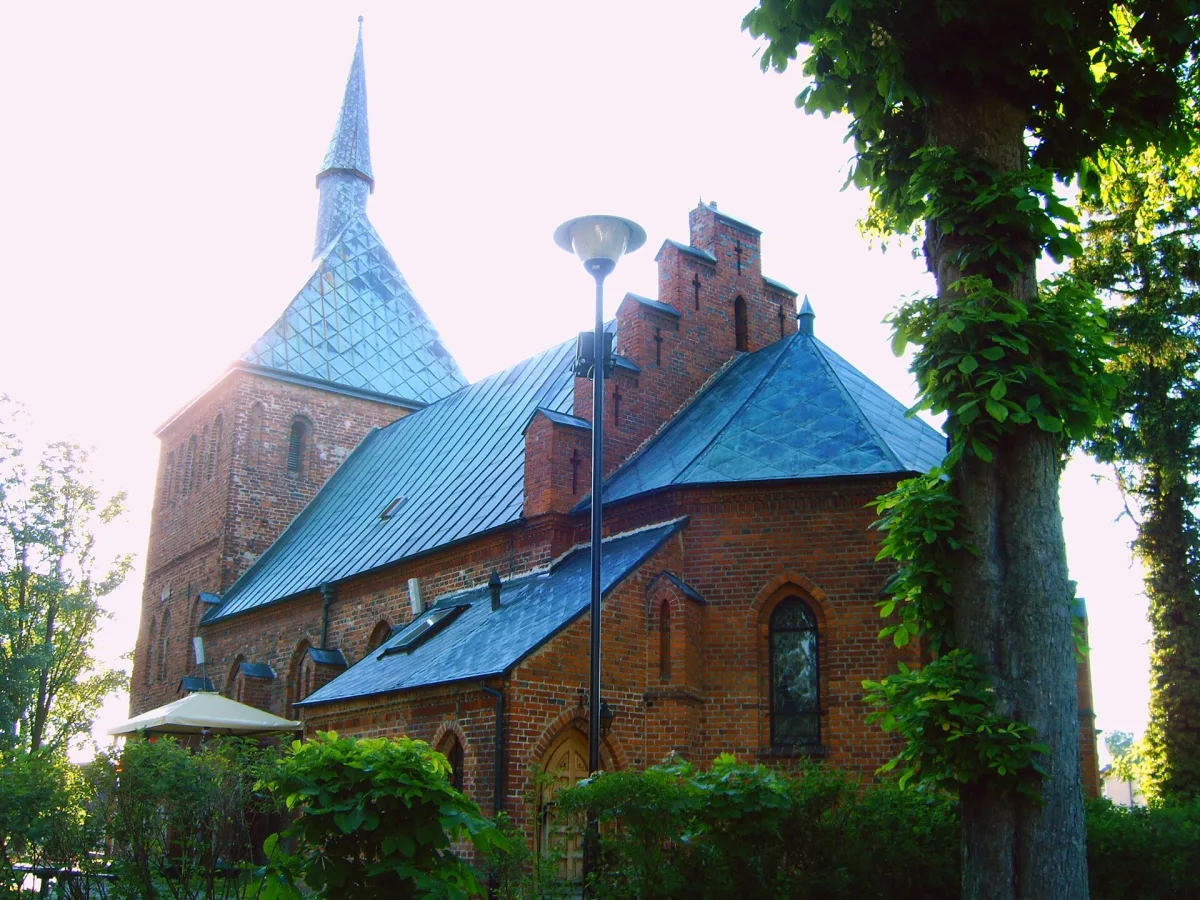
Today its port part has a yacht harbour, the Trzebież Marina, on the site of the former Andrzej Benesz Central Sailing Centre. The marina's website states that it offers yacht berths, servicing, crane launching and winter storage. Not far away, about 300 metres from it, stands the Church of the Exaltation of the Holy Cross. The present Baroque building dates from 1745 and stands on the foundation of a much older church, built around 1359.
On the Aleksander Doba promenade stands the bench monument to this traveller, unveiled on 9 September 2023. Doba, a kayaker and the first person to cross the Atlantic alone by kayak from Africa to South America, also paddled along the Polish maritime border from Police to Elbląg.
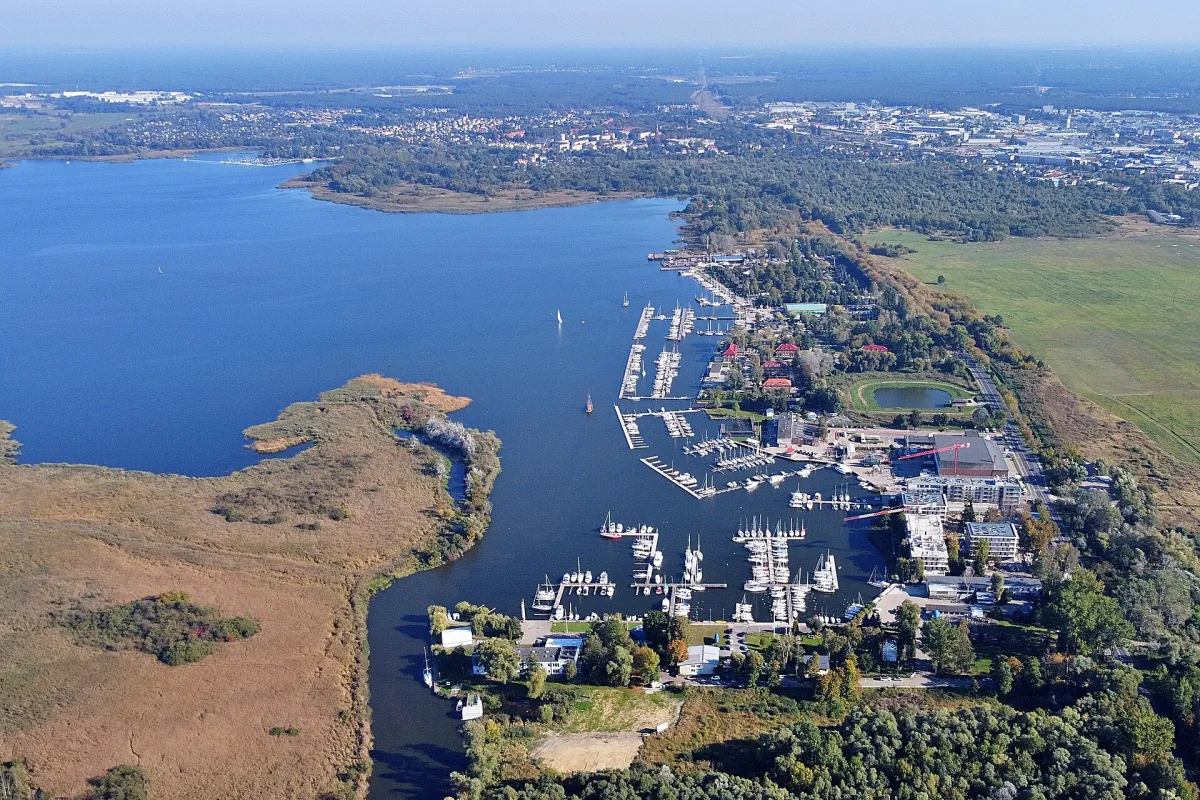
Stepnica: a small port and a marina in a canal
Stepnica lies on the eastern shore of Stepnica Bay, a part of the Oder Estuary. Wikipedia describes the port in Stepnica as a small seaport, established in 1963 by decision of the Minister of Shipping. Vessels up to 75 m long, 13 m wide and with a draught of up to 3.1 m can call there. The port has two areas: the Railway Basin, used for handling bulk cargo, and the Fishing Basin, where fishing boats and yachts are moored. According to Wikipedia two sailing clubs operate there. The Wikipedia entry on the town describes it as a port of local importance, serving fishing, sailing and commercial-handling functions.
Separately, in the northern part of the town, lies the marina on the Mill Canal, also known as the Krampa or Sports Canal. According to the description of the marina, the canal is 780 m long, and the marina belongs to the West Pomeranian Sailing Trail. Along the bank runs a road of cobblestones, which gives the place the character of an old marina. The mooring rules are given by the Stepnica municipality.
Stepnica itself is, according to Wikipedia, a former Slavic fishing settlement, mentioned in the 13th century. In the interwar period it became a holiday resort of the people of Szczecin: there was a beach, a yacht harbour, and ships of the white fleet called at the pier. A ferry ran to the western bank of the Oder, to Police. The famous sailor Robert Hilgendorf, a captain of great sailing ships, came from the town, and the yacht harbour in Stepnica bears his name. Stepnica received town rights on 1 January 2014. St Hyacinth's Church was built in 1741 on a Greek cross plan, which is rare in West Pomerania.
Nowe Warpno: a port by the border
The third port lies on the southern shore of Nowe Warpno Bay, in the Polish, south-western part of the Lagoon. Wikipedia describes it as a port with a fishing harbour and a maritime border crossing, adapted for the clearance of passenger ferries and sport and tourist craft. White fleet ships run from Nowe Warpno to neighbouring Altwarp, and also to Ueckermünde and Kamminke. The fairway leading to the port lies partly on the Polish-German border.
The town has an older origin than the port: according to Wikipedia it was most probably founded in 1295. After the great fire of 1692 a half-timbered town hall was built here, completed in 1697, which is still the seat of the municipal authorities. Beside it stands the Gothic Church of the Assumption of the Blessed Virgin Mary from the 15th century.
Around the Lagoon
All three localities can be reached by the cycle route around the Szczecin Lagoon. According to the West Pomerania cycling portal, the circular Polish-German route is 296 km long and divided into seven stages. One of them leads from Ueckermünde through Trzebież to Szczecin.
Be the first! Add a comment.
You need to log in to add a comment.
Log in