
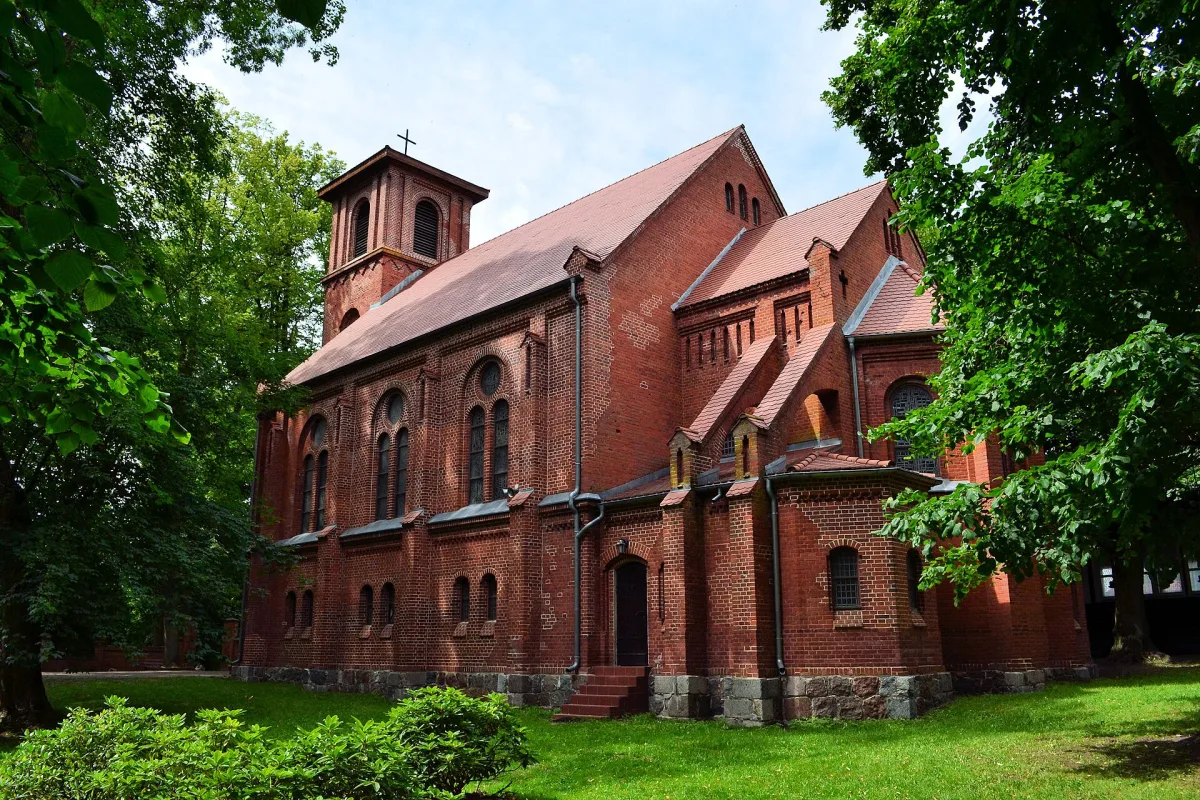
A church in the middle of the village
According to Wikipedia, a wooden church was built in Trzęsacz in 1124, and at the turn of the 14th and 15th centuries a brick Gothic church dedicated to St Nicholas took its place. The heritage register, according to the Zabytek.pl service, dates the ruin to the second half of the 15th century, so the year the brick building was constructed depends on which source is adopted. The church stood in the middle of the village, at a distance of about 1.8 to 2 km from the seashore. It was built of hand-moulded brick on a foundation of fieldstones, on a rectangular plan measuring 23 by 9 m, with a chancel closed on five sides.
After the Trzebiatów Diet of 1534, according to Wikipedia, the church passed from the Catholics to the Protestants. In 1658 it was renovated and fitted with pews, stalls, a pulpit, a font and an altar. The wooden tower of 1650 was damaged by lightning in the 18th and early 19th centuries and was finally pulled down, and a bell tower with two bells was put up in its place. In the churchyard lay a cemetery, which the sea began to uncover in the second half of the 18th century, and which was closed in 1809.
Metres to the edge of the cliff
Wikipedia gives the distance of the church from the edge of the cliff over the years:
- 15th century: 1.8 to 2 km
- 1750: 58 m
- 1806: 14.5 m
- 1820: 13 m
- 1835: 12 m
- 1855: about 5 m
- 1868: 1 m
The entry adds that the first attempt to halt abrasion was made in 1750, when the cliff was 58 m away. Fascine mats and protective piles were used, which did not stop the erosion. The museum in Trzęsacz describes this somewhat differently: according to the photo captions on the museum's website, in 1850 the church stood about 5 m from the edge, and in the famous photograph of 1870 it was only a metre from it. The dates thus differ by a few years, and the order of magnitude is the same.
Even though in 1868 the cliff was a metre away, services were still held in the church. Wikipedia states that the last was held on 2 March 1874, and the church was closed for safety reasons on 2 August 1874. In a footnote the entry notes that, according to other studies, the last service took place on 2 August and the closure a day later. In place of the old church a new one was built, completed in 1880, today the Church of Divine Mercy, which according to Wikipedia stands by provincial road no. 102 in the interior of the village. According to Wikipedia a new cemetery was established in 1812, because the previous one, beside the old church, had begun to be threatened by the retreating cliff.
Wall by wall: how the church disappeared
According to Wikipedia, in 1891 foundation stones began to emerge from the undercut cliff, and in 1900 the sea took the first fragment of a buttress. On the night of 8 to 9 March 1900 the north wall collapsed. The entry lists further losses year by year:
- 1901: the rest of the cemetery, the north and north-east walls, part of the chancel
- 1903: the north-west corner
- 1909: a fragment of the wall closing the chancel
- 1913: the northern part of the façade
- 1917: the east entrance
- 1922: the southern part of the façade
- 1930: another fragment of the chancel
- 1956: the south-west corner with a buttress
- 1973: a fragment of the chancel
- 1975: a small piece of the western part of the south wall
- 1 February 1994: half of the south wall
The dates are not identical in every account. The Wikipedia entry on the village itself says that in 1901 the first part of the church collapsed, while the entry on the church gives the night of 8 to 9 March 1900. The museum in Trzęsacz writes on its website that the north wall fell in 1930 and that the sea took the south-west corner with a buttress in 1965, whereas Wikipedia gives 1956 for the corner. Anyone comparing the accounts should expect these discrepancies.
Saving one wall
After a considerable part of the south wall collapsed in 1994, the authorities of the Rewal municipality decided to preserve the remains of the walls. According to Wikipedia many ideas were considered, including one as radical as moving the surviving wall inland. The solution of the company Stabilator was chosen. In 2001 a revetment was laid at the foot of the cliff, and in 2002 a new foundation was made under the ruins and strengthened with two vertical lime-cement columns 15 m long and a diagonal ground anchor, also 15 m. The foot of the cliff was covered with an 80-metre gabion revetment. All that remains of the church today is the south wall, 12 m long and 6 m high, standing on the edge of the cliff.
The museum in Trzęsacz captions a photograph from 2007 as an image of the ruins already secured against sliding, and a photograph from 2015 shows that they can be viewed from a viewing platform at 20 m above sea level. Wikipedia does not mention 2007, so this date should be read as the year of the photograph, not the year of the works. The programme of a field session of the University of Szczecin lists Trzęsacz as a site where the history of the church shows the scale and dynamics of coastal change over different time scales, and also discusses the coastal protection methods used by the maritime offices and their effect on the morphodynamics of the coast. As for the church on the edge of the cliff itself, it is worth remembering that the cliff is still sliding, so one must keep well back from the edge.
Where the furnishings went
Before the walls fell, the furnishings were removed. According to Wikipedia they went to the cathedral in Kamień Pomorski, some to museums in Szczecin and Berlin, and part of the triptych to Rewal. The Gothic triptych was taken down in 1758, and its central shrine can be seen in the Church of the Holy Saviour in Rewal. The early Baroque altar of 1673 was moved in 1901 to the co-cathedral in Kamień Pomorski, and since 2003 it has stood in the Church of Divine Mercy in Trzęsacz. The Renaissance stalls of 1583 remained in Kamień Pomorski. The bell of 1679, moved to the new church, was melted down in 1902 and recast, and in 1917 it was finally melted down for cannon.
The legend of Zielenica and the museum by the cliff
A legend is linked with the cliff, which Wikipedia cites in the entry on the church. According to the legend, fishermen caught Zielenica, the goddess of the sea, and the local parish priest imprisoned her. Zielenica died of longing and was buried in the churchyard, and her father, the Baltic, was from then on to send wave after wave to reclaim his daughter's body. This is a story, not a record of events. In the Multimedia Museum on the Cliff, located according to Wikipedia 50 m from the ruins, the legend of Zielenica is told by an animation, and the following rooms show the history of the village, the process of abrasion, the significance of the 15th meridian and the last moments of the church on the cliff. The museum was founded in 2000 and reopened after modernisation in May 2014.
Around Trzęsacz
Inland, beside a stud farm, stands the palace in Trzęsacz. According to the heritage register it is a brick building from the 18th century, part of a palace and farm complex which, according to Wikipedia, is in private hands, so it is viewed from the outside. Along the coast to the east, in Niechorze, stands a lighthouse built on the high cliff shore. The cliff in Pustkowo is crowned by the Baltic Cross of Hope, a metal cross 19 metres high, and further west, in Dziwnówek, the Klif nature reserve protects a stretch of coast that retreats naturally.
Wikipedia notes that in 1896 the first, western line of the Gryfice Narrow-Gauge Railway, linking Gryfice with Niechorze, passed through Trzęsacz, and a station of the Coastal Narrow-Gauge Railway lies at the southern end of the village. Steam locomotives and carriages of the former narrow-gauge railways of West Pomerania have been collected in the Permanent Exhibition of Pomeranian Narrow-Gauge Railways in Gryfice.
Be the first! Add a comment.
You need to log in to add a comment.
Log in