
A park that went from land to sea
Wolin National Park lies in the central-western part of Wolin Island, between the Pomeranian Bay and the Szczecin Lagoon. According to the park's website, it was established in 1960. Wikipedia states that it then covered 4,844 ha, while the park's website says that until 1996 it had 4,691 ha, so the exact size of the original area depends on the source. What happened in 1996 is certain: a strip of coastal Baltic waters one nautical mile wide, an archipelago of islands in the back delta of the Świna and the surrounding waters of the Szczecin Lagoon were included within the boundaries. According to Wikipedia and the park's website, from that moment it was the first marine park in Poland.
The present area is 10,937 ha. The park's website breaks it down into three parts: forest ecosystems cover 4,646 ha, or 42.83 per cent, water ecosystems 4,687.86 ha, or 43.22 per cent, and non-forest land ecosystems 1,513.81 ha, or 13.95 per cent. Water is therefore the largest single component of the park, although it is associated mainly with forest and cliff. According to Wikipedia, the originator of the park was the forester Mieczysław Tarchalski, and its organiser and first director was Leon Niedzielski.
Three landscapes of one island
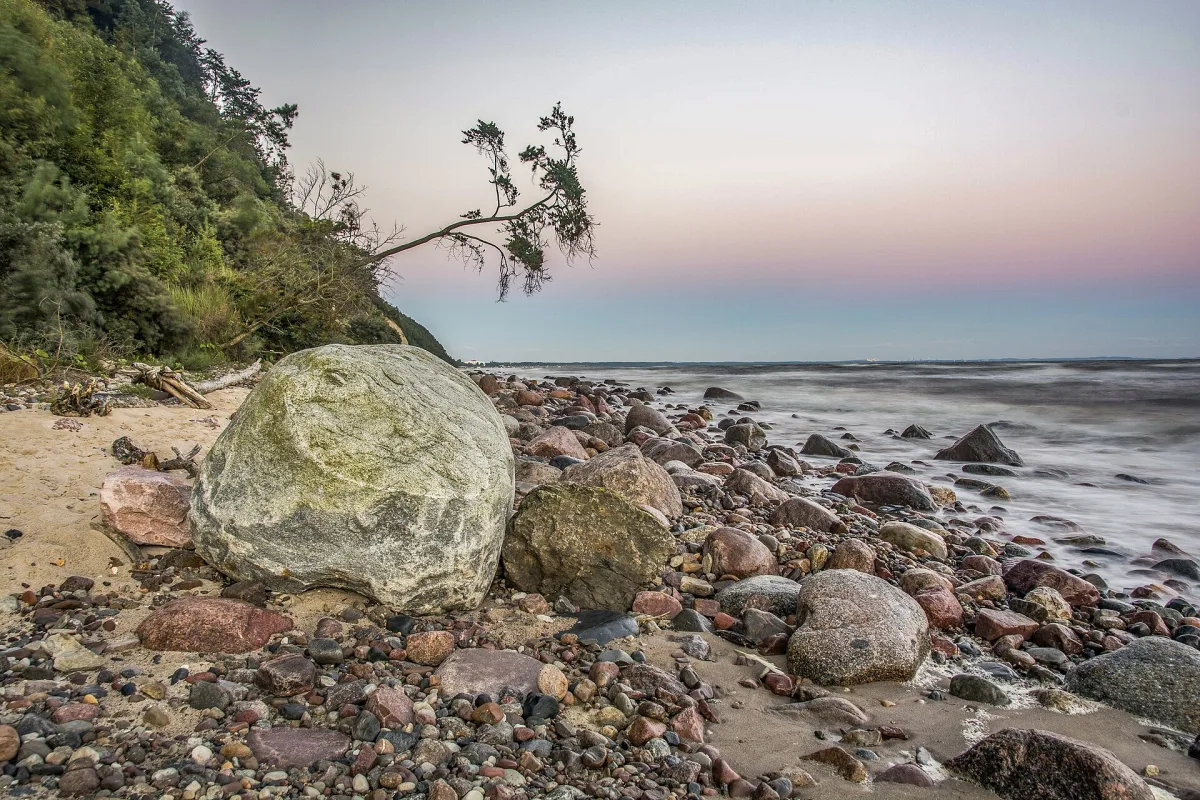
The dominant feature is a range of end moraine, which meets the sea along a stretch of about 15 km. Moraine hills cover about 75 per cent of the park's area, and the highest of them, Grzywacz, is 115.9 m above sea level. At the shore the range ends in a cliff, which the park's website describes as the highest of the active ones, at 93 m, while Wikipedia gives 95 m. In the field, the cliff is most easily seen from the summit of Gosań and from Kawcza Góra, which, according to Wikipedia, are among the park's five viewing points, together with Zielonka, Piaskowa Góra and the Lubin Hillfort.
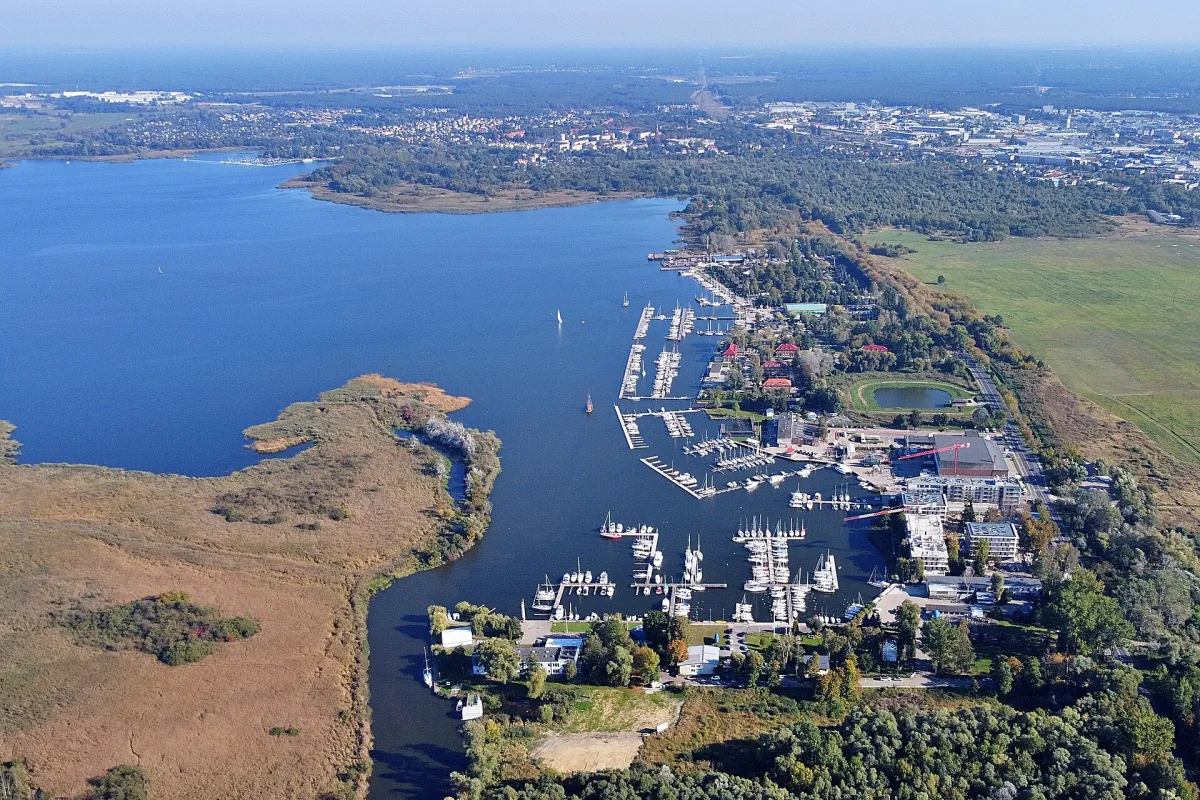
The second landscape by area is the delta of the Świna, with several dozen marshy islets separated by straits. The park's website notes that the process of its formation is continuing: every year the configuration of the bed changes and new shallows and islets appear. Wikipedia adds that the delta area has been classed as a bird refuge of European importance. The third type is a lakeland with glacial lakes, eskers and kames in the vicinity of Warnowo, and a small part is occupied by an outwash plain between Wapnica and Karnocice.
In the eastern part, near Warnowo and Wisełka, lie glacial lakes, among them Zatorek, around which a nature trail runs. Lake Turkusowe looks different: Wikipedia counts it among the park's artificial lakes, because it filled a former chalk pit.
The white-tailed eagle and other birds
The park's logo shows a white-tailed eagle and the less conspicuous sea holly, which is a plant, not a bird. According to Wikipedia, the park's symbol is the white-tailed eagle, and living specimens can be seen in the aviaries of the bison enclosure. The museum shows it in another guise: according to the park's website, the non-forest and aquatic exhibition includes a white-tailed eagle hunting and carrying prey, and a diorama of a nest with chicks.
The park's website and Wikipedia agree that more than 230 bird species have been recorded in the park. As breeding species they list the white-tailed eagle, the aquatic warbler, the dunlin and the red-breasted flycatcher. Wikipedia explains the wealth of birds by the location: the main bird migration route along the Baltic coast runs through Wolin, and the park gives waterbirds peace and a food supply, especially during the spring and autumn migrations. The waters of the Pomeranian Bay are, according to both sources, the habitat of the grey seal and the harbour porpoise. According to Wikipedia, a reintroduction of the eagle owl is also under way, and eagle owls live in the aviaries of the enclosure.
Bison, the museum and the forest
The Bison Show Reserve lies in the forest about 1.5 km from the centre of Międzyzdroje and covers 28 ha, of which 20 ha is the bison paddock. According to the park's website, the first four bison were brought in July 1976 from Borki and Białowieża: the cow Pomina, the bull Podskakiewicz and two heifers, Pompea and Podwyżka. The park explains that these are lowland bison, entered in the European Bison Pedigree Book, and that their names begin with the syllable Po, from the first letters of the word POLAND. The size of the herd has varied in different periods from 5 to 12 animals, and one or two calves are usually born each year. The bison from Wolin are not returned to the wild because, according to the park, the Wolin forests have too poor a food base.
The Natural History Museum of Wolin National Park stands in the centre of Międzyzdroje, on Filaretów Hill. According to Wikipedia, it is housed in a modern Educational and Museum Centre with five rooms with a total area of 900 square metres, and earlier, until 1995, in a historic white villa from the turn of the 19th and 20th centuries. Wikipedia also says that it holds the largest museum collection in Poland of male ruffs in breeding plumage: 130 specimens. The park's website adds a geological exhibition with Baltic amber.
Forests cover the moraine hills. According to the park's website and Wikipedia, pine occupies 68 per cent of the land area, beech 23 per cent and oak 7 per cent. The park's website states that more than 1,300 species of vascular plants have been recorded on Wolin Island, of which about 600 grow within the park. Wikipedia lists seven strictly protected areas, including six forest ones, and rare plants: the royal fern, sea holly, Pomeranian honeysuckle and northern wintergreen. According to it, the surroundings of Wisełka have a coastal crowberry pine forest on podzol soils.
Trails, the lighthouse and the hillfort
The park maintains several marked trails: the Coastal Trail, the Trail along the Baltic and the Szczecin Lagoon, the green forest trail through the Warnowo-Kołczewo lakeland and the black trail to Kawcza Góra. Wikipedia also lists the nature trails Zatorek and Łuniewo and the cycle routes R-10 around the Baltic and R-66 around the Szczecin Lagoon. By the coastal trail stands Kikut Lighthouse, and on the Szczecin Lagoon, at the highest point of the lagoon cliff, the Lubin Hillfort. According to Wikipedia, a stronghold existed here between the 10th and 12th centuries, and in its centre the foundations of the oldest church in Pomerania have survived. A hoard discovered at the hillfort contained more than a hundred Arabic dirhams from 951.
The park is a protected area, so rules on moving around the trails, set by the manager, apply in it. At the cliff one must keep to the marked path, because the face is still slipping. It is best to check the rules for moving around and visiting on the park's website before setting out on a route.
Be the first! Add a comment.
You need to log in to add a comment.
Log in