
Stargard is well suited to a one-day walk, and at a relaxed pace to a weekend. The Old Town is compact, the walls, towers and museums are separated by a few dozen to a few hundred metres, and a park runs along the fortifications. Below is the route in the order in which it is easy to walk: the Market Square, streets with museums, the towers by the Pyrzyce Gate, parks and finally places for poorer weather.
The Market Square and surroundings
The Old Town Market Square has been the centre of the town since the mid-13th century. The eastern frontage is formed by the town hall from the end of the 14th century, rebuilt in 1948-1961, and the Baroque guardhouse. Behind the collegiate church, on Kazimierza Wielkiego Street, stands Protzen House, a Gothic town house from the first half of the 15th century with a gable decorated with blind arcades. Today it houses a music school, so it is viewed from outside.
The interiors of the guardhouse and the neighbouring town houses are occupied by the Archaeological and Historical Museum, which also runs an exhibition in the Basteja by the walls. According to the Wikipedia entry, the first museum in the town, the Heimatmuseum, operated from 1908, and most of its collections were taken to Greifswald in 1945.
The arsenal and the granary
In the southern part of the Old Town stand two utility buildings from the time when Stargard was a town of merchants and a garrison. The Arsenal was built around 1500 and according to Wikipedia is unique in Pomerania, because no other town has preserved a building of a similar purpose. Today it houses the State Archive. The Granary from 1685 stands on the Młynówka and according to Wikipedia is the oldest of the four surviving granaries of this type in West Pomerania. Grain went from here down the Ina, on to Inoujście.
Walls, the Pyrzyce Gate and towers
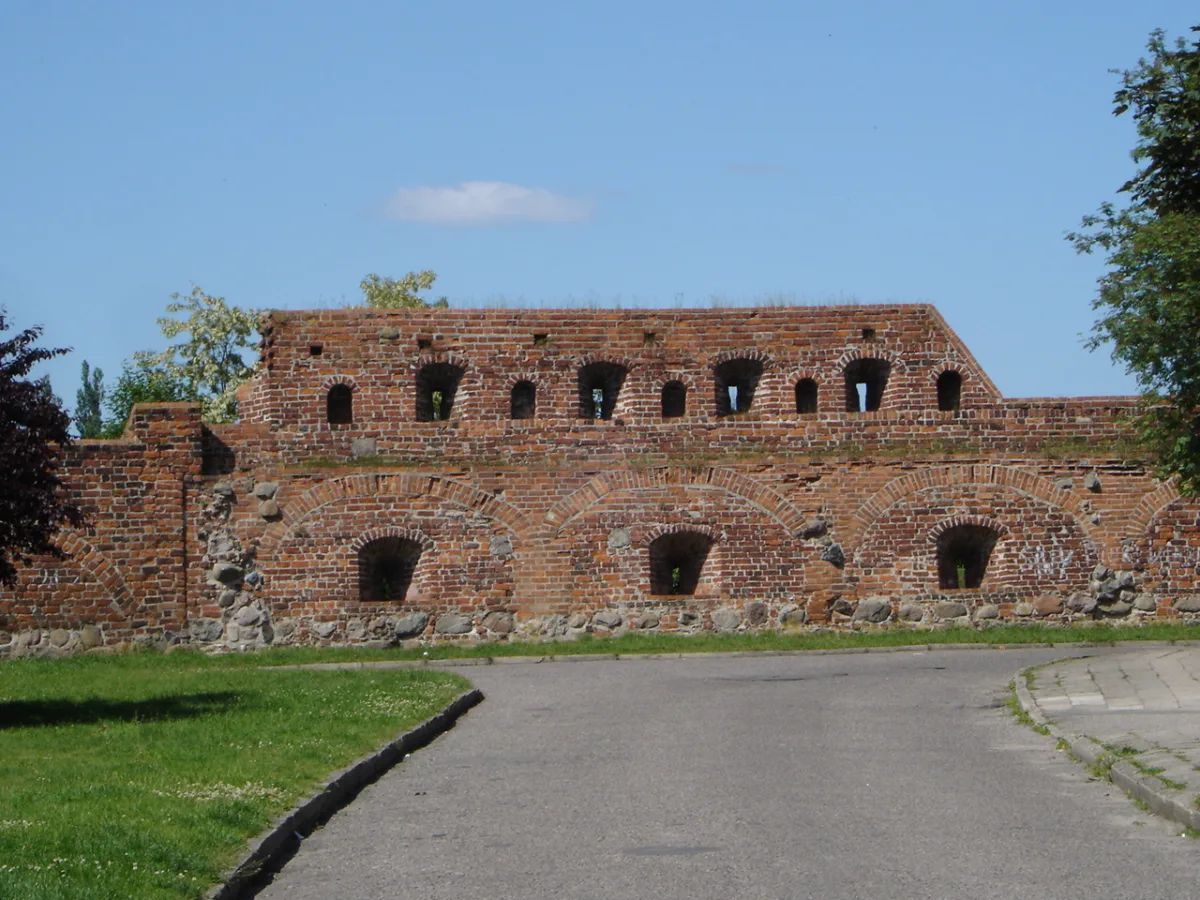
It is best to see the defensive walls in a single walk. The preserved length exceeds a kilometre, and in 2010 the walls together with the collegiate church were designated a Historic Monument (pomnik historii). The oldest sections of fieldstone, up to 6 metres high, can be seen by the Pyrzyce Gate. The brick superstructure of the gate dates from 1439.
Next to it stands the Basteja, built in the 16th century for defence using firearms. According to the description of the site, it is the only one of three such structures in the town that is preserved in its entirety. Since 2013 it has housed a multimedia exhibition on the history of Stargard up to the 1920s. Beside it rises the 31-metre Weavers' Tower, also called the Ice Tower, because from the 18th century ice was stored in its former dungeon.
Further on, at the crossing of Warowna and Łokietka streets, stands the 14th-century Red Sea Tower, 34 m high, with three viewing terraces. The origin of the name is not known for certain. Tales speak of blood from the Thirty Years' War or of convicts thrown from the top, while the Wikipedia entry considers more likely an origin from the rust-coloured marshes that were here before the tower was built.
Parks along the fortifications
Bolesław the Brave Park surrounds the Old Town on the north and west and was created on former earth ramparts. The main avenue, Słowicza, runs along the former rampart. In the park stands a brick water tower from 1896-1897, according to Wikipedia 65 m high, with a green helmet and decoration referring to the Red Sea Tower.
In the north-east, on the Ina, lies the Castle Park: 2.61 ha on the site of a former stronghold, that is the oldest part of the town. Just behind it stands the Białogłówka Tower, linked with a legend about women defending the town. The legend says they poured boiling tar on the attackers. From here it is close to the Wałowa Gate.
For poorer weather
The Filary Stargard Science Centre is housed in a renovated town house on Chrobrego Street. According to the centre's website, the exhibition has three parts: historical, scientific with more than 55 interactive exhibits, and one devoted to technology. It works well as a break in a walk along the walls, especially with children.

Be the first! Add a comment.
You need to log in to add a comment.
Log in