
Poland's fifth largest lake, with a bed below sea level
Miedwie lies on the Pyrzyce Plain, in the south-eastern part of the Szczecin Coastland. According to Wikipedia it covers 35.27 km², which makes it fifth among Polish lakes and second, after Dąbie, in West Pomeranian Voivodeship. A similar wording appears in a study by the Institute of Land Reclamation and Grassland Farming in Falenty, Szczecin Branch, whose authors describe a lake of 35.3 km² as the fifth largest in Poland. The catalogue value from the Atlas of Polish Lakes by Jerzy Jańczak (1996), cited by Wikipedia, is 3,527 ha.
According to Wikipedia the water surface lies at about 14 m above sea level, and the maximum depth is 43.8 m, the average 19.3 m. The article describes Miedwie as the largest cryptodepression in Poland, that is, a body of water whose bed lies below sea level: 29.8 m below sea level. Wikipedia bases this information on the website of Kobylanka municipality. The shoreline is about 39 km long, the lake is 16.2 km long and 3.2 km wide at its widest. The shores are treeless, and in the southern part marshy.
It is a ribbon lake with a through-flow. The Płonia flows through Miedwie, and the Ostrowica, the Miedwinka, the Gowienica Miedwiańska and the Kunowski Ditch flow into it. According to the Institute of Land Reclamation study, the catchment covers 1,033 km², 85 per cent of it farmland, and the lake holds about 682 million m³ of water, 73 per cent of which comes from surface inflows.
Water for Szczecin since 1976
The authors of the study from Falenty write that Miedwie has been the main source of drinking water for Szczecin since 1976, and the abstraction is 1.4 m³ per second. According to the Encyclopedia of West Pomerania, in its entry on the Szczecin Water and Sewage Company, in 1976, owing to growing demand, water from an intake in Lake Miedwie was brought to Szczecin. Wikipedia places the intake near Żelewo.
The Miedwie Water Production Plant is, according to the same encyclopedia, the largest of the eight plants supplying the city. Miedwie and Pomorzany draw surface water, and the other six plants use groundwater. The encyclopedia notes that, given the fall in water consumption in the city, only the Miedwie, Pilchowo and Skolwin plants work continuously.
The study from Falenty describes how the quality of the water changed. In 1962-1973 it corresponded to purity class I, in 1974-1978 to class II, and in 1979-1996 to class III. The authors point out that large amounts of phosphorus and nitrogen continue to reach the lake, which intensifies eutrophication. According to Wikipedia, studies from 2009 assessed the ecological status as moderate (class III) and the chemical status as good, and in the overall two-level assessment the state of the waters was found to be poor. In 2003-2006 a ban was in force on the lake on using craft with combustion engines within 200 m of the shore, except for approaches to jetties and harbours.
A lake that shrank
Wikipedia describes the present body of water as a remnant of the Pyrzyce Glacial Lake, in which the waters of the melting ice sheet collected. Until 1746 the lake covered almost 4.2 thousand ha at a level of 16.5 m above sea level. In the mid-18th century Frederick II ordered the drainage of the surrounding area and the regulation of the Płonia in order to gain farmland. After the work of David Gilly the water level fell by 2.5 m and the surface area shrank by 575 ha. This is when the lakes Będogoszcz, Zaborsko and Żelewko were formed, connected by the Płonia. In 1959 the sill at the mouth of the Płonia was destroyed, which lowered the level by about 36 cm, and in 1976 a weir regulating the outflow was built. According to Wikipedia, higher average water levels and greater fluctuations have persisted since then.
The Encyclopedia of West Pomerania adds that the section of the Płonia between the river and Lake Miedwie, 5 km long, is regulated and is called the Płonia Canal (Kanał Płoński). The whole Płonia is 72.6 km long, rises in the Myślibórz Lakeland south of Barlinek and flows into Lake Dąbie.
During the Second World War, according to Wikipedia, a torpedo factory, Gerätewerke Pommern Madüsee, operated at the lake, working first for the Luftwaffe and after 1944 also for the Kriegsmarine. On the eastern shore in Kluczewo, until 1993 there was a Red Army air base, which had no sewage treatment plant and, as the article states, contributed to the pollution of the lake.
The name, the vendace and the devil
Wikipedia, citing a study of geographical names, writes that the name was already mentioned in the 12th century, and the most widely accepted view is its Slavic origin from the word med, meaning honey. An alternative hypothesis derives it from a Proto-Indo-European root meaning middle. The name Miedwie was introduced officially in 1949, in place of the German Madüsee. Older residents of the area still use the form Madiza today.
At the end of the 1940s relict organisms from the Ice Age were found in Miedwie, and Wikipedia also names the Miedwie vendace as an autochthonous species. The lake is linked with a tale about the prior of the abbey in Kołbacz. According to a record from a resident of Żelewo, there were no vendace in the lake, so the prior made a bet with the devil that he would bring them. When the devil was returning with the fish, the monks surrounded the lake and crowed like roosters, so the devil released the vendace into the water and fled, and the prior saved his soul. This is a legend, not a historical event.
Morzyczyn and the trails around the lake
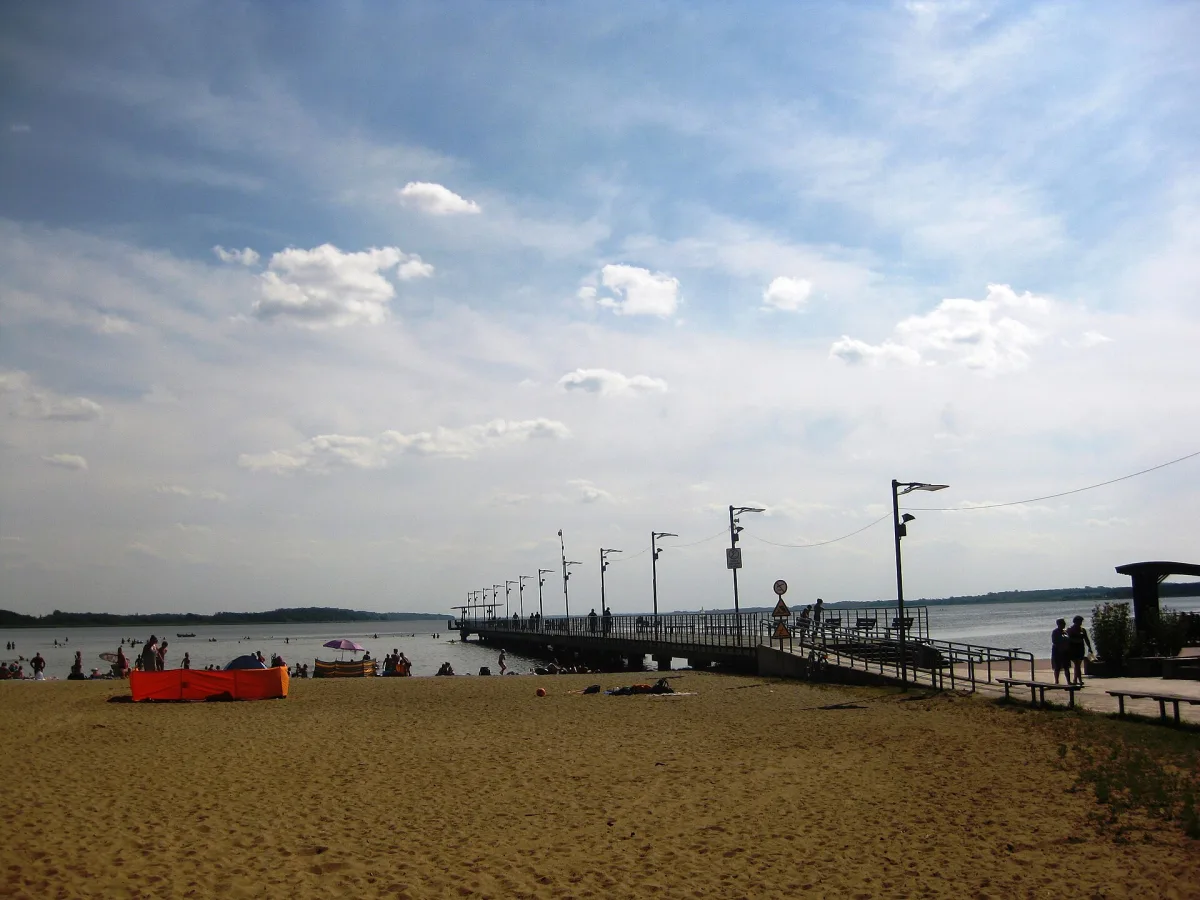
Many holiday villages lie by the lake. Morzyczyn, in Kobylanka municipality, is according to Wikipedia a holiday village with a promenade about 2 km long. Along the promenade there is a skatepark, a bandstand, a playground and jetties over a small marsh. The first mention of the village dates from 1752, and settlers were brought from the Dessau area after the marshes around the former Pramiedwie were drained. At the turn of the 19th and 20th centuries a holiday resort was established here.
A cycling trail runs around Miedwie: Morzyczyn, Brodogóry, Giżyn, Kołbacz, Kobylanka and back to Morzyczyn. From the village of Miedwiecko, about 1.5 km from Morzyczyn, it is closest to the railway station.

Be the first! Add a comment.
You need to log in to add a comment.
Log in