
A park created from Quistorp's gift
The oldest core of Szczecin's greenery stretches from the centre to the north-west and has a single benefactor. According to Wikipedia, Johannes Heinrich Quistorp gave the city adjoining areas: the square that is now called Jasne Błonia (the Bright Meadows), and the Arkonka Forest (Las Arkoński). The first name of Jan Kasprowicz Park came from his surname: it was founded in 1900 as Quistorp Park and was called that until 1945.
Wikipedia calls Kasprowicz Park the largest city park in Szczecin, with an area of about 27 ha. It lies on the slopes of the Niemierzyn Valley above Lake Rusałka. Together with a fragment of Arkonka Forest Park it forms a natural and landscape complex of 96.8 ha. Species rarely found in Poland grow here, including ponderosa pine, Serbian spruce, bald cypress and Caucasian wingnut. In the park stand an amphitheatre from 1976, the sculpture Fiery Birds (Ogniste ptaki) by Władysław Hasior from 1975 and the Monument to the Polish Deed (Pomnik Czynu Polaków) by Gustaw Zemła, unveiled in 1979. On the edge of the park lies the Rose Garden, recreated in 2007.
Jasne Błonia was created in 1925-1927 and is now entered in the heritage register. The green space was laid out on land of the Quistorp family, and the square was initially called Quistorp-Aue. According to the Visit Szczecin website, 213 sycamore-leaved plane trees grow on it, which the website calls the largest concentration of this species in Poland. An avenue leads from here on to Kasprowicz Park.
Różanka has its own separate history. According to Wikipedia it was founded in 1928 on the occasion of a gardeners' congress, and after reconstruction in 2006-2007 it was opened on 20 April 2007. According to Wikipedia more than nine thousand roses in 99 varieties grow there, and according to Visit Szczecin 9083 roses in 107 varieties. The garden is the end point of the Golden Trail (Złoty Szlak) for walkers and cyclists, which begins at the Castle of the Pomeranian Dukes.
Parks on former cemeteries
In Szczecin several large parks were laid out where there were previously cemeteries. This is not a curiosity but a clear trace of the city's history, visible in the layout of the paths.
Stefan Żeromski Park is according to Wikipedia the second largest city park in Szczecin, with an area of about 22 ha. The first germ of it appeared in 1721, when a Protestant cemetery was founded for the French minority. In 1802 the municipal Grabowo cemetery was set aside beyond the Royal Gate. In 1900 the city authorities closed both cemeteries and laid out a park in their place. About 177 species and cultivars of trees and shrubs grow here, and some of them are more than a hundred years old. Among the sculptures are the monument to Stefan Żeromski and the sculpture Prometheus by Anna Paszkiewicz.
A similar origin belongs to the Stefan Kownas Dendrological Garden, which adjoins Kasprowicz Park to the north. It covers 15.5 ha and was laid out in 1973-1974 on the site of the former Majdański Cemetery. Even terraces on the slopes and steps, with a difference in level of 13.5 metres, still recall the cemetery layout. In turn, Brodowski Park on the Warszewo Hills was created in the 1970s after the pre-war complex of the Brodowo Cemetery was cleared. According to Wikipedia the old layout of paths has survived, and in the stand of trees grow monumental oaks with trunk girths from 320 to 392 cm. On Słowicza Street stands a former cemetery chapel from 1911, now a church, and a stone commemorating those buried. Both parks are on the sites of former cemeteries, so keep quiet there.
Greenery on the outskirts: forest, water catchment and pond
Outside the city centre the parks turn into forests. Zdroje Forest Park is the north-western fragment of the Beech Forest, covering 173 ha, in which mainly beech grows. Trails and educational paths lead through it to viewpoints, and in the southern part lies the Zdroje nature reserve.
The smaller, 23-hectare Klęskowo Forest Park lies on the right bank in an undulating part of the Beech Forest, between the Bukowe and Słoneczne estates. According to Wikipedia, century-old beech woodland predominates there, and alongside grow trees from various continents, including ginkgo and Caucasian fir. On the eastern edge of the park are the ruins of a manor of the Dohrn family, who came to Szczecin in 1790.
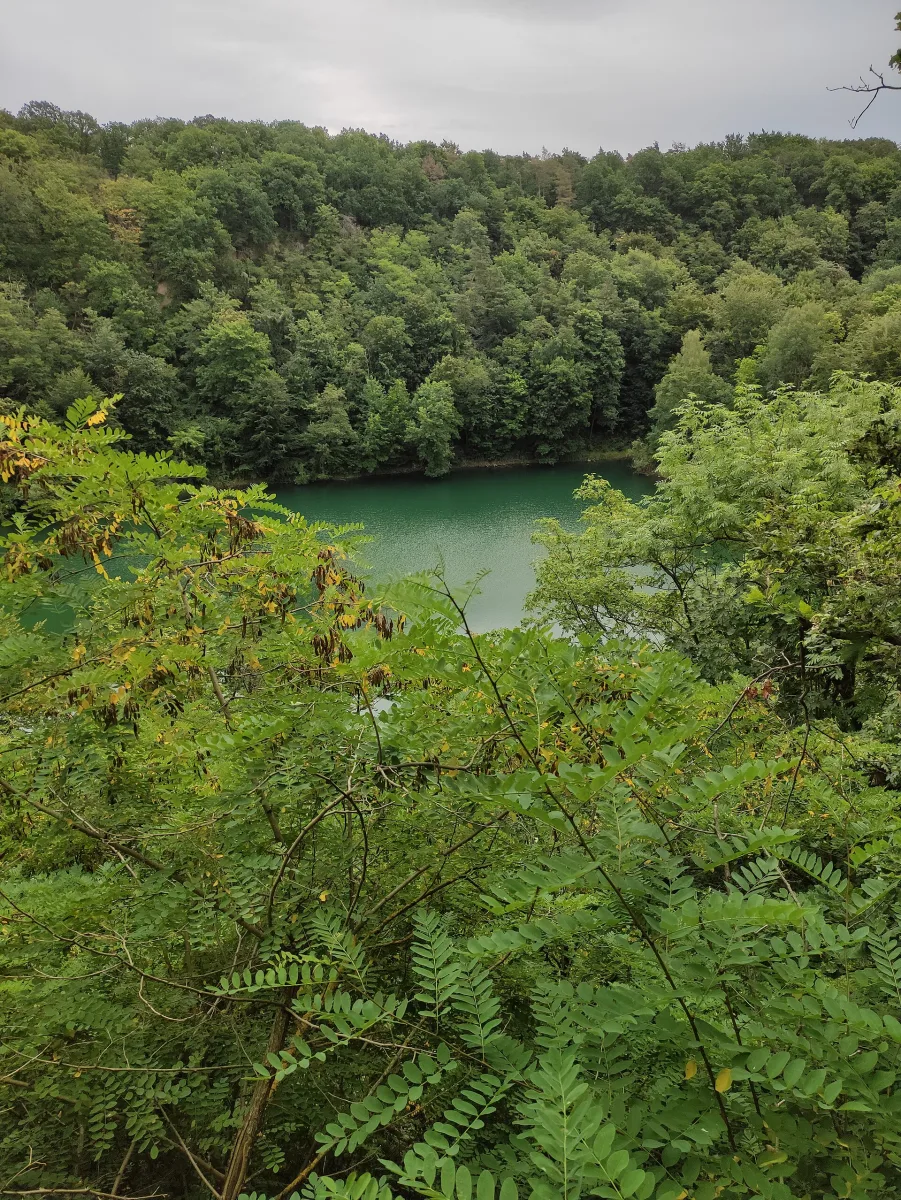
In the northern part of the city, on the border of the Warszewo and Bukowo estates, lies the Wodozbiór natural and landscape complex of 63.39 ha. It was established by a resolution of the City Council of 16 May 1994, and the aim of protection is to preserve the landscape, the shape of the terrain and the watercourses and water bodies. On the grounds of the complex lies Wysoki Staw. The smallest in this set is the Rubinowy Staw (Ruby Pond) on the Słoneczne estate, 70 m long and 40 m wide. The banks are concreted and fenced, so the pond is viewed from behind the fence, and walking paths run around it.
How to read Szczecin's greenery
The layout of the city parks is easy to see on the map as a belt leading from Jasne Błonia through Kasprowicz Park to Arkonka Forest. On the other side of the centre a dendrological park operates on former cemeteries, and on the outskirts of the city the forests of the Beech Forest begin. Rules of entry, regulations and current restrictions are given by the managers of the individual areas.

Be the first! Add a comment.
You need to log in to add a comment.
Log in