
The 1824 bathing resort and the spa house by the quay
Świnoujście is a port and fortress town, but since the early 19th century also a seaside resort. According to Wikipedia, the first bathing season was opened here in 1824, and as early as 1826 the first spa house, built near the harbour quay, was put into use. The building was demolished immediately after the outbreak of the First World War.
The town around the resort already had its own history by then. Wikipedia states that the settlement of Swinemünde was founded in 1743, the port was proclaimed in 1746 and town rights were granted in 1765. According to the museum's website, the oldest surviving building is the former town hall, which today houses the Sea Fishing Museum. The building was erected from the spring of 1805 to the summer of 1806, and the heritage register gives the date 1805.
The Spa Park: Lenné and the dispute over hectares
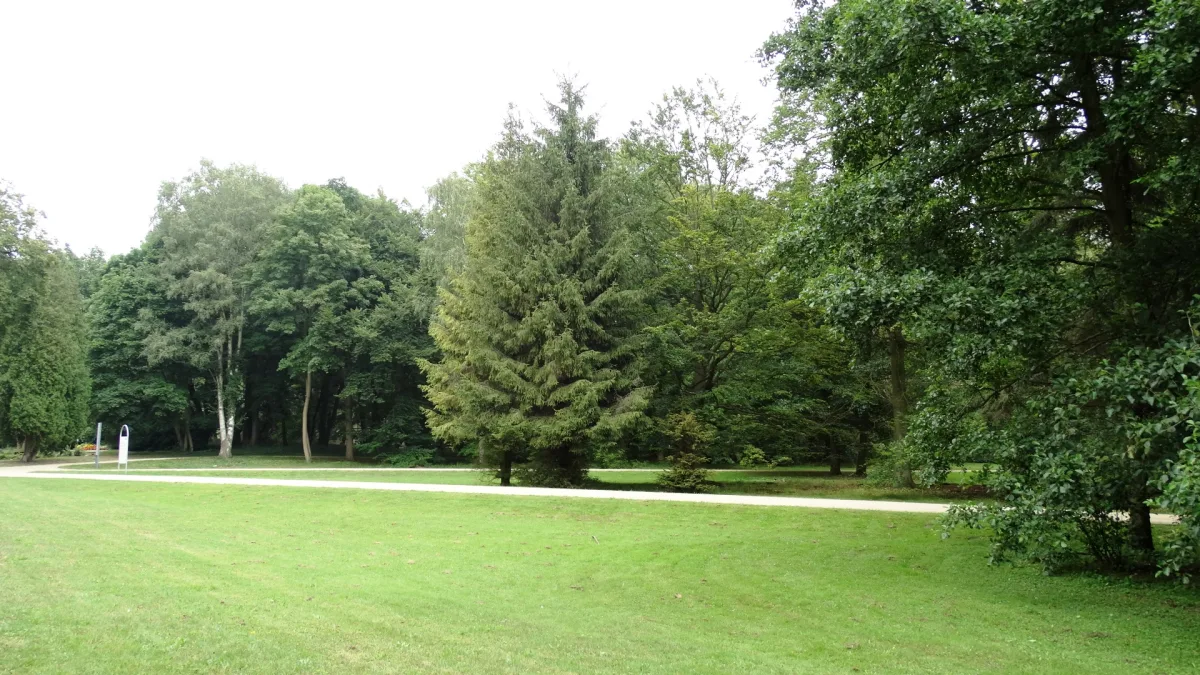
The greenery for the resort was provided by the Spa Park. According to Wikipedia, the ground first had to be made: hydraulic works turned a former coastal shoal into new land secured with vegetation. The design was prepared by the Prussian landscape architect Peter Joseph Lenné, who in 1827 sent about 1,500 tree and shrub seedlings from Sanssouci. A year later the park was, according to Wikipedia, essentially laid out. No planning document by Lenné has survived, and the authorship is considered certain on the basis of the layout of the paths, axes, squares and tree plantings.
The area of the park is given in different ways. The Wikipedia entry on the park itself gives 58 ha, the entry on the town of Świnoujście 40 ha, and a study by the National Heritage Board of Poland about 60 ha. The difference may result from whether only the historic core is counted or also the later extensions: in the interwar period the park was enlarged by the West Spa Park. In 1945, after the air raids, the park was devastated, and the new Spa House of the turn of the 19th and 20th centuries burned down. Clearing and new plantings were carried out in 1958-1959 and in the 1970s, and a thorough revalorisation took place in 2002-2012.
Brine: 1895 or 1897
Świnoujście began to count as a brine resort later than Kołobrzeg. In the main entry on the town, Wikipedia writes that in 1824 Świnoujście became a seaside resort, and in 1895, after the discovery of springs of brine and peat, a spa. In the section on the spa, however, the same entry gives the year 1897 as the date of the discovery of the springs of therapeutic brine, after which natural-medicine facilities were built. The exact year is thus not settled even by a single entry, and the difference is two years. According to Wikipedia, at the end of the 19th century a spa district arose at a rapid pace, separated from the town centre by the park.
Wikipedia also records that the seaside promenade was built at the turn of the 19th and 20th centuries and was lit in 1910. Because of erosion it has moved away from the line of the beach by more than 150 metres, although when it was built it bordered directly on it.
Churches and buildings from the resort period
Several surviving buildings in the town centre are linked with the growth of the town in the second half of the 19th century. The red-brick Post Office building was erected in 1878 and remodelled around 1900, and the heritage register dates it to 1878-1901. The Church of Christ the King has a body from 1788-1792, and the tower was added in 1881.
The Church of Our Lady Star of the Sea of 1895-1896 was built, according to the heritage register, as the first Catholic church in the area, mainly with Polish seasonal workers in mind. Two Evangelical churches date from the early 20th century. The register dates the Church of the Sacred Heart of Jesus in Przytór to 1901-1902, although the year 1895 also appears elsewhere. The Neo-Gothic church of 1904, funded by Emilia Heyse, was demolished after the war, but the tower of the Martin Luther church was left, because it appeared on navigation charts. Today it is a viewing terrace.
After 1945: the Soviet zone, the spa enterprise and the new promenade
According to Wikipedia, the spa part of the town was occupied by Soviet troops until 1957. In 1959 the State Enterprise Świnoujście Spa was established. The entry on the town today lists 15 spa treatment facilities, including two spa hospitals and eleven sanatoriums, and regards the bromide-iodide-sodium brines as the spa's greatest asset.
The promenade was renovated in 2019-2020: it was renamed the Historic Promenade, is 1.5 km long and, according to Wikipedia, a water clock and brine graduation towers were put up beside it. The cost of the project was more than 18.3 million zloty. The brine graduation towers stand at its western end, at the entrance to the beach, and the brine flows to them from Świnoujście Spa. Parallel to it, in 2018-2019, the 950 m Health Promenade was built. In 2011 the pedestrian and cycle Cross-Border Promenade to the German Heringsdorf was opened, almost 4 km long.
The symbol of the town is Stawa Młyny, a white navigation mark in the shape of a windmill at the end of the breakwater. According to Wikipedia, it was erected in 1873-1874 during the modernisation of the fairway. The breakwater and the mouth of the Świna already belong to the Port of Świnoujście, which is a short distance from the resort and which since the 18th century has been, alongside the spa, the second basis of the town's existence.

Be the first! Add a comment.
You need to log in to add a comment.
Log in