
The National Museum and its branches
Szczecin's museums begin with the National Museum, the largest cultural institution in the West Pomeranian Voivodeship, which according to Wikipedia looks after more than 150,000 objects. The institution was established on 1 August 1945 as the Polish Municipal Museum, and received the rank of national museum in 1970. Apart from the main building it has four branches in the city centre and an exhibition in Gryfice, so they are easy to visit one after another on a single walk.
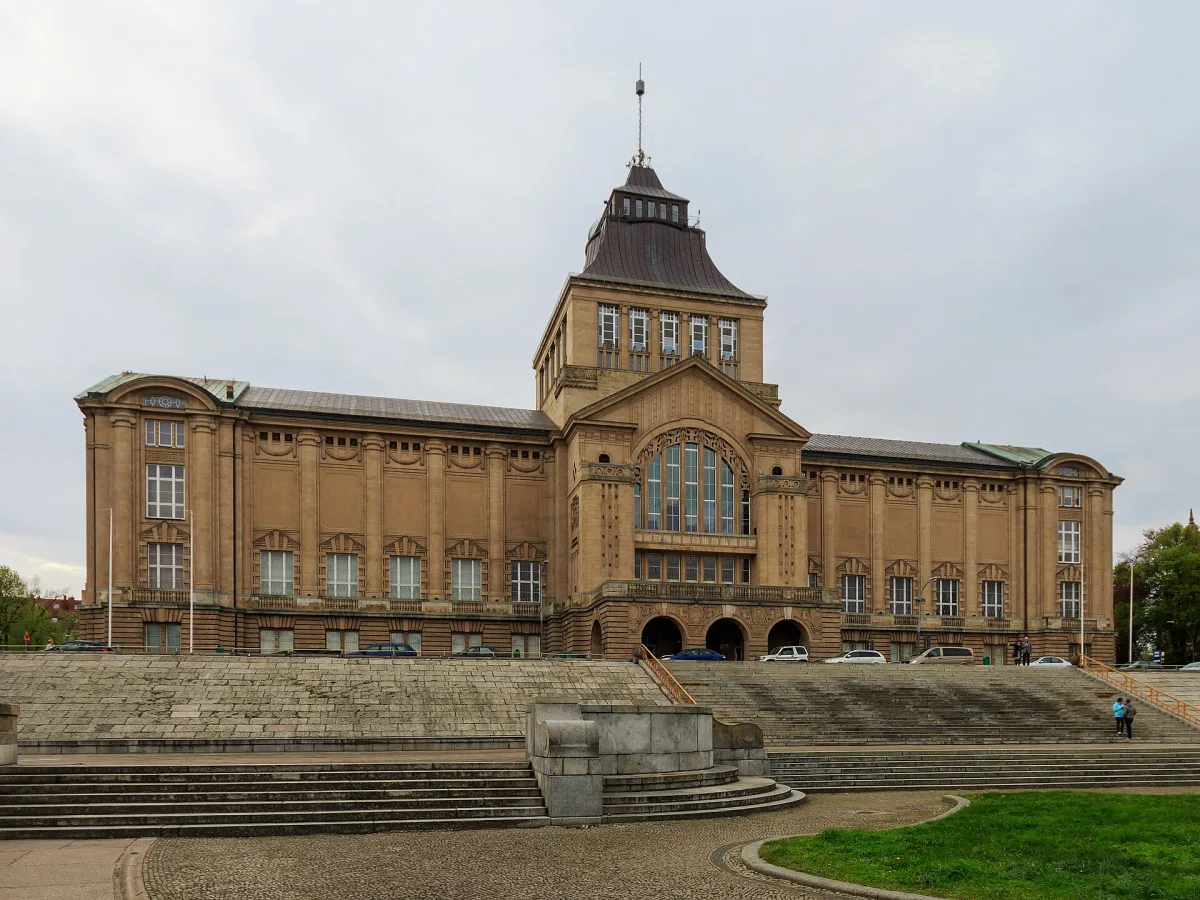
The Main Building stands on the Chrobry Embankment and was built in 1908-1911 to a design by Wilhelm Meyer-Schwartau, while the heritage register dates the whole to 1908-1913. The building was never completed: the original design envisaged a four-wing building with two courtyards, and in 1913 roughly half of the plan was opened. The permanent displays include medieval art in Pomerania, art of the 16th and 17th centuries and the Szczecin Dohrn collection. Wikipedia also mentions the African exhibitions, because according to it the Szczecin museum has the largest collection of material culture from non-European countries in Poland.
The other branches are the Baroque Palace of the Pomeranian Estates' Diet on Staromłyńska Street, which according to the museum's website houses the Museum of Regional Traditions, and the Museum of Contemporary Art in the Neoclassical former commandant's office of the fortress garrison. According to the museum's website, the latter branch bases its programme on temporary exhibitions and its own collection and coordinates the international Mare Articum programme with the Baltic Biennial of Contemporary Art. The Szczecin History Museum is housed in the Gothic Old Town Hall, rebuilt in 1972-1975, and its permanent exhibitions are devoted to the history and culture of the city.
Recent history and everyday life in the PRL
The Przełomy Dialogue Centre is a branch of the National Museum on Solidarity Square, devoted to the history of Szczecin and West Pomerania from the city's incorporation into Poland in 1945 to the changes of 1989. The pavilion opened to the public on 25 January 2016, and most of it lies underground. According to Wikipedia the exhibition covers, among other things, the border, migrations and the Szczecin Shipyard after 1945, the events of December 1970 and January 1971, August 1980 and martial law, and August 1988 and the year 1989. Solidarity Square was one of the places of demonstrations and fighting in December 1970, and the museum writes of 16 people killed in clashes with the army and the militia. The building, designed by Robert Konieczny, won the title of World Building of the Year at the World Architecture Festival in 2016.
The same period is presented differently by the Szczecin in the PRL Museum, a private museum of everyday life in 1952-1989 (the PRL is the Polish People's Republic). According to the museum's website there are thousands of exhibits, arranged in zones: a flat, an allotment, a party official's office, childhood, shopping, sport and leisure. The Underground Routes of Szczecin beneath the Main Station, in turn, is a museum in a former German air-raid shelter from the Second World War. According to the site's own page, one ticket covers three routes: “World War II”, “Cold War” and “Selfie with the PRL”.
Military history and defence are also shown by the Military Technology Museum, created by volunteers of a foundation in a bunker on Międzyodrze-Wyspa Pucka. According to the foundation's website it collects mementoes connected with the army, civil defence, the militia, December 1970, the Solidarity underground and the PRL. The museum opens on announced dates, so before a visit you need to check the foundation's website.
Technology, science and play
The Museum of Technology and Transport is housed in a historic tram depot on Niemierzyńska Street. According to Wikipedia it shows the Stoewer collection, that is, products of a Szczecin family that began with sewing machines and later built a car factory. There are also Junak motorcycles, Osa scooters, trams and buses, and the Motoeksperymentarium with 15 interactive stations.
The Maritime Science Centre on Łasztownia is an interactive exhibition about the sea in a building modelled on a ship's hull, with a planetarium and a viewing terrace. And the Be Happy Museum in the city centre is, according to the museum's website, a place with optical illusions, ball pits and gaming zones, where visitors may touch the exhibits. Each of these institutions gives tickets, opening hours and current exhibitions on its own website.

Be the first! Add a comment.
You need to log in to add a comment.
Log in