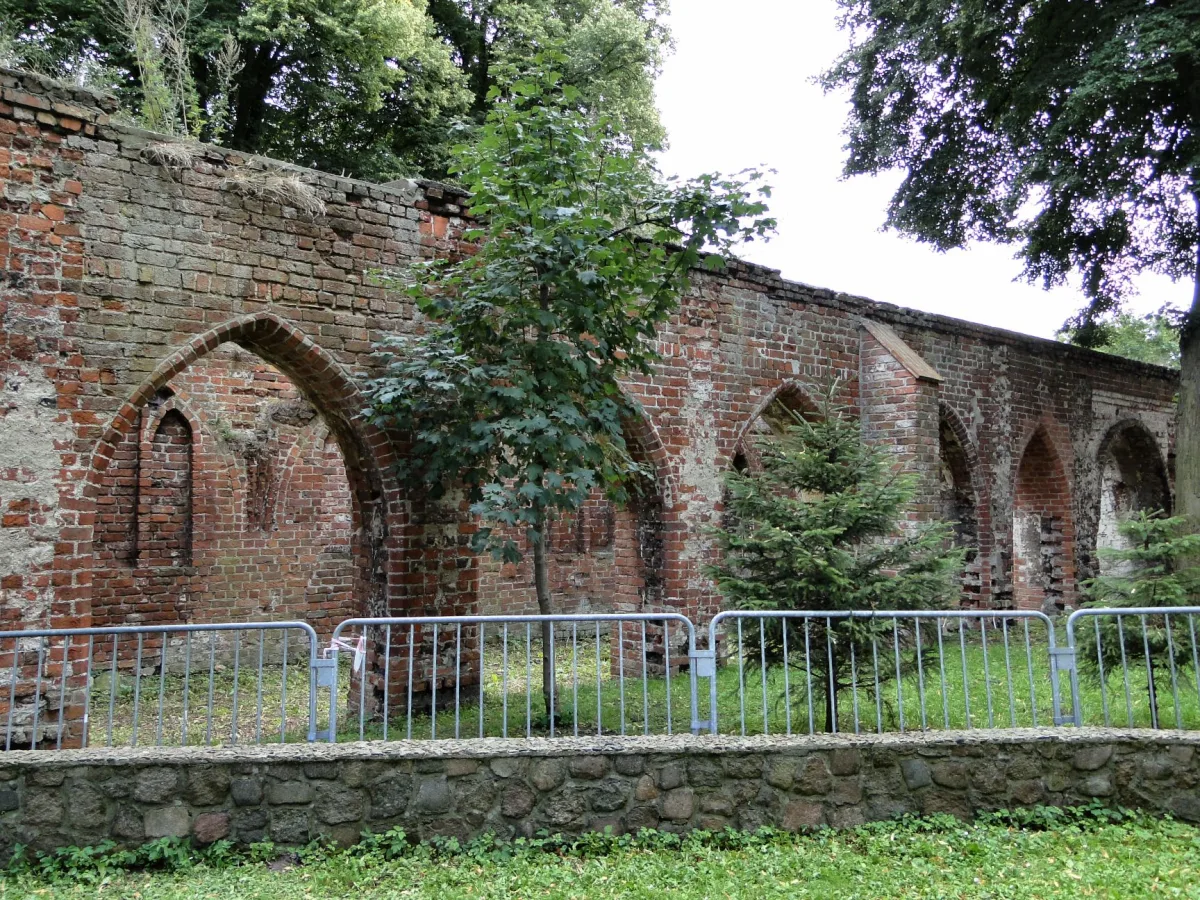
The remains of a medieval Augustinian monastery in Police-Jasienica, secured as a permanent ruin.
In Police-Jasienica, on the bank of the Gunica River, stand the single-storey walls of a former Augustinian monastery, secured as a so-called permanent ruin. Next to it has survived the Church of Saints Peter and Paul the Apostles in Police-Jasienica.
The Augustinians were brought to Jasienica in 1331 by the Pomeranian duke Barnim III. The monks regulated the Gunica, set up a mill, had several inns, grew hops, kept sheep and pigs, and received permission from the duke to fish in the Szczecin Lagoon. First a church stood here on Marian Hill, and then a monastery was built in the Gothic style, with its own water supply, hospital and library. In 1344 Barnim III granted the monks an estate comprising Stare Warpno with the Warpno Bay and the Wkrzańska Forest. The monks often quarrelled with the Pomeranian dukes, and Bogislaw X even dissolved the monastery and brought in Augustinians from Möllenbeck near Rinteln.
The monastery was dissolved in 1534 in connection with the introduction of the Reformation in the Duchy of Pomerania. In 1543-1583 it housed a teachers' college founded by Duke Barnim XI, and then the building became a ducal hunting castle. At the end of the 16th century the Swedish king's governor Nils Bielke rebuilt the buildings and hid the Gothic forms, and in 1769-1775 Elisabeth Christine Ulrike of Brunswick-Wolfenbüttel rebuilt them again in the late Classicist style. After her divorce from Frederick William II, later king of Prussia, she rested here, having been sent to Szczecin.
In the 1960s the upper storeys were demolished, leaving the single-storey walls. The perimeter walls of the southern and eastern wings have survived up to the height of the first floor, together with the cellars. The monastery consisted of two two-storey wings and a church, together open to the west around a courtyard, and the buildings had a cloister with blind windows, in which a ceramic Maltese cross was discovered. Every year the Augustinian Fair (Jarmark Augustiański) takes place on the site of the ruins.

Be the first! Add a comment.
You need to log in to add a comment.
Log in