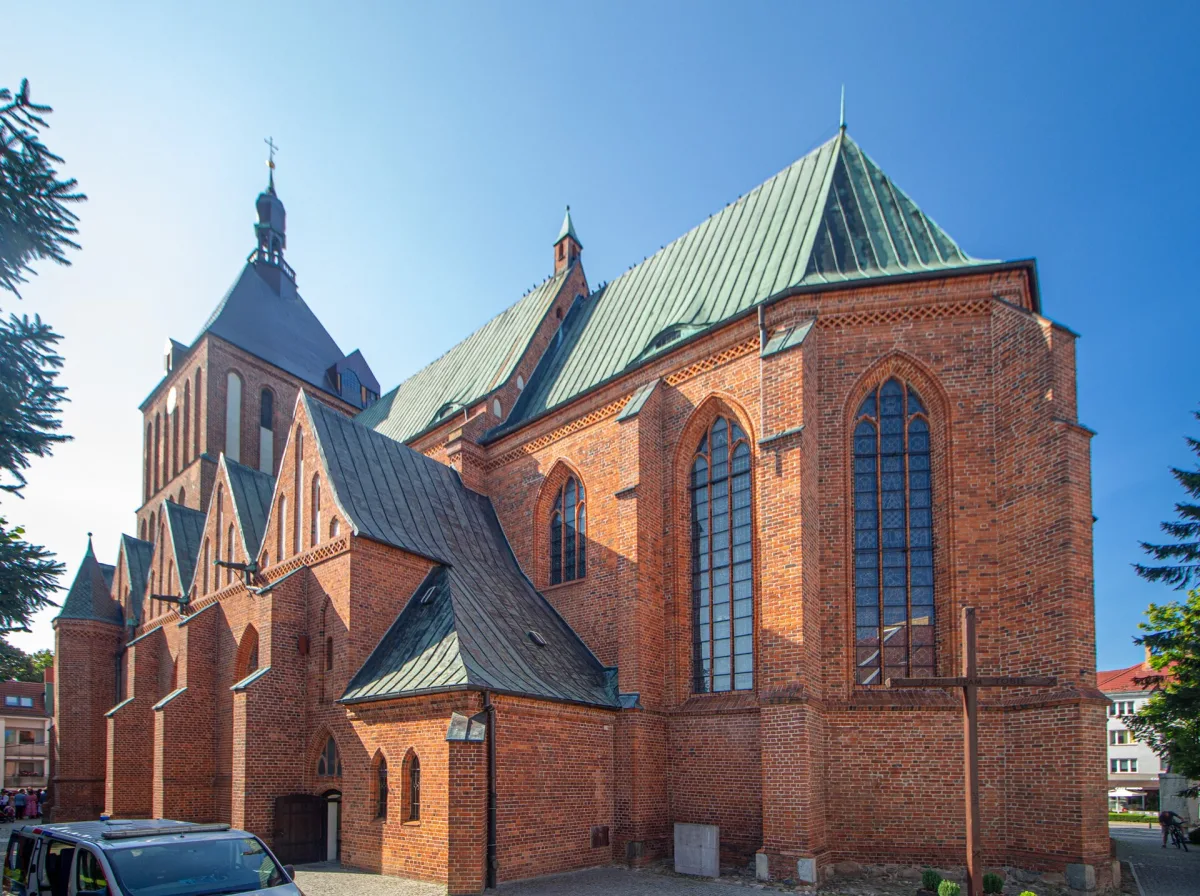
A Gothic basilica from 1300-1333, a former parish church, since 1972 the cathedral of a new diocese.
The Cathedral of the Immaculate Conception of the Blessed Virgin Mary is the most important and most valuable monument in Koszalin. It was built in 1300-1333 as a three-aisled basilica with a massive tower, initially as a parish church. Since 1972 it has served as the cathedral of a new diocese, and inside it you can see a Gothic crucifix from the 14th century and a reconstructed late Gothic altar from 1512.
From 1534 to 1945 the church was Protestant. In the middle of the 19th century the interior was re-Gothicised: many valuable elements were removed, and the Gothic high altar was replaced with a neo-Gothic one. After the Second World War most of the neo-Gothic furnishings were removed. The church underwent a thorough renovation as part of the programme of renovation and conservation of the medieval cathedrals of West Pomerania.
The cathedral is oriented, and closed on the east by an elongated, three-sided chancel. The aisles, chancel and porch are covered by a star vault with ribs of brick moulded in a trefoil shape. The walls of the nave are supported by twelve octagonal pillars of red brick, six in each of two rows, which according to the Wikipedia entry symbolise the twelve apostles. The walls are supported by stepped buttresses, and under the eaves runs a frieze of profiled brick in the shape of a four-leaf clover.
At the west stands a four-storey tower 56 m high, covered with a tented roof. It is crowned by a six-sided gallery and a lantern with an onion dome, and the clock was placed under the roof in 1754. The tower's elevation is decorated with numerous blind niches, and on the lower storey there are two pointed-arch, stepped entrance portals.
The original high altar, a pentaptych, was made in 1512 in oak by Andreas Wenzel of Iwięcino. In the middle of the 19th century it was dismantled, some of the sculptures were dispersed, and the altar case and the painted wings were lost. In 2012 the surviving figures, after renovation and restoration of their original colours, were placed in a new altar case modelled on Gothic solutions. In the central part stand St John the Baptist, the Virgin Mary with Child and St John the Evangelist, and on the wings are sculptures of the twelve apostles.
On the rood arch hangs a Gothic crucifix from the 14th century, saved from the fire of the chapel on Chełm Hill in 1533. A vine, a symbol of the Tree of Life, winds around the shaft of the cross. In the porch stands an early Gothic font carved in the 13th century by Gotland sculptors, in the shape of a sixteen-sided bowl with arcades. Among the furnishings the entry also lists the tomb slab of the marshal of the court of Duke John Frederick, Peter Kameke of Łasin, made by the Szczecin bell-founder Rolof Klassen, and the painting “Resurrection” by August Friedrich Hauptner from 1845.
The organ was built in 1899 by the firm of Schlag und Söhne as opus 536. In 2017-2019 a general renovation of the instrument was carried out, and it was given a new console. At present four bells hang in the cathedral, cast in 1979 in Poznań at the foundry of Saturnin Skubiszyński. The largest of them is the largest bell from that foundry.
The cathedral lies right by the old town, about 100 metres from the Old Town Market Square.
At a distance of 0.5 to 0.8 km are the Museum in Koszalin and the Castle of the Pomeranian Dukes.

Be the first! Add a comment.
You need to log in to add a comment.
Log in