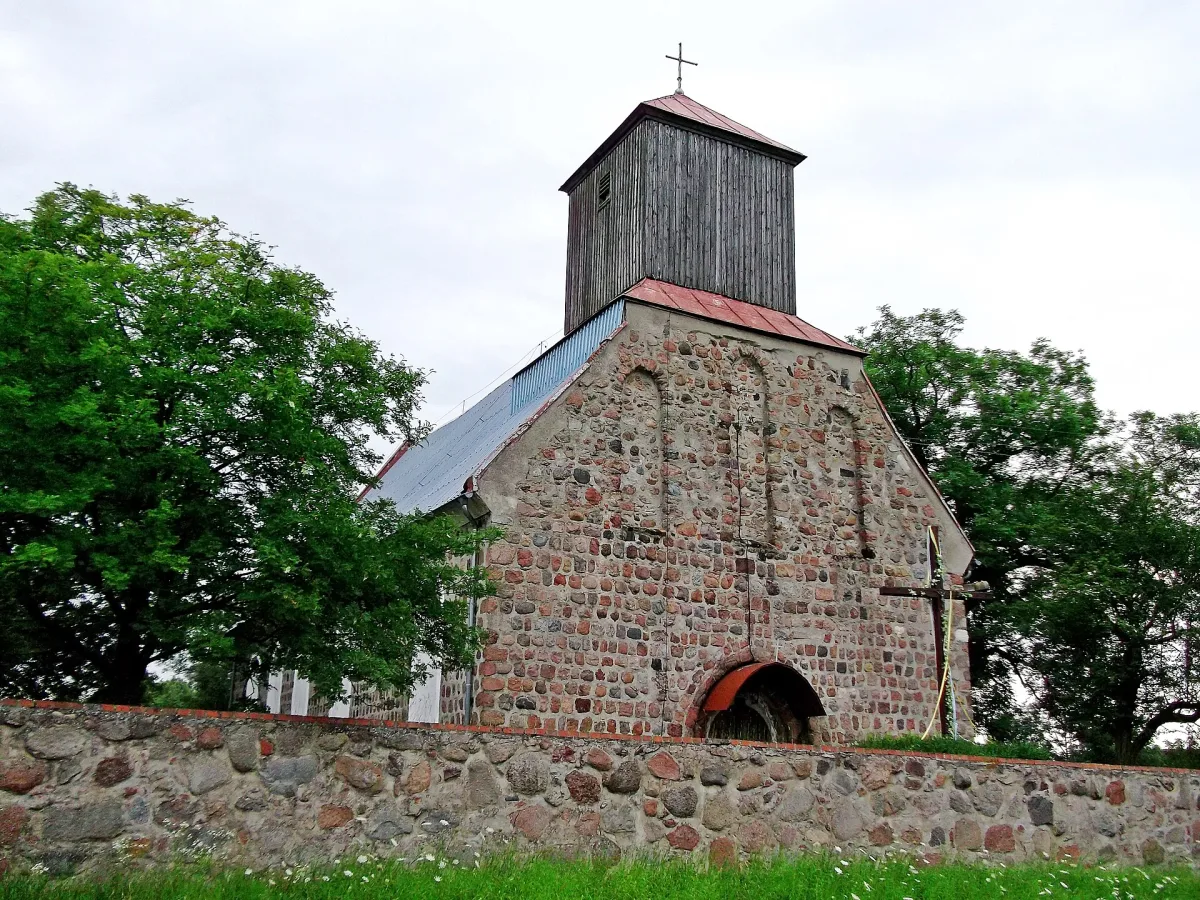
Stone church of the mid-13th century built by the Templars from Rurka, with a wooden tower and a chequerboard mark carved by a mason in the wall.
The church in Lubanowo was built in the mid-13th century of regularly dressed stone blocks. It was built by the Templars from Rurka, to whom the village belonged. Today it is the parish church in Banie municipality.
The church is a hall church on a rectangular plan measuring 26.3 by 9.5 metres, with a straight-ended chancel and a gable roof. Above the western part of the nave stands a wooden tower with a pavilion roof. The gable of the west elevation is decorated with three pointed blind arches, the middle one taller, and in the lower part of the elevation is a portal with three steps. A second such portal, plastered, is on the south side.
At the south-east corner, in the first and fifth courses above the plinth, a mason's chequerboard mark was carved in the ashlar. Beside it can be seen a walled-up narrow late Gothic window, probably a hagioscope, that is a window for the sick, or a piscina.
The interior is covered by a wooden beam ceiling. An 18th-century high altar and a 19th-century organ gallery have survived, and a bell of 1697 hangs in the tower. The church was rebuilt in the 18th century. After damage in the Second World War it was repaired and on 30 October 1948 blessed as a Catholic church. Adjoining the church is a former cemetery surrounded by a stone wall with a walled-up gate on the south side. On it stands a monument to the villagers who fell in the First World War, which is now the pedestal of a figure of Christ.
Within a few kilometres lie the church in Banie (about 4.6 km) and Lake Dłużec (about 5.6 km).

Be the first! Add a comment.
You need to log in to add a comment.
Log in