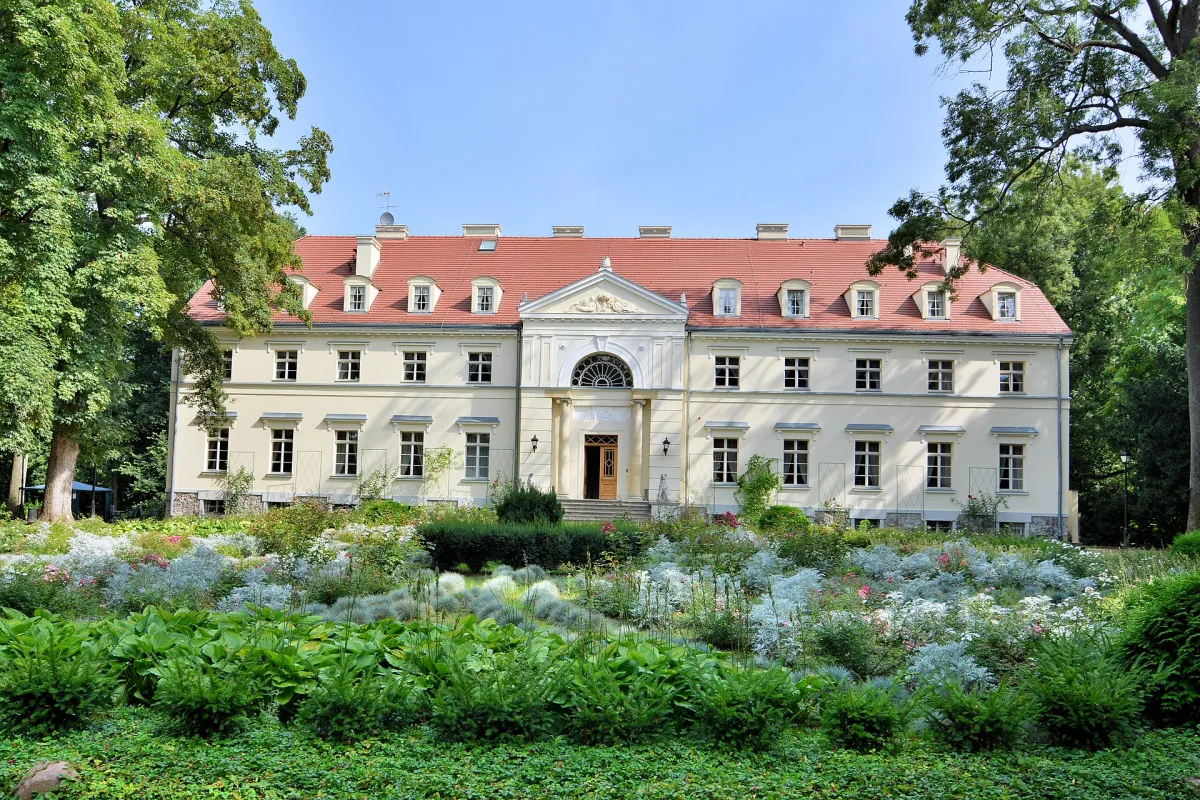
An arboretum by the palace in Przelewice with a collection of about 1,200 plant species, laid out in 1933-1938 on a former English park.
The Dendrological Garden in Przelewice is an arboretum by the palace in the municipality of Przelewice, in Pyrzyce County. The whole covers about 45 hectares, of which 30 ha, together with the palace, are intended for visitors. About 1,200 species of trees, shrubs and herbaceous plants grow here.
The sources give the dates of the beginnings differently. The garden's website gives 1805 as the start of the English-style park, which was laid out by August Heinrich von Borgstede, while the Wikipedia entry speaks of a palace park from about 1814, after the palace was built. Borgstede bought the estate in 1799, and the palace and park were created in his time.
In 1821 the estate was bought by Prince August of Prussia, and in 1825 Augusta Arend, the mother of his children, was ennobled and became the “Lady of Przelewice”. After her the park was reshaped by successive owners, and between the avenues for some time there were an asparagus farm, orchards and vegetable gardens.
The garden owes its present character to the years 1933-1938. The then owner Conrad von Borsig, co-owner of the firm August Borsig, transformed the park into a dendrological collection. The design was prepared, and the rebuilding supervised, by Karl Heydenreich of the Späth horticultural firm. This layout is under conservation protection, and the park was entered in the heritage register in 1976. About 22 ha of the part for visitors is precisely the pre-war part of the garden, and the rest was added after the war.
The symbol of the garden is the dove tree, whose flower found its way into the coat of arms of the municipality of Przelewice. This species, like several others growing here, appears in the World Red List of endangered and threatened plants. The collection also includes the tiger-tail spruce, Brewer's spruce and Wilson's spruce, the hairy maple, the Japanese white pine, bamboos, the Atlas cedar and the giant sequoia. Among the understorey plants are the American skunk cabbage, the Japanese butterbur and the winter aconite.
The most impressive tree is a pedunculate elm with a girth of 607 cm and a height of 31 m (measured in 2012). The mild climate means that many frost-sensitive plants grow here. On the area added after the war, along the boundary ditch, a rock garden was created in 2000-2003.
After the war the garden was administered by various institutions, including a state farm. In 1993 it passed to the municipality of Przelewice, and in April 2021 the farm complex together with the palace and garden was taken over by the self-government of the West Pomeranian Voivodeship. It is home to the institution Ogrody Przelewice, that is, a centre of rural culture and environmental education.
Right next to the garden stands the Palace in Przelewice, and about 500 m away the Church of Our Lady, Queen of Poland.

Be the first! Add a comment.
You need to log in to add a comment.
Log in