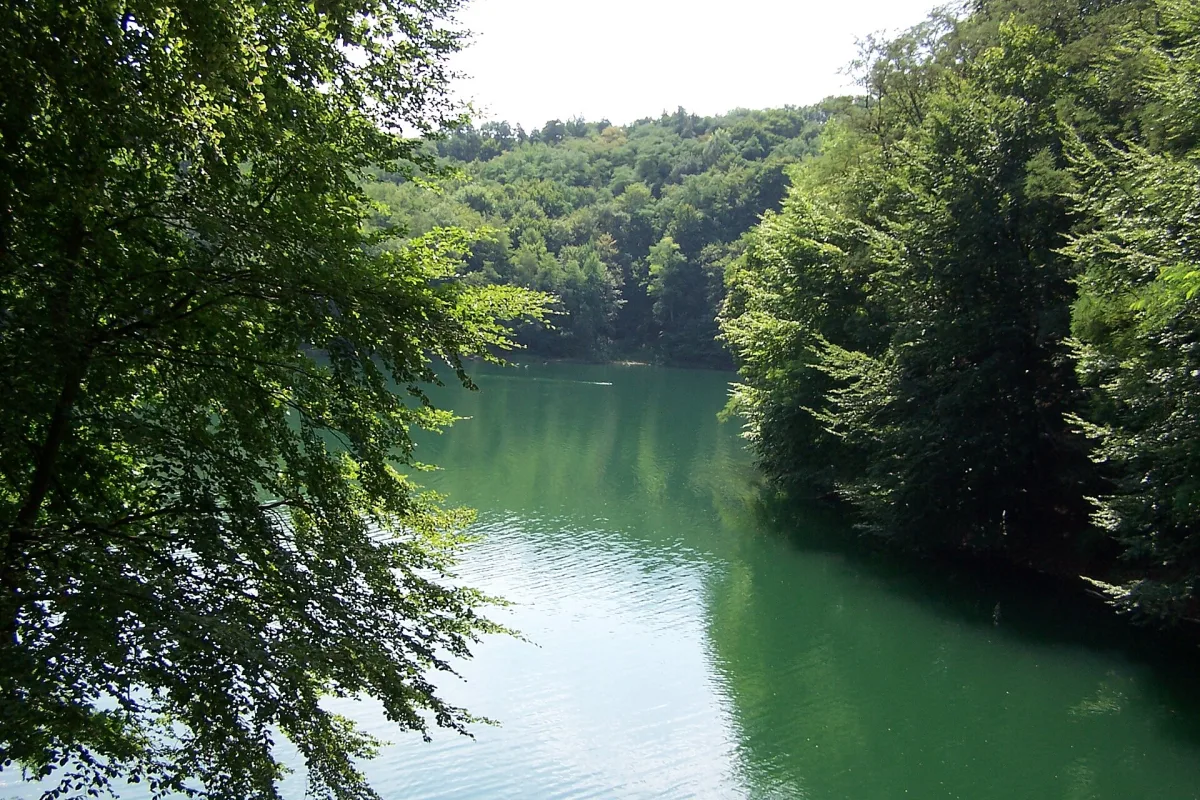
An artificial lake in the pit of a former chalk mine in Zdroje, flooded in 1925, in the Beech Forest, with viewpoints in the area.
Emerald Lake (Jezioro Szmaragdowe) is an artificial lake in Zdroje, Szczecin, in the Szczecin Landscape Park “Puszcza Bukowa”. It formed in the pit of a former chalk and marl mine, which was flooded with water in 1925. It owes its name to the emerald tint of the water, caused by the calcium carbonate it contains from the dissolving of calcite. Before 1945 it had the names Herta See and Kreide See.
In 1862 the Stern Portland cement factory was built next to it. Near the factory, industrial extraction began of a glacial raft of marl with a thickness of about 40-60 m. At first the raw material was extracted above the groundwater level; later the pit began to be deepened until it reached a depth of about 20 m relative to its surroundings. The extracted material was carted to the cement works, and the overburden was dumped on a spoil heap, today View Hill (Wzgórze Widok).
On 16 July 1925, in the southern wall of the pit, a layer of waterlogged sands was struck, through which water poured in violently. The flood came from beneath a high, vertical wall of marl. All the workers present at the time managed to save themselves. In 1959 another landslide occurred in the southern part, which reduced the area of the lake by about 0.4 ha. Remains of mining machinery still lie on the bed, and by the shore rises a concrete bridge, a relic of the track of the light railway that carried away the extracted material.
A local legend is linked with the flooding of the mine. From the beginning of the 14th century a greedy and spiteful spirit called Skarbek was said to haunt the mines, who over the years gathered enormous riches and hid them underground, at the foot of the southern cliff. When a miner's pickaxe uncovered this treasure, Skarbek flooded everything with water. This is a folk tale, not an established historical fact.
The reservoir has an area of 28,540 m², a length of 289 m, a width of up to 165 m and a depth of 18 m. The volume of water is 53,330 m³, and the water surface lies 42 m above sea level. Groundwater flows into the lake all the time, which can be seen when walking along the path right by the shore, and its excess drains into a small well by the viewing bridge. The steep walls of the former pit are still changing: new gullies, landslides and niches are forming.
Because of the high calcium carbonate content of the water, no intensive biological life has developed, and there are no reeds or rushes on the banks, so few waterbirds are seen here. The forests in the area grew up spontaneously after extraction ceased after 1925. Today Pomeranian beech forest predominates, with fragments of xerothermic oak wood. On sunlit slopes xerothermic plants grow, and in the forest woodpeckers, nuthatches, ravens, cuckoos and tits nest.
View Hill is 55 m above sea level and is one of the spoil heaps of the former mine. At its edge is a viewpoint called the Eye on Szczecin, and the area has been developed for visitors: there are shelters, benches and places for fires. The Czanowo Hills reach 94 m above sea level and give panoramas of Szczecin's left-bank part.
On the slopes there survive remains of military buildings from the 1930s or from the time of the Second World War, beneath which run tunnels with a total length of about 700 m. The Szczecin Exploration Society has opened part of the tunnels to visitors. In winter visiting is not possible, because bats hibernate in the tunnels.
Nearby there is also the artificial grotto “Za Łukami” of 1880, built on the initiative of the owner of the Stern cement works, and the ruins of the palace of the Toepffer family. From the Baresel viewing tower of 1904, which was about 30 m high, Goleniów and Stargard could be seen in good weather. The tower was destroyed in 1945, and today only faint remains of it survive on Polana Słoneczna (the Sunny Glade).

Be the first! Add a comment.
You need to log in to add a comment.
Log in