Lakes in West Pomerania: dozens of lakes, from Dąbie in Szczecin to Drawsko and Pile, with swimming spots, trails and islands.
This is a guide for travellers choosing a lake for a day by the water, a bike ride, a paddle or a quiet walk. It covers large lakes of the Pomeranian lakelands, lakes inside towns, coastal lakes cut off from the Baltic by sand spits, and water bodies in national parks. Access to the shore is free everywhere, and most of these places suit a solo walk.
Which lakes in West Pomerania should you see first?
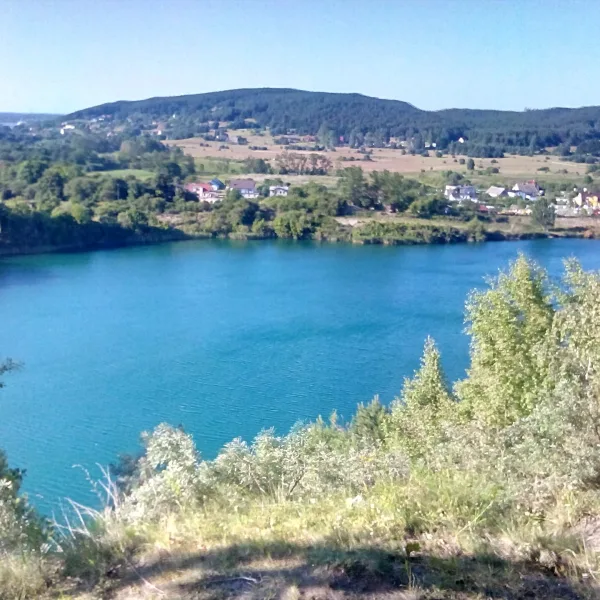
For a first trip, pick one of three places: Drawsko in the Drawsko Lakeland, Dąbie inside Szczecin itself, or Jezioro Szmaragdowe (Emerald Lake) in the Bukowa Forest. Each shows a different side of the region: a deep glacial lake, a spread of the Oder delta, and water in a former chalk pit.
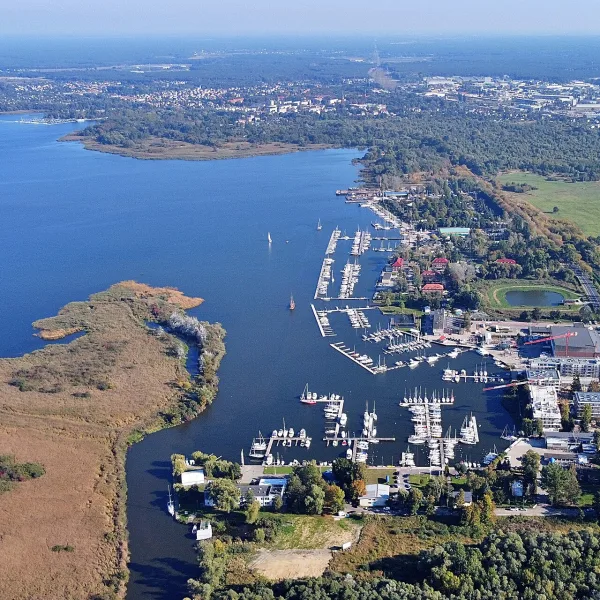
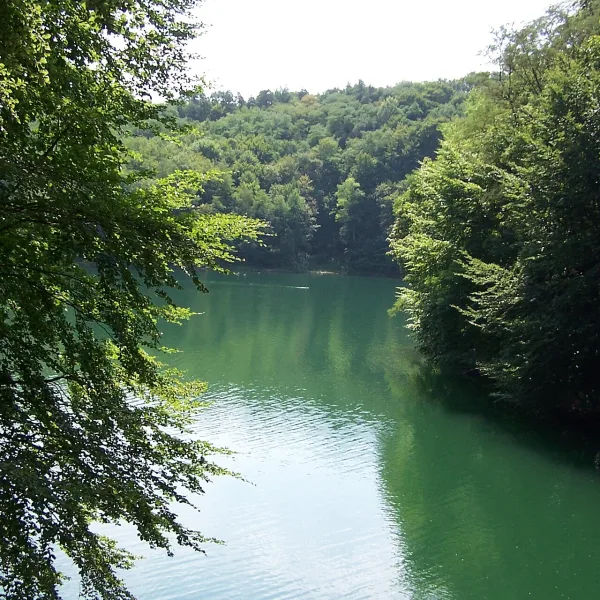
Drawsko is the second deepest lake in Poland after Hańcza, with twelve islands, beaches and sailing bases. Dąbie, a delta lake in the Lower Oder Valley, lies entirely within Szczecin and has a fairway for seagoing ships as well as marinas. Szmaragdowe in the Zdroje district formed when a chalk quarry was flooded in 1925, and there are viewpoints nearby. The story of the place is told in an article about how a chalk mine turned into a lake.
Which lakes are in Szczecin and close to the city?
Two lakes from this list lie within the Szczecin city limits: Dąbie and Szmaragdowe. Just beyond the city are more: Glinna Wielka and Jezioro Binowskie in the Stare Czarnowo municipality, inside the Bukowa Forest, and the Zalew Szczeciński (Szczecin Lagoon) with harbours at Trzebież, Stepnica and Nowe Warpno.
Dąbie divides into northern Dąbie Wielkie and southern Dąbie Małe, and the channels joining it to the Oder created a dozen or so islands. It suits sailors and anyone who likes walking along marina quays. Szmaragdowe is smaller and calmer, so it works for a short trip after work or a walk with a camera.
The Bukowa Forest by the water
Glinna Wielka covers 75.6 ha and lies on the southern edge of the Bukowa Forest. There is an old stronghold site by the lake, and trails cross in the Łużec clearing. Jezioro Binowskie, in the south-western part of the forest, has a beach, holiday centres and trails starting in Binowo. Both can be combined in one day because the distance between them is short and each is reached through the forest. If you like forest and water together, also look at the category Parki i przyroda (parks and nature).
The Szczecin Lagoon
The lagoon is a coastal lake of the Baltic crossed by the Polish-German border. The islands of Uznam and Wolin separate it from the sea, and three straits connect it to the Baltic. For a visitor it is above all a watery landscape: harbours, bathing places on the Polish shore and walking routes along the water.
What is there to see at the lakes of the Drawsko Lakeland?
The Drawsko Lakeland holds the largest group of lakes on this list: Drawsko, Jezioro Lubie, Jezioro Wielimie, Siecino, Wierzchowo and Chlewo. They differ in size, depth and surroundings, so it pays to match the lake to the plan for the day.
Lubie covers 1,487.5 ha and has beaches, holiday centres, a canoe route and a cycling route. Wielimie has the largest inland-lake island in Poland and a view across the water from the village of Gwda Wielka. Siecino, in the Złocieniec municipality, has two bathing places, a quiet zone, islands and a 38.9 km cycling route around the shore. Wierzchowo, in the Szczecinek municipality, has long sandy beaches, and the river Gwda, popular with canoeists, flows out of it. Chlewo is a lobelia lake near the village of Porost, in a Natura 2000 area, with a bathing place.
Four of these lakes are compared in the article Lubie, Ińsko, Wielimie and Woświn: four lakes, four characters, with sources and discrepancies in the data. Drawsko itself, its island Bielawa and its fishing tradition have a separate text: Lake Drawsko: Bielawa island, fishermen and pre-war motorboats.
Which lakes lie inside towns?
Many lakes in the region have shores inside towns, so you can visit them without planning an expedition. By Jezioro Nowogardzkie in the centre of Nowogard there is a park and medieval defensive walls from the 14th century. Golczewo has two lakes: Jezioro Szczucze with a bathing place, a walking pier and a promenade, and the shallow Jezioro Okonie with a birdwatching viewpoint.
Wałcz has four lakes in this guide, and two of them stand out. Raduń has the only suspension bridge over a lake in Poland, bathing places and a red trail to the Drawa National Park. Jezioro Zamkowe cuts into the town, has a sailing harbour and a shoreline of almost 11 km. All the lakes of Wałcz are gathered on the page Jeziora: Wałcz.
Barlinek, Myślibórz, Moryń, Ińsko and Biały Bór are further towns where the lake is part of the town. They are covered in the next section on the Myślibórz and Ińsko lakelands.
Which lakes to choose in the Myślibórz and Ińsko lakelands and nearby?
These are good directions for people who want to combine water with visits to small towns. Jezioro Myśliborskie is the largest lake of the Myślibórz Lakeland, about 600 ha, with two bathing places and sailing regattas. Morzycko in Moryń has a bathing place and a lake bed lying below sea level. The article Moryń: circular walls, Lake Morzycko and the Glacier Land Geopark on the Oder covers the town, its walls and the geopark.
Jezioro Ińsko covers 596 ha, lies in the Ińsko Landscape Park, and has an island nature reserve and a town bathing place. In the same park are Krzemień, next to the Krzemieńskie Źródliska reserve, and Jezioro Sierakowskie with a campsite on the western shore.
In Barlinek, Jezioro Barlineckie has a beach, a bathing place, four islands and a green trail around the lake. How the town connects with the lake and the chess player Emanuel Lasker is explained in Barlinek: the town of Emanuel Lasker, the lake and the Barlinek Landscape Park. The group also includes Bierzwnik, with an island and an old-growth reserve in the Bierzwnik Forests, and Jezioro Dominikowskie near Drawno, with a pier, a sandy beach and a camping field.
Which lakes lie by the Baltic and in the Wolin National Park?
Near the coast there are two kinds of water: coastal lakes cut off from the sea by a sand spit, and the lakes of Wolin. Jamno in the Mielno municipality is linked to the sea by a canal and has sailing harbours and tourist boat trips. Kopań, north-east of Darłowo, is shallow and slightly brackish, because during storms the sea flows into it through a channel. It is a bird breeding ground and a place for windsurfing.
On the island of Wolin there are three lakes worth knowing. Jezioro Turkusowe (Turquoise Lake) in the Wolin National Park formed in the pit of a former chalk mine and has blue-green water. Jezioro Czajcze is horseshoe-shaped, with a peninsula that once held a stronghold and a glacial boulder called Wydrzy Głaz. Wicko Wielkie is a former bay of the Szczecin Lagoon, mostly inside the national park, with the harbours of Lubin and Wapnica.
Lakes of the Gryfice Plain
Jezioro Kamienica near Dargocice has a bathing place, a campsite and a legend about a drowned town. Jezioro Kołomąckie near Gryfice has a beach, piers and camping cabins on the north-eastern part of the shore only.
Where is it quiet, and where can you sail or paddle?
The data on the lakes gives a few simple pointers. If you want quiet, go to Siecino with its quiet zone, or to Jezioro Hajka and Jezioro Rosnowskie, where petrol engines are banned in the season. Both are reservoirs on the river Radew, and Hajka has a historic hydroelectric plant from 1912.
For sailors there are Dąbie, Drawsko, Jamno and Jezioro Zamkowe in Wałcz with its harbour. Canoeists like to stop at Wierzchowo and on the Gwda, and at Dłużec, through which the Tywa flows. For lying on a beach, consider Lubie, Wierzchowo, Jezioro Szczucze, Jezioro Jeleńskie with a playground and a camping field, and Karwowo in the beech forest near Łobez.
Which lakes suit cycling, walking or birdwatching?
For cycling, Siecino works well with its route around the shore, and for walking, Jezioro Barlineckie with its green trail all the way round. At Jezioro Rosnowskie and Hajka you walk by the water next to a historic power plant. Birds are best watched at Okonie in Golczewo, where there is a birdwatching viewpoint, and at Kopań, a bird breeding ground.
Other lakes to consider are Pile, the largest lake of the Szczecinek Lakeland, on which Borne Sulinowo lies, and Bytyń Wielki, the largest lake of the Wałcz Lakeland, up to 41 m deep, in a nature reserve and with two stronghold sites. In Biały Bór the lake Łobez has a town beach and a walking and cycling path around it. Lubiatowo near Tuczno has a bathing place, a campsite and a nature reserve around it.
What else is there to see near the lakes?
Many lakes lie next to other places worth a stop. The region also has Wzgórza i szlaki (hills and trails), Punkty widokowe (viewpoints) and Plaże i wybrzeże (beaches and coast), which are easy to combine with a day by the water. When it rains, Muzea (museums) make a better plan, and with children check Dla dzieci. For an evening by the water away from crowds, Klimatyczne miejsca (atmospheric places) are also a good choice. If you are planning a day in the Bukowa Forest, see the list Jeziora: Stare Czarnowo.
Frequently asked questions
Which lake in West Pomerania is the largest?
Of the lakes described here, the largest water body is the Szczecin Lagoon, a Baltic lagoon covering several hundred square kilometres. Among inland lakes, the largest by area in Szczecin is Dąbie, at over fifty square kilometres. Drawsko is the second deepest in Poland.
Where are the lakes with bathing places?
Bathing places can be found at Siecino, Jezioro Ińsko, Jezioro Myśliborskie, Morzycko, Jezioro Barlineckie, Jezioro Szczucze, Karwowo, Lubiatowo and Jezioro Kamienica, among others. Before you travel, check whether the chosen place has an official bathing area in the season, because dates differ.
Which lakes are close to Szczecin?
The nearest are Dąbie and Jezioro Szmaragdowe, both within the city. A little further out are Glinna Wielka, Jezioro Binowskie and the Szczecin Lagoon with the harbour at Trzebież.
Which lakes are good for canoeing?
Wierzchowo is the source of the Gwda, a river loved by canoeists, and the Tywa, used for canoe trips, flows through Dłużec. Lubie has a canoe route and a cycling route. Before you set off, check conditions on the stretch you choose.
Are the lakes quiet?
Yes, if you choose the right place. Siecino has a quiet zone, and at Hajka and Jezioro Rosnowskie petrol engines are not allowed in the season.
Where can you see a lake with an unusual water colour?
Jezioro Szmaragdowe in Szczecin and Jezioro Turkusowe in the Wolin National Park both lie in former chalk pits. The first formed when the pit flooded in 1925, and the second has blue-green water.

 Lakes