Things to do in Dębno: three churches from different eras, a town hall in an eclectic villa and a Jewish cemetery from the 18th century.
Dębno is a town where churches play the main part, from brick of the mid-19th century to a church from the 1980s. On a walk you will also see the villa that now serves as the town hall.
Which church in Dębno should you see first?
Start with the Church of Saints Peter and Paul on Konstytucji 3 Maja Square, because it is a monumental three-aisled building. The other two churches stand in other parts of Dębno, so you can add them as time allows.
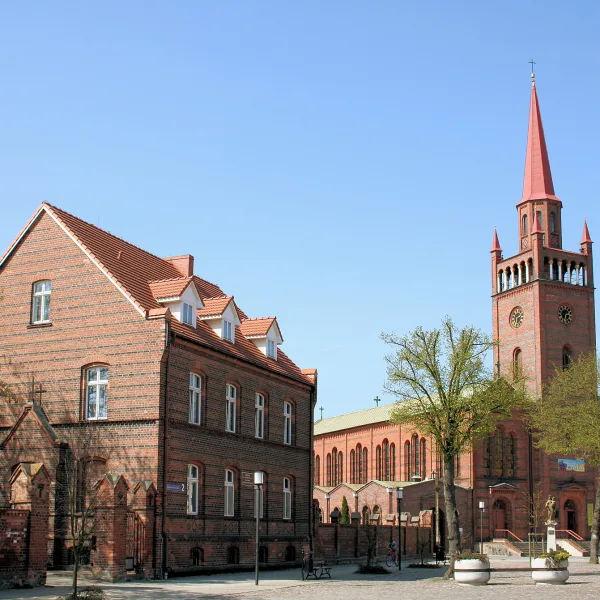
The Church of Saints Peter and Paul in Dębno is a three-aisled building of red and clinker brick, raised in 1852-1857 in the Rundbogenstil, the round-arch style. It was built as a Protestant church and since 1945 it has been a Catholic parish church run by the Salesians. The model was the Berlin church by Stüler, and the reason for building was the collapse of the tower of the earlier church in 1845.
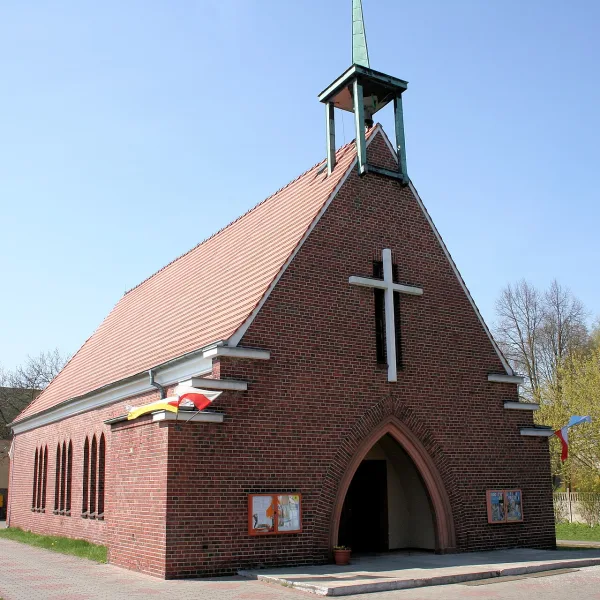
On Pułaskiego Street stands the Church of St Anthony, built in 1932-1933 of unplastered brick. The heritage register classes it as modernist, although Wikipedia describes it as neo-Gothic. It is now an auxiliary church, and its altar holds a wooden figure of the patron saint.
The youngest is the Church of Our Lady of Fatima on Harcerska Street, built from 1983 to 1994. Its foundation stone comes from the Grotto of the Annunciation in Nazareth. The parish took over the role of the former parish of St Anthony. The same churches are grouped on churches and monasteries in Dębno and cathedrals, churches, monasteries in Dębno.
What to see in Dębno besides the churches?
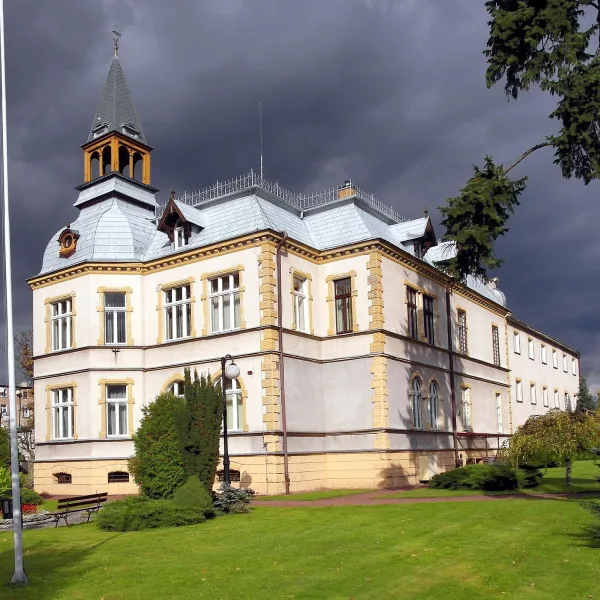
Besides the churches, see the town hall in Dębno (Neumann villa) at Piłsudskiego 5. It is an eclectic villa from 1905, entered in the heritage register, with a dome above the front projection. It was built by Kurt Neumann, son of the owner of the Dębno printing house.
The building stands on the former Friedrichstrasse, which linked the main street of the town with the road from the railway station. It is of plastered brick, one storey with an attic, and a polygonal dome crowns the form. It is a good stop for anyone who likes private architecture. Other buildings in a similar spirit are on the page architecture in Dębno, and solo trips on the page Dębno solo.
What to read about the small towns of the New March?
Dębno is one of the small towns of the former New March, so it is worth setting it beside its neighbours. The article Small towns of the New March describes the walls in Mieszkowice and Recz and the town halls in Lipiany, Dębno and Trzcińsko-Zdrój.
Is there a memorial site in Dębno?
It is the Jewish cemetery on Kostrzyńska Street. The account stays factual, since the site commemorates a former community and has nothing to do with leisure.
The Jewish cemetery in Dębno covered about 0.2 hectares. It is entered in the register of monuments and dated to the middle of the 18th century. During the Second World War the cemetery was devastated. It is now unfenced, and the only trace of it is a few remains of graves. There is no known plaque or lapidarium on the site.
Frequently asked questions
How many churches can you see in Dębno?
Three: Saints Peter and Paul (a former Protestant church of the mid-19th century), St Anthony from the 1930s and Our Lady of Fatima from the 1980s.
Where is the town hall in Dębno?
In the Neumann villa at Piłsudskiego 5, built in 1905. The building is entered in the heritage register.
Where does the foundation stone of the Church of Our Lady of Fatima come from?
From the Grotto of the Annunciation in Nazareth. The church was built from 1983 to 1994 on Harcerska Street.
Is the Jewish cemetery in Dębno fenced?
No, the site is unfenced and only a few traces of graves remain. It lies on Kostrzyńska Street.

 Churches and monasteries