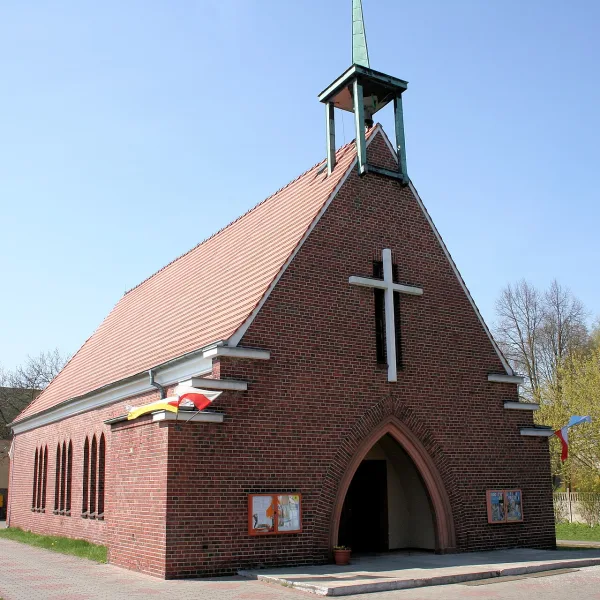
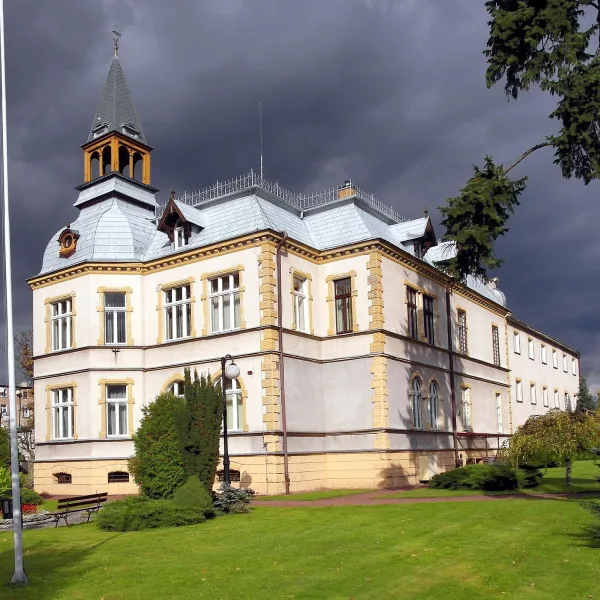
Architecture in Dębno: a brick church in the Rundbogenstil, an eclectic villa with a dome that serves as the town hall and a modernist church of St Anthony.
Dębno has no single historic market square, but it does have three buildings from different decades, from the mid-19th century to the 1930s. All stand in town and make a short itinerary for admirers of brick and local history. A fuller picture of the town comes from what to see in Dębno, and comparisons with other towns await under architecture across the region.
Which buildings in Dębno are the most interesting architecturally?
The grandest is the church on Plac Konstytucji 3 Maja, the most unusual is the town hall in a former manufacturer's villa, and the youngest is St Anthony's church.
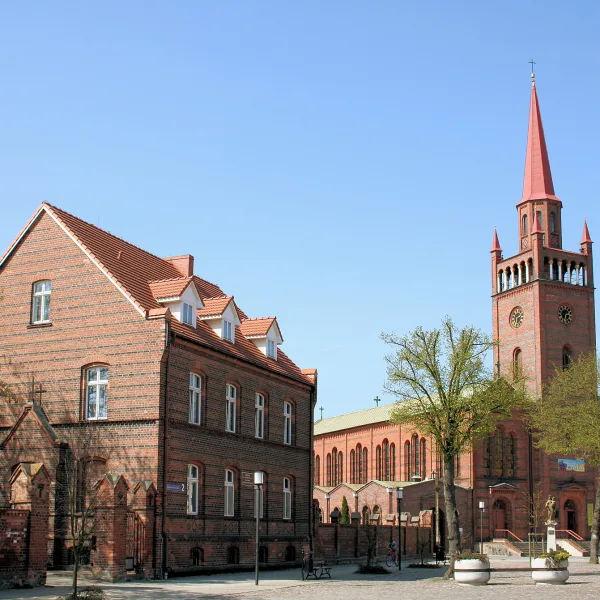
The Church of Saints Peter and Paul in Dębno has three naves and walls of red and clinker brick; it was raised in 1852-1857 in the round-arch style, after the pattern of Stüler's Berlin church. It began as a Protestant church. The Town Hall in Dębno (Neumann Villa) occupies an eclectic residence of 1905 at Piłsudskiego 5, with a dome rising over its front. Kurt Neumann, son of the local printing-house owner, had it built. The third building, St Anthony's Church in Dębno on Pułaskiego street, was built in 1932-1933 of bare brick; the register of monuments treats it as modernist.
Other small towns of the former New March are covered in Small towns of the New March: walls in Mieszkowice and Recz, town halls in Lipiany, Dębno and Trzcińsko-Zdrój, which is worth reading first.
Frequently asked questions
Where does Dębno keep its town hall?
In the Neumann Villa, Piłsudskiego 5. The eclectic house dates from 1905 and is listed as a monument.
Which church is the oldest in Dębno?
The one dedicated to Saints Peter and Paul, from 1852-1857. St Anthony's dates from 1932-1933.

 Churches and monasteries