
In the former Neumark (New March), south of Szczecin, lie several small towns that share a medieval origin and a modest scale. Some have kept their defensive walls, others only a trace of the old fortifications, and town halls and churches tell the rest of their history. This text brings together five such places: Mieszkowice, Recz, Lipiany, Dębno and Trzcińsko-Zdrój.
Mieszkowice: a ring of walls and a grid layout
According to Wikipedia, Mieszkowice received its town charter in 1295, and in 1300-1320 the town was surrounded by a defensive wall. The heritage register, cited in the same article, describes the fortifications as built in the 13th-16th century and states that the ring of walls has survived in full, is 5-7 metres high, and that of the gates only the 15th-century Gunpowder Tower survives. Wikipedia writes that both gates were demolished in 1870 and 1872, when the town began to grow beyond its medieval boundaries after the opening of the railway station.
The Gunpowder Tower stands in the south-eastern corner of the walls and, according to the heritage register, is the only remnant of the gates. The layout of the town is, according to Wikipedia, a medieval parallel layout, with streets crossing at right angles. The centre is marked by the market square, beside which stands the Church of the Transfiguration from the end of the 13th century, built first of cut granite and later extended. In 1937 a second, smaller Church of the Holy Spirit was built for the small Catholic community, known colloquially as the church beyond the tracks.
Recz: stone walls and towers
According to Wikipedia, Recz has the layout of an oval-shaped medieval town and is mostly encircled by a fieldstone wall from the 14th-15th century. The walls had four gates and two water postern gates. The outline of the fortifications has survived, as the heritage register cited in the article states, along the whole perimeter of the former town. Among the towers, Wikipedia mentions the Choszczno Tower, also called the Mill Tower, from the 14th century, and the Drawa Tower, that is, the stone gate from the 16th century, 15 metres high. Today it serves as a viewing point.
Wikipedia states that in 1945 a tank battle took place in the town and Recz was destroyed by about 70 per cent. In the town stands the Church of Christ the King, a brick hall church from 1352-1355 with an altar from the early 17th century. The article on the town adds that the Marchian road, called the Cistercian route, ran through Recz, and that a convent of Cistercian nuns was brought here in 1296.
Lipiany: an ellipse between the lakes
Lipiany lies between two lakes which, according to Wikipedia, formed at the beginning of the 19th century after the water level of one larger body of water was artificially lowered. The Old Town has a late medieval layout based on an ellipse with a centrally placed market square, and its whole area is entered in the heritage register. Of the fortifications, two Gothic gates from the early 15th century remain, the Pyrzyce Gate and the Myślibórz Gate, along with remnants of the walls on the north-eastern side.
The market square is today Plac Wolności, which five streets lead into. Around it stand small Classicist or half-timbered townhouses, and the buildings around the square survived 1945 almost entirely. In the middle stands the town hall. The most important church is the Church of the Assumption of the Blessed Virgin Mary. Wikipedia dates it to the 13th century, but after rebuilding in the 19th century only fragments of the chancel walls remain of the original structure.
Dębno: a town without walls
Dębno had no walls: according to Wikipedia the settlement was surrounded by ramparts and a moat, but without defensive walls. Originally it was a village with an oval-street layout and an elliptical square in the centre, belonging to the Templars and then to the Hospitallers. In 1850 the town moat was tidied up and a promenade was laid out along it. The date of the grant of town rights is disputed: Wikipedia lists the years 1540, about 1562 and 1570, and 1570 is taken as the official one.
The war of 1945 brought destruction reaching, according to Wikipedia, 35 per cent of the buildings, and after the destruction of Chojna the county authorities moved to Dębno. The most important church is the Church of Saints Peter and Paul, built in 1852-1857 in the round-arch style after the tower of the old 13th-century church collapsed in 1845. The town authorities sit in Neumann's villa, which was not built as a town hall.
Trzcińsko-Zdrój: towers and gates
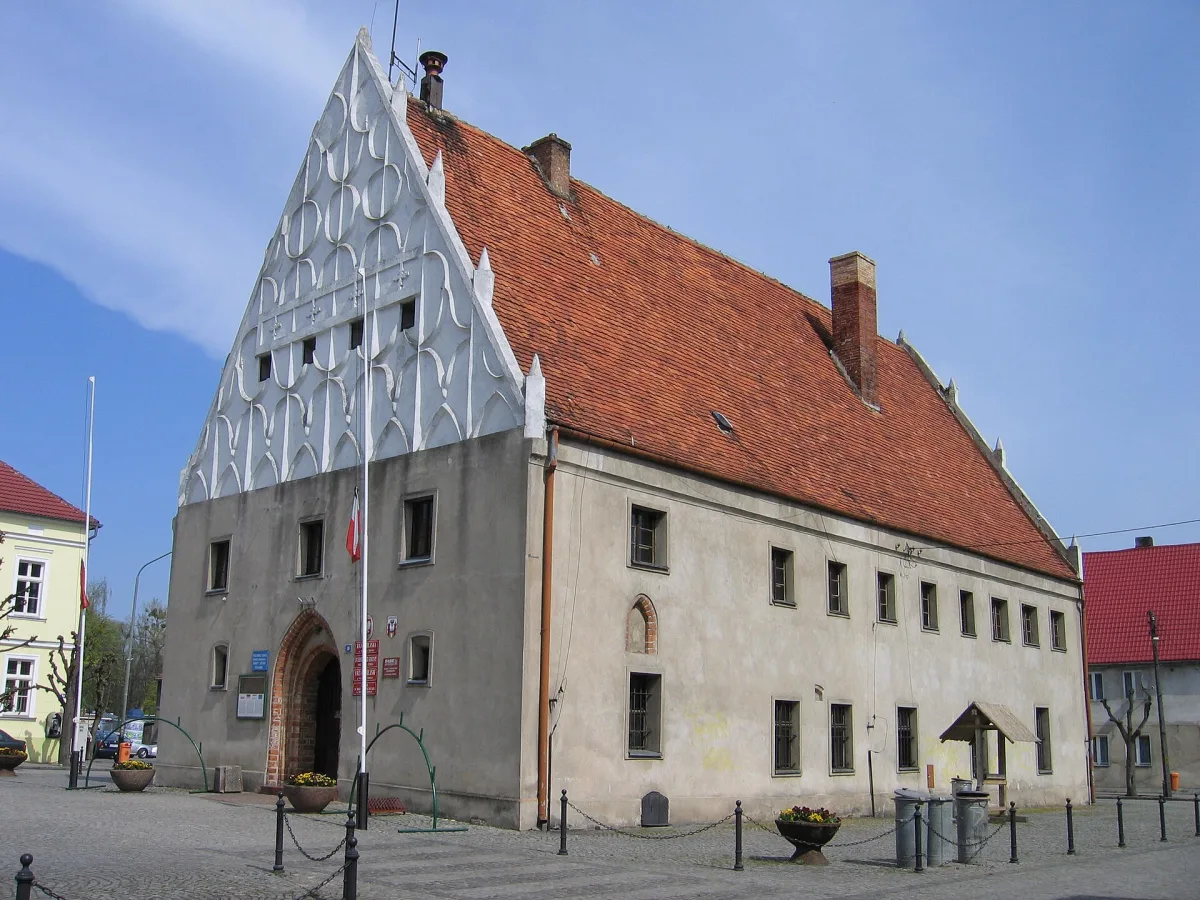
According to Wikipedia its walls date from the early 14th century, the late 15th century and the late 19th century, and include 25 towers and two gates. The Myślibórz Gate was built in the early 14th century and was raised in brick, and the same article mentions the extension of the gate systems around 1483. Among the towers, Wikipedia names, among others, the Gunpowder Tower, the Stork Tower and the Bindas Tower. In the market square stands the town hall, a combination of two former buildings with a Gothic portal.
What sets them apart
Mieszkowice and Recz still have walls along the whole perimeter of the former town, in Lipiany two gates and a fragment of the walls remain, and in Trzcińsko the towers and gates form the largest set according to Wikipedia. Dębno was bounded by ramparts and a moat, not walls. The history after 1945 is shared: Recz lost about 70 per cent of its buildings, Dębno 35, Mieszkowice about 30, and Lipiany only 39 buildings. That is why these towns are read today first by the layout of their streets and squares, and only then by their walls.


Be the first! Add a comment.
You need to log in to add a comment.
Log in