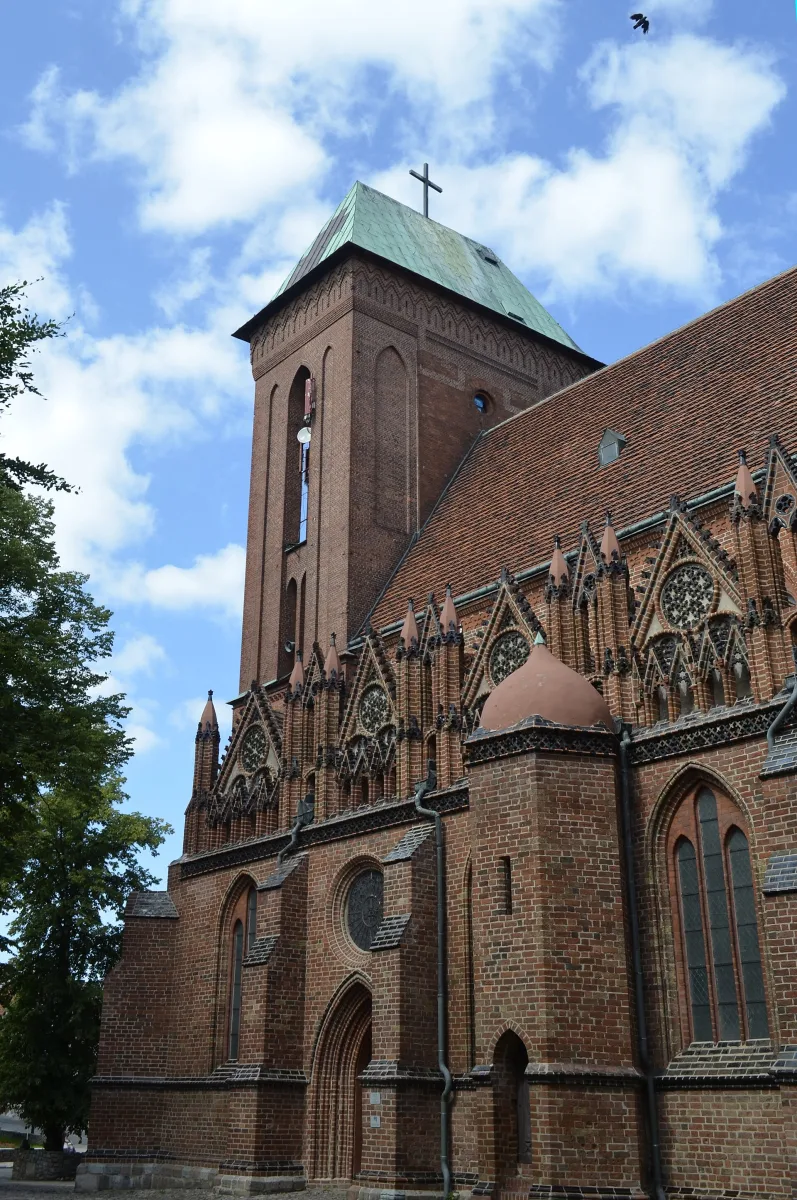
A Romanesque-Gothic brick basilica, the former cathedral of the Kamień bishopric, a Historic Monument, with a Baroque organ from 1669.
The Cathedral of St John the Baptist in Kamień Pomorski is a brick Romanesque-Gothic basilica, the former cathedral of the Kamień bishopric and today the co-cathedral of the Szczecin-Kamień archdiocese. Together with the neighbouring buildings it has been recognised as a Historic Monument (pomnik historii). Wikipedia calls it the oldest sacred building in West Pomerania. Since 1964 an organ music festival has been held at it.
After the Christianising mission of St Otto of Bamberg in 1124, a wooden church of St John the Baptist was built in the settlement outside the stronghold. In 1176 Duke Casimir I founded a cathedral on its site, and the construction was linked with moving the seat of the Pomeranian bishops from Wolin. Work probably began in 1172-1176 using granite ashlar, and was then continued in brick. Originally the church was a Romanesque basilica on a Latin cross plan, with a transept, a choir and a semicircular apse.
The second stage of construction brought the Gothic nave. Work was finished in 1370, and the church was completed at the end of the 15th century. The vault is supported by twelve pillars, which symbolise the twelve apostles. The two side aisles differ from each other: the southern one is wider and has a star vault, the northern one is narrower and has a cross-ribbed vault.
After the death of the last Catholic bishop in 1544 the cathedral passed into Protestant hands. It was a Lutheran and then an Evangelical Union church until 1945, although it kept its cathedral rank. After the war it returned to the Catholic Church, and in 1972, after the creation of the Szczecin-Kamień diocese, it became a co-cathedral. It is dominated by a neo-Gothic tower block, which was given its present form in 1934.
According to findings from 2021, the cathedral has the oldest surviving roof truss in Poland. The structure dates from the 13th century, although some elements were replaced over the centuries. Medieval carpenters' marks have survived, and the oak was brought from the island of Wolin. Wood samples point to felling in 1260-1268, and in another place in 1360-1361. The timber from the roof over the chancel may be even older.
In the chancel stands a late Gothic triptych from the end of the 15th or the beginning of the 16th century, with the Assumption of the Virgin Mary in the central part. On the north wall of the chancel hang two paintings from 1527 from the workshop of Lucas Cranach the Elder: “The Way to Calvary” and “The Crucifixion”. The pulpit from 1682 is richly decorated. The north portal from the 12th century is the oldest, and the south portal dates from 1230-1250.
Since 2010 the church has been a sanctuary. It is known for the image of the Crucified Lord Jesus and Our Lady of Sorrows from Brzozdowice, which was brought by repatriates from Lviv.
The Baroque organ was funded in 1669 by the last titular bishop of Kamień, Duke Ernest Bogislaw de Croÿ. Since 1964 organists from all over the world have given concerts on it as part of the Organ and Chamber Music Festival, organised by the H. Wieniawski Music Society. The parish also accepts bookings for organ presentations for groups from Monday to Friday.
On the north side a cloister garth with cloister walks adjoins the body of the church. The parish website calls it the only cathedral cloister garth in Poland. After 1310 the cloister walks on the north side were built, and in 1848-1850 their restoration began, but the south wing was not rebuilt.
The cathedral lies in the town centre, next to the Bishop's Palace. Right next to it is the Museum of the History of the Kamień Land.
About 200 metres further on stands the town hall, and nearby the Church of the Assumption of the Blessed Virgin Mary.

Be the first! Add a comment.
You need to log in to add a comment.
Log in