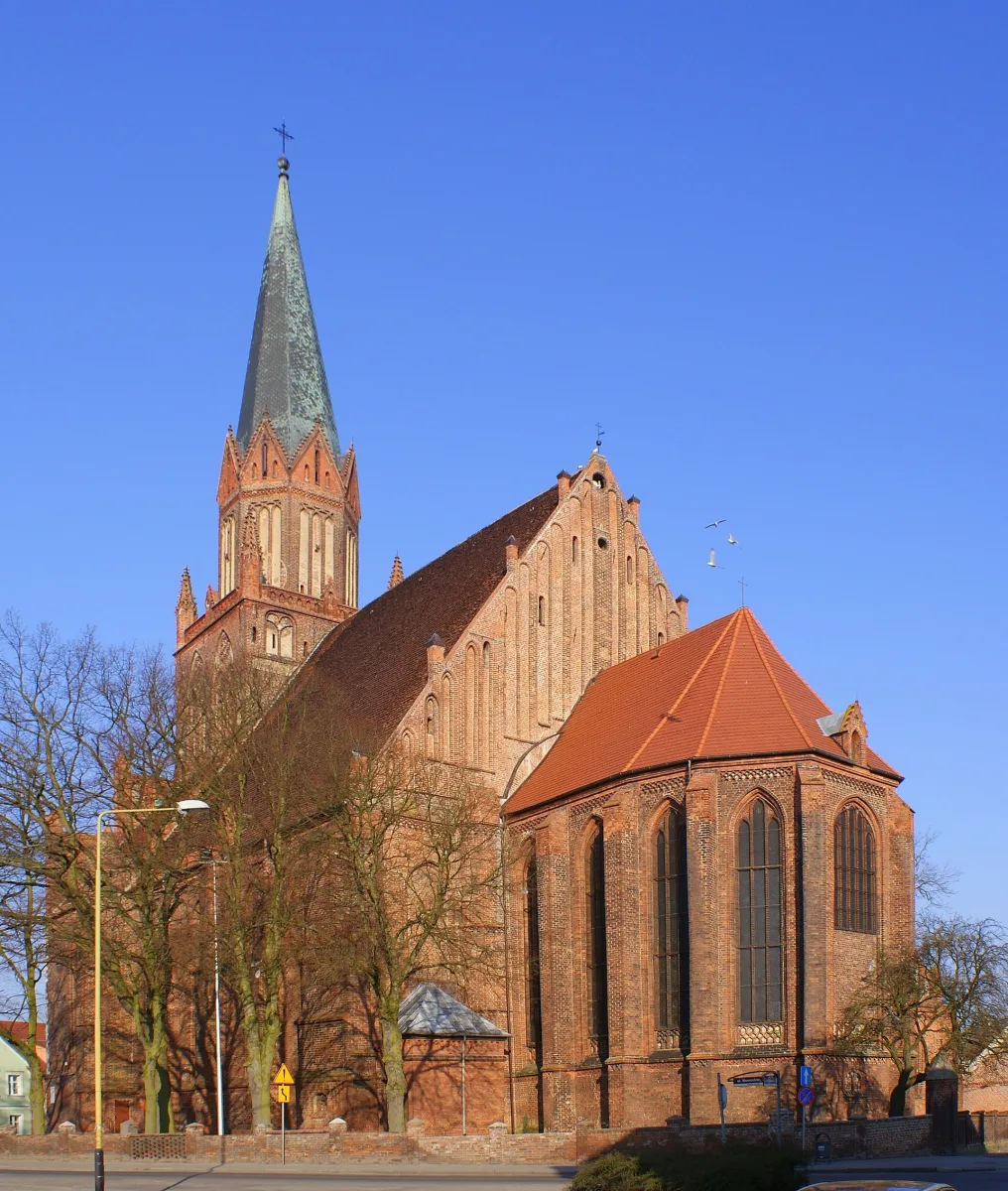
A Gothic hall parish church of the 14th-15th centuries with a 90-metre tower, a bell of 1399 and Neo-Gothic furnishings, today a Marian shrine.
The Church of the Motherhood of the Blessed Virgin Mary, known as St Mary's, is a Gothic hall church with a tower 90 metres high. It is also the Archdiocesan Marian Shrine of Our Lady of Trzebiatów.
The founding of Trzebiatów dates from 1277. The first church in the town was, according to the National Heritage Board of Poland study, probably built on the site of the former pre-charter settlement, and in 1285 Norbertine nuns were brought to Trzebiatów, who took over the church then being built and added a convent. Construction of the present Gothic parish church began around 1328: in the first half of the 14th century the chancel was built, in the second half the nave, and in the 15th century the tower massif and somewhat later the sacristy. A Latin school operated at the church from 1328, in which in the 16th century Johannes Bugenhagen was rector.
In 1534 the Diet in Trzebiatów resolved to adopt the Reformation in the Duchy of Pomerania, and the church became Protestant. As early as 1857 the architect Friedrich August Stüler described the poor condition of the church and recommended renovation, and in 1865-1867 the church was rebuilt and re-Gothicised. After the Second World War the church returned to the Catholics and became a Marian shrine, and the decree granting it this status was announced on 7 October 1996.
The church is oriented, Gothic, built of brick. It has a three-aisled, four-bay hall with a chancel closed on three sides and a tower body on the west equal in width to the nave. The total length of the church is 72 metres and the width about 28 metres. The elevations are buttressed and decorated with ceramic recessed friezes with a quatrefoil motif, and at the corner of the body stands an octagonal stair turret.
The tower is 90 metres high and is crowned with a gilded cross. In 1784 a new crowning was built for it, and during the rebuilding of 1865-1867 pinnacles in the Neo-Gothic style were added. Three bells hang in the tower, two of which are Gothic: the smallest bears the year 1399 and is among the oldest in Poland, and the bell “Maria” of 1515 was cast by the Stargard bell founder Lütke Rose.
The interior is a hall, with octagonal pillars and star vaults. On the chancel arch a Gothic painting with busts of Old Testament prophets has survived, restored in the 19th century. In 1986 images of Polish saints were added here.
Most of the furnishings are Neo-Gothic, from the time of the restoration in 1865-1867. The high altar and the pulpit were made of artificial stone to a design by Konrad Kruhl, and in the altar hangs a painting of Mary with the Child by Ernst Deger of Düsseldorf, venerated as an image of Our Lady of Grace and crowned in 2006. The stained glass in the chancel of 1867 was made by the Berlin firm of Louis Müller to a design by the conservator Ferdinand von Quast, and the central one was donated by King William I.
The organ was built in 1842 by Friedrich Schulze, and in 1865-1867 it was rebuilt by Barnim Grüneberg of Szczecin. According to the Wikipedia entry, on 29 May 1842 Haydn's oratorio “The Creation” was performed on it under the direction of Carl Loewe. Stone tomb slabs have also survived, including the Gothic one of Arnold Krampehl from 1382, three wooden Baroque epitaphs and the cheeks of Renaissance choir stalls. The sculpture “Our Lady of Sorrows” from the first quarter of the 15th century, which comes from this church, is today displayed in the National Museum in Szczecin.

Be the first! Add a comment.
You need to log in to add a comment.
Log in