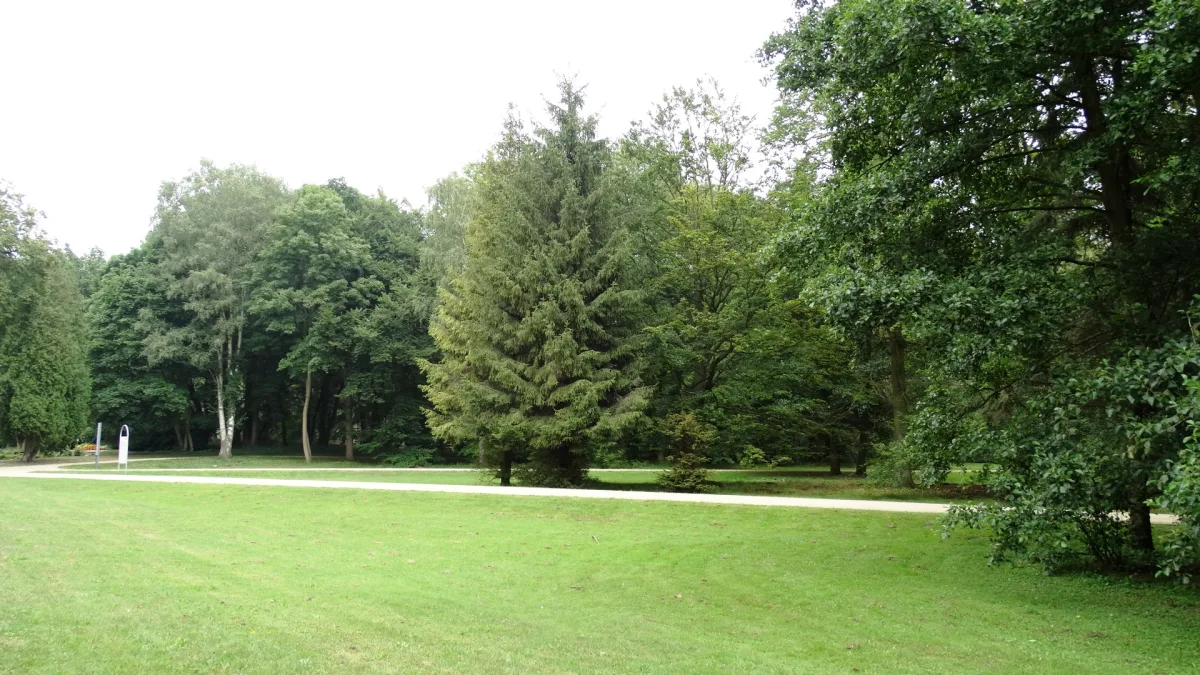
A historic spa park from the 1820s, associated with a design by Peter Joseph Lenné, with avenues, sculptures and old trees.
The Spa Park in Świnoujście is a historic landscape park on the eastern edge of Uznam (Usedom) island, designed in the 1820s as the grounds of the emerging spa. About 60 species and varieties of trees grow in it, and its designer was, according to the sources, Peter Joseph Lenné, the famous Prussian gardener.
The site of today's park was an extensive shoal. Hydraulic engineering works on the regulation of the Świna and the building of the port, carried out from 1721, turned it into new land strengthened with plantings of grasses, shrubs and trees. On maps from the turn of the 18th and 19th centuries the area was called Plantage.
A new stage came after the decision to create a seaside bathing resort. The first season was opened in 1824, and in 1825-1826 the Spa House was built near the harbour quay. The design of the park was entrusted to Peter Joseph Lenné: the artist came to Świnoujście in June 1826, and in 1827 he sent from Sanssouci about one and a half thousand tree and shrub seedlings. The original drawing of the design has been lost, but correspondence with the town has survived, and the layout of the paths, the main axes, the squares and roundabouts and the water system convince researchers of Lenné's authorship.
Work was halted by the town's financial difficulties, and after 1851 the extent of the park to the east was limited by the building of fortification works on the western side of the mouth of the Świna. At the turn of the 19th and 20th centuries a promenade was laid out and a new Spa House was built, and the Berlin building councillor Mächtig changed the layout of the park: he laid out a network of narrow, winding paths and places for pavilions, kiosks, a fountain with spring water and a shooting ground. In the interwar period the park was enlarged by the Western Spa Park, which is closed off by Matejki Street.
In 1945, after the air raids on Świnoujście of 12 March, the park was devastated, and the Spa House burned down. Clearing and new plantings were carried out in 1958-1959 and in the 1970s. A thorough restoration took place in 2002-2012: it enriched the landscape values and equipped the park with playgrounds for children, pavilions, monuments and fountains.
The area of the park is given in different ways. The Wikipedia entry on the park itself gives 58 ha, the entry on the town of Świnoujście 40 ha, and a study by the National Heritage Board of Poland about 60 ha, reached gradually by the 1920s. The differences may result from whether only the historic core is counted, or also the later extensions.
The tree stand is dominated by European beeches, pedunculate and sessile oaks, European ashes, horse chestnuts, sycamore maples, black alders and field elms. Among the rarer trees are yews, Nikko fir, Crimean lime, Caucasian wingnut and ornamental varieties such as weeping beeches. The oldest specimens have survived in the western part of the park, and many of them have reached the characteristics of natural monuments.
In the western part the layout of the avenues is star-shaped, enriched by curved paths. The natural monuments are a pine with ivy called “Rodzina” (the Family) by Matejki Street and the elms called “Przemytnicy” (the Smugglers) on the Jachtowa Street side. The park is decorated with numerous sculptures, and according to the entry on the town it has 17 kilometres of avenues and paths.
Marked trails run along the northern, eastern and southern edges of the park: the red E9 Coastal Trail and the blue EV10 Baltic Sea Cycle Route.

Be the first! Add a comment.
You need to log in to add a comment.
Log in