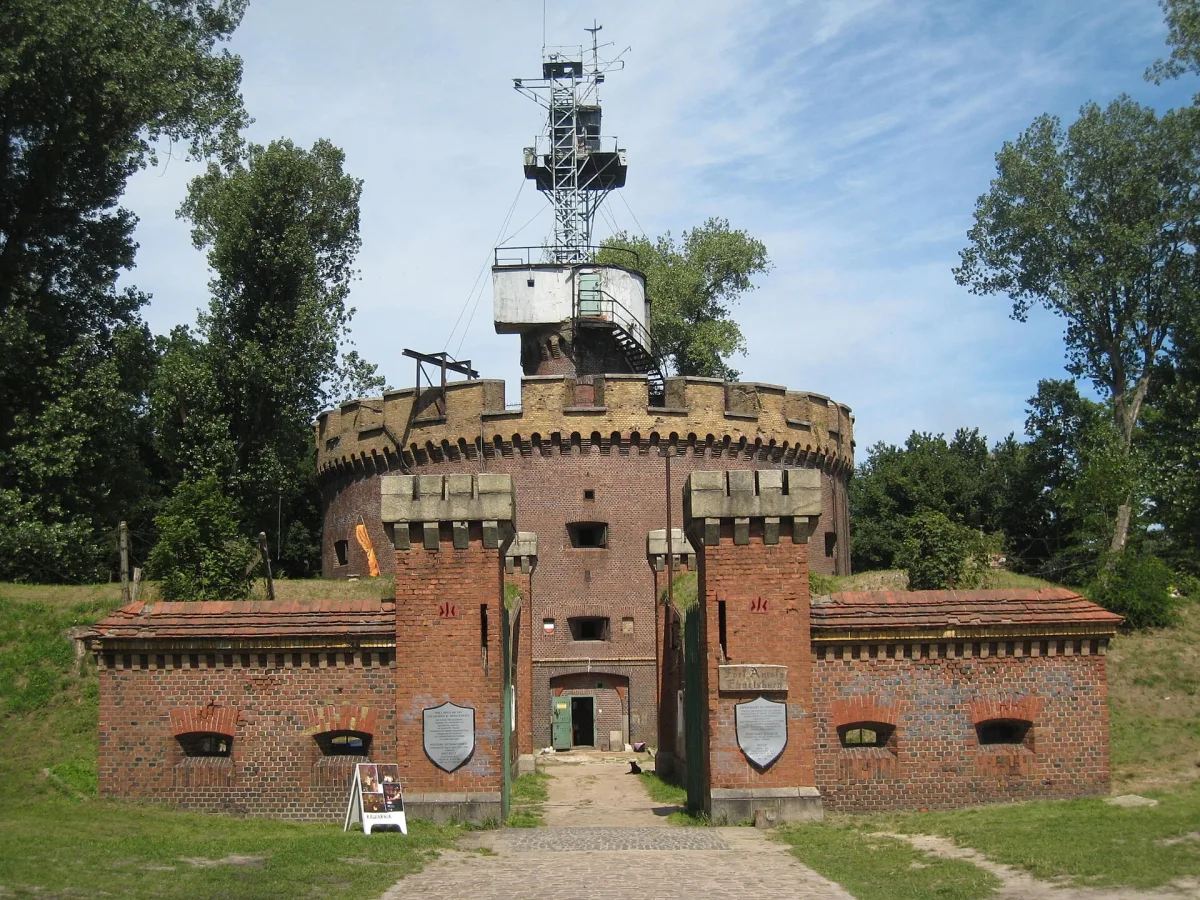
A Prussian fort from 1854-1858 in the form of a three-storey rotunda, today a museum of military architecture and a cultural venue with exhibitions and a cafe.
The Angel Fort in Świnoujście is a Prussian fort from 1854-1858, also called Fort III or the Tower Fort: a three-storey brick rotunda with a terrace and an observation tower, surrounded by ramparts and a moat. It stands on Jachtowa Street, on the western bank of the Świna. Today it houses a museum of military architecture and a cultural venue with exhibitions, a cafe and a Vikings' hall.
The fort was built during the reign of the Prussian king Frederick William IV as an artillery and observation point of the Świnoujście Fortress, which was made up of four forts. It was meant to defend the western complex of fortifications from the land side. The ground floor was manned by infantry with small arms, and the upper floors served light field artillery. Guns and ammunition were hauled up by ropes through oval openings in the ceilings.
By 1863 the fort had been surrounded by earth ramparts with a double water-filled moat. In 1870-1880 three shelters for field guns, a small ammunition store and a gunners' shelter were built into the inner rampart. At the end of the 19th century a telegraph and electric power were installed. The garrison was a company of infantrymen and artillerymen, about 100 men. The entries on the fort do not say why it was called the Angel, so we do not settle the question.
In the interwar period the fort came under the German navy and was adapted for chemical warfare: gas-tight armoured doors and window covers were fitted. A position for an anti-aircraft radio station was set up on the tower. During the Second World War the fort was rebuilt and equipped with electricity, central heating, radar, radio stations, telegraph and telephone, and the site served as an air observation post. In May 1945 the garrison evacuated without a fight. After the war the fort was taken over by the Russians, who had an air observation and communication point with the ships of the Soviet fleet here until 1992.
The fort's website says that you can meet the history of three eras here: Prussian, German and Soviet. Outside there survive a defensive gate with loopholes, in whose pillars you can see steel wheels for raising the drawbridge, artillery sheds, a small store and a gunners' shelter. At the entrance stand two pairs of armoured doors from the interwar period, and on the staircase there are stone spiral steps and the oval openings of the former ammunition lift.
The interiors hold exhibitions devoted to defence, contemporary painting, photography and sculpture. The site's website lists a Vikings' Hall, a navigation room, an amber mine, a cafe and a terrace. The fort hosts concerts, poetry evenings, knightly fighting shows, feasts and bonfires. At present the site is undergoing renovation.
The other forts of the fortress lie in the area: about 400 metres away stands the Western Fort, and less than a kilometre in the other direction the Gerhard Fort. The route can be extended to the lighthouse, roughly 700 metres away.

Be the first! Add a comment.
You need to log in to add a comment.
Log in