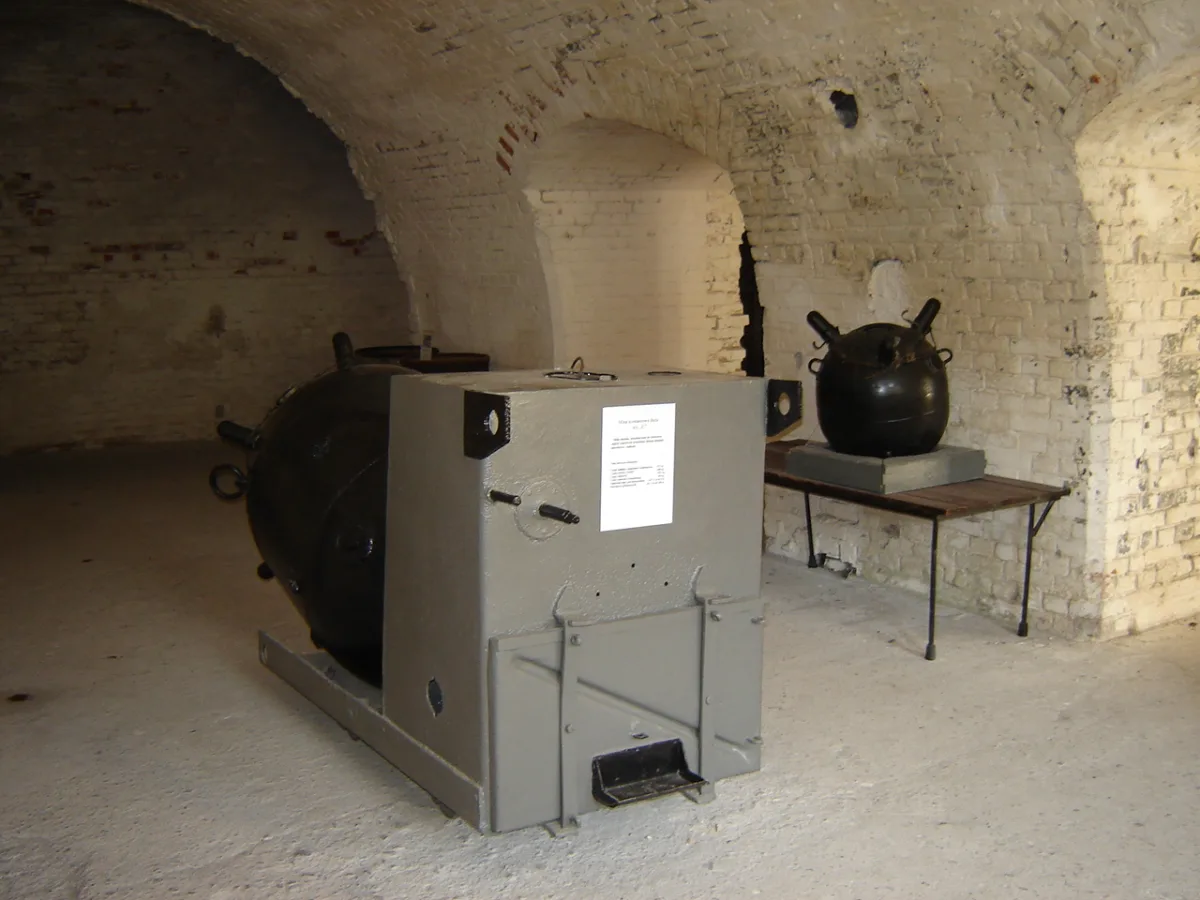
A Prussian coastal fort from 1856-1861 at the mouth of the Świna, home to the Fortress History Museum, with underground casemates and shelters.
The Western Fort in Świnoujście, formerly the Westbatterie, is a coastal fort of the Prussian Świnoujście Fortress from 1856-1861, built to defend the port against hostile ships. It stands on Jachtowa Street, in a wooded area near the mouth of the Świna. In its oldest part, a square redoubt, the Fortress History Museum operates.
The fort began as a small artillery redoubt on a square plan. By 1863 it had been reinforced with masonry wings and surrounded by an earth rampart and a moat. In 1878-1887 it was extended into a heavy fortified coastal battery with an artillery terrace and underground casemates. The Wikipedia entry says that until the early 20th century it was manned by about 300 infantrymen and artillerymen, and that in its original form it was called Batterie A. It was one of four fortress works at the mouth of the Świna that made up the Świnoujście Fortress.
During the First World War a battery of four heavy 210 mm coastal guns was stationed here, later dismantled under the provisions of the Treaty of Versailles. For the interwar period the Wikipedia entry gives a battery of four 150 mm guns, and the museum's website says that such a battery was stationed in the fort during the Second World War and came under the Kriegsmarine Artillery School. In 1941 a concrete command bunker was built on the west wing.
In 1939-1945 the fort bore the name Fort Henningsen. It was given in honour of Wilhelm Henningsen, who had earlier served in the fort and was killed on 1 September 1939 during the attack on Westerplatte. The museum gives the date of the naming as 1940, and the Wikipedia entry as 1939. A plaque commemorating him hung on the gate. The fort is not the same site as the Vineta battery complex, located a few kilometres away.
After 1945 the fort was occupied by the Russians, who built three concrete bunkers for 127 mm coastal guns in the centre and at both ends of the fort. In 1962 the site was handed to the city. In the 1970s vegetable and fruit stores were set up in the underground casemates, which caused further damage. In 2001 the fort was leased by the Fort Enthusiasts' Association “Reduta”. It has been open to visitors since June 2004, and since 2008, after a change of leaseholder, the officially registered Fortress History Museum has operated here. Many of the exhibits were found in the area of the fort or in the fort itself.
There survive a defensive gate with loopholes, to which a causeway once led, the square redoubt, an underground corridor with halls of the former ammunition chambers and round openings of the ammunition lifts, and artillery sheds from the second half of the 19th century. There are also the concrete command shelter of the Henningsen battery with staff rooms and an optical rangefinder position, and an artillery gallery with positions for heavy guns. The central gun emplacement has survived in its original state, and in the centre and on the left wing stand Russian gun shelters.
About 400 metres away stands the Angel Fort, and less than a kilometre from here the Gerhard Fort. It is about 700 metres to the lighthouse.

Be the first! Add a comment.
You need to log in to add a comment.
Log in