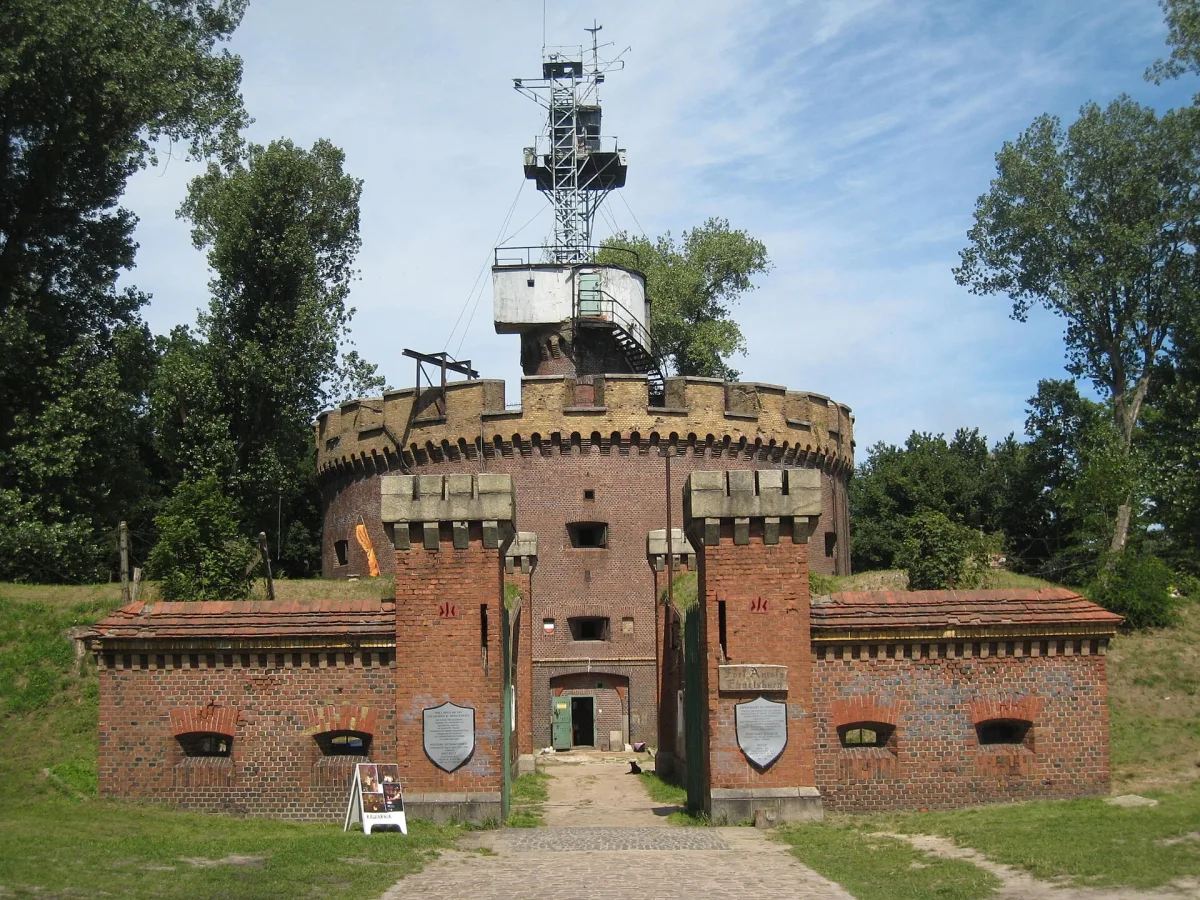
A Prussian 19th-century fortification complex defending the port of Świnoujście, of which three of the four forts survive: Angel, Gerhard and Western.
The Świnoujście Fortress (German: Festung Swinemünde) is a Prussian complex of fortifications built in the 19th century to defend the port at the mouth of the Świna. It was designed by Johann Leopold Ludwig Brese. The fortress was made up of four forts, three of which survive to this day: the Angel Fort, the Gerhard Fort and the Western Fort. The fourth, known as Fort I, was destroyed in the 1970s.
The first fortifications at the mouth of the Świna appeared at the beginning of the 17th century and, according to the website of the Fortress History Museum, were built by Albrecht von Wallenstein. The Prussian government decided to build a fortress in 1846, but work began only after the First Schleswig War, during which a Danish frigate blockaded the port in 1848-1849. The makeshift ramparts thrown up then were later used in the permanent fortifications, which is why 1848 is usually regarded as the beginning of the construction of the forts.
The first fort, Werk I, was built in 1849-1856. In 1854 construction began on a redoubt-type land defence fort, Werk II, on the western bank of the port channel. Two years later two forts for coastal artillery were begun at the same time: the Ostbatterie and the Westbatterie. In this way a complex of fortifications around the mouth of the Świna came into being, made up of two coastal forts, two land defence and command forts, and lunettes and advanced redoubts for infantry. In 1863 Świnoujście was declared a third-class naval fortress.
After the Franco-Prussian War a law of the Reichstag of December 1871 approved the modernisation of all the forts, and the work continued until 1881. The next stage began in 1898 with Admiral Alfred von Tirpitz's naval armament programme, and the most intensive work fell in 1905-1914, when elements of steel and concrete appeared in the forts. In 1908-1911 concrete bunkers were built for five heavy coastal batteries. Before the First World War the fortress had six batteries of coastal artillery, and after its end it was armed with nine coastal and anti-aircraft batteries.
After the Treaty of Versailles the fortress had to be partly disarmed, and after the Paris Agreement of 1926, which allowed Germany limited fortification work on its eastern borders, the forts came to life again. Among those who served in the garrison were Admiral Wilhelm Canaris and Karl Dönitz. Before the Second World War modern artillery, communication systems and command posts were installed, and the port became the largest Kriegsmarine base on the Baltic.
In March 1945 bombers attacked the town and the port, and in the park around the western forts large bomb craters can still be seen. At the end of April Soviet troops surrounded the islands of Wolin and Uznam (Usedom). On the order of Admiral Dönitz, on 4 May 1945 almost all Wehrmacht units left the fortress, which spared both sides a battle for its capture. The Russians entered the town on 5 May 1945. They used all the forts until 1961, and the Angel Fort until 1992.
The three surviving forts now have hosts and are open to tourists. The Angel Fort is a three-storey rotunda with a terrace. The Western Fort, the former Westbatterie, houses the Fortress History Museum. The third is the Gerhard Fort. The distances between them are small, so a visit can be arranged as a single route.

Be the first! Add a comment.
You need to log in to add a comment.
Log in