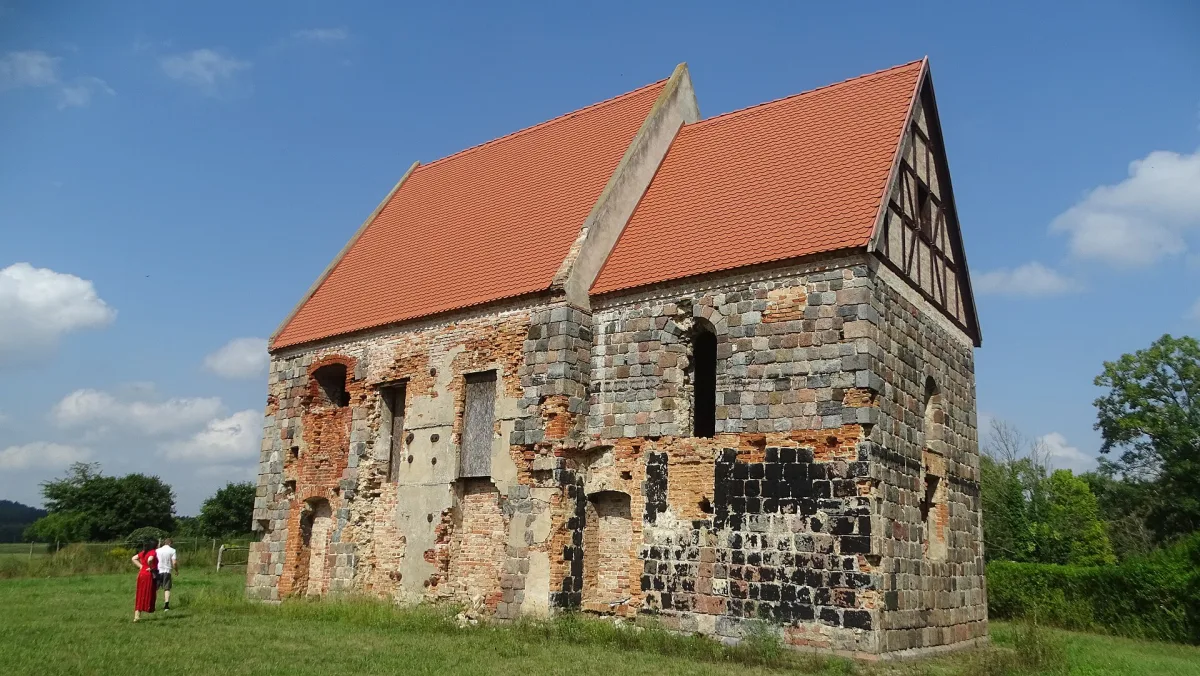
Granite chapel of a Templar commandery of the 13th century, later a granary and distillery, today a historic monument viewed from the outside.
The Templar chapel in Rurka in Chojna municipality is a granite building of the mid-13th century, a remnant of a commandery of the Knights Templar on the Rurzyca River. Over the centuries it changed its purpose: it was a chapel, a granary, a distillery and a store.
Duke Barnim I of Pomerania granted the Templars the Banie land in 1234 and 1235. In the early 1240s the brothers began to build a seat on a rise surrounded by the marshy floodwaters of the Rurzyca. According to the National Heritage Board of Poland it was a commandery of the castle-and-farm type with a mainly economic function, and its defensibility came from its position among marshes. The exact date of the chapel's construction is not known: the sources allow it to be placed between 1244, when the brothers settled in Rurka, and 1248, when it was visited by the Bishop of Kamień. After the dissolution of the Templars in 1312 the estates were taken over by the Knights Hospitaller.
In 1373 the commandery was attacked and burned, and the chapel desecrated. The National Heritage Board of Poland links this raid with the dispute between the Hospitallers and the von Wedel family, while the Wikipedia entry on Rurka speaks of burghers of Chojna and knights led by Wedel. The chapel served for liturgy until 1490, then passed into the hands of the margraves of Brandenburg and in the 18th century became a grain store. After a fire in 1874 it was converted into a distillery, which operated until 1945, and until 1973 the building served as a store. Research and securing work was carried out in 1995-2004.
The chapel has a rectangular nave measuring 10.86 by 8.80 m and a narrower chancel. The walls were built of regularly dressed granite ashlars, and in the south wall gaps filled with brick can be seen. In the chancel three round-arched windows have survived, and inside the outline of a vault and a wall that may have been the base of a gallery. The chapel is viewed from the outside, next to the former manor park. In the village itself stands the Church of St Joseph of the 19th century, which is not a remnant of the order.

Be the first! Add a comment.
You need to log in to add a comment.
Log in