
The fourth instrument in the cathedral
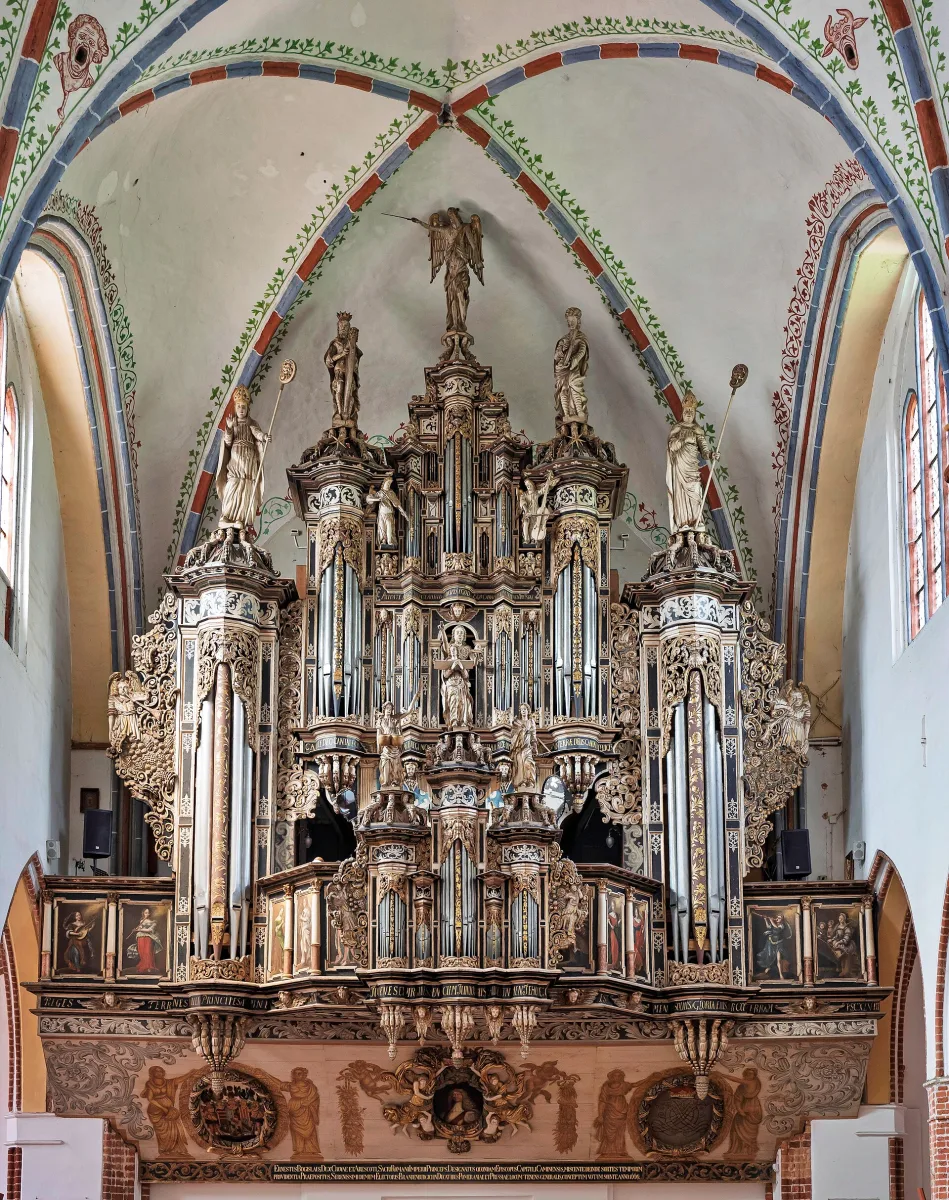
The organ in the Cathedral of St John the Baptist in Kamień Pomorski was not the first in this church. According to Wikipedia the present instrument is at least the fourth in the cathedral. Wikipedia states that the first mention of an organ dates from 1433, while the parish website writes of a first organ funded in 1332 during the rebuilding after a raid by the Brandenburgers. According to both sources the second instrument was funded by Bishop Benedict Wallenstein, and the parish gives the year 1485. The decision on a third was taken in 1580, and after about ninety years it was decided to build another, which has survived to this day.
The founder was Ernest Bogislaw de Croy, whom Wikipedia calls the last Lutheran bishop of Kamień. According to the same entry he set aside the equivalent of 90 kg of silver for the construction. The parish website quotes his letter in which the duke announces the construction of a new organ at his own expense, and adds that 163 pipes from the old instrument were reused.
The builders and the years 1669-1672
Work began in 1669. According to Wikipedia and the parish, the design was made by Friedrich Breyer, who began the construction but, for reasons not known in detail, did not finish it. The parish mentions difficulties, poor working conditions and bureaucratic obstacles, about which the duke's letters to the chapter speak. From 1670 the main contractor was Michael Berigel, written Berigiel in the entry on the organ. The parish calls him an organ builder from Szczecin, a pupil and son-in-law of Friedrich Stellwagen, the organ builder of Stralsund.
Wikipedia states that the instrument was built in 1669-1672, and that the first concert took place on the first Sunday of Advent 1672. The parish gives 29 November 1672 as the date of completion, and the acceptance was to have been carried out by the organ builder Balthasar Heldt, who according to the parish described it in a letter of 16 December 1672 as without defects. The entry on the co-cathedral states that in 1672 the instrument had 2660 pipes, while the parish says it had 39 stops divided among three manuals and a pedal. The specification from about 1790, which Wikipedia cites, has four divisions: Rückpositiv, Hauptwerk, Oberwerk and pedal.
The case: figures, paintings and the founder's portrait
The decorative setting took longer to complete than the instrument itself. According to Wikipedia the ornamented case was made by Martin Edelber, recorded in the parish as Martin Edelberg, the sculptures were made by Johann Grundmann of Frankfurt an der Oder, and the paintings and gilding by the Stargard painter Johann Schmidt. Finishing work continued until 1683. The parish states that the portrait of the duke on the slanted side of the gallery was placed there after the founder's death in 1692.
The case is decorated with eleven full-relief figures. At the top stands the Archangel Michael, below him King David with a harp and a figure with a lyre, whom Wikipedia in one entry calls Saul and in another the prophet Jeremiah. There are also two bishops in pontifical vestments, Saint Otto of Bamberg and Ernest Bogislaw de Croy, and Wikipedia describes the figure of the founder as sometimes identified with Erasmus Manteuffel, the last Catholic bishop of Kamień. Further on can be seen two angels with string instruments, John the Baptist and three women, one of whom sings, the second plays kettledrums and the third plays cymbals. Ten paintings of women making music in seventeenth-century dress are incorporated into the gallery balustrade. According to Wikipedia, which cites a 2002 study by Skibiński, the female figures symbolise kinds of sacred music and the paintings secular music.
Rebuilding, the war and reconstruction
The first repair was needed in 1726, followed by others in 1787, 1800, 1817, 1828 and 1830. The parish describes a long-unresolved problem with the stability of the case. In 1888 Barnim Grüneberg rebuilt the instrument so that according to Wikipedia it had 44 stops, and according to the parish he changed its sound from baroque to romantic. In 1941 the Grüneberg firm tried to reverse this. Wikipedia in the entry on the co-cathedral states that this was led by Felix Grüneberg, while the parish says that the work was carried out by the Grüneberg firm under the direction of Rudolf von Beckerath of Hamburg.
In 1945 the organ was devastated. Wikipedia states that 90 per cent of the playing elements were destroyed, and that during the renovation in 1962 88 per cent of the pipes were found to be missing. Kurt Berendt of Wałcz began the repair in 1962, and from 1964 Zygmunt Kamiński of Warsaw worked on it. The parish recorded the acceptance of his work on 31 May 1965. The next general overhaul began in 1996. Wikipedia in the entry on the organ states that in 2004 Władysław Cepka carried out a thorough renovation, while the entry on the co-cathedral says that from 2003 the work was completed by the organ workshop of Bronisław Cepka of Wronki. Both versions agree on the surname, but not on the first name or the year.
According to Wikipedia the organ today has 3300 pipes and 47 stops. From the instrument of 1669-1672 the rebuilt case, the carving and the front pipes of four sections have survived. Wikipedia also writes of the original polychromy of the case, while the parish describes the repainting of the sculptures in white in 1830 and a conservation in 1938-1940, so the descriptions of the present colours of the case are not consistent.
Concerts in the Kamień cathedral
According to Wikipedia, since 1964 concerts have been held on this organ, organised by enthusiasts of the Kamień Land and the Henryk Wieniawski Szczecin Music Society. The event is international in character and runs through the summer months, and the programme includes organ concerts and performances by choirs and soloists, with music of the old masters and contemporary music. The entry on the co-cathedral says that organists from around the world give concerts here as part of the Festival of Organ and Chamber Music. Both of these mentions give the year 1964.
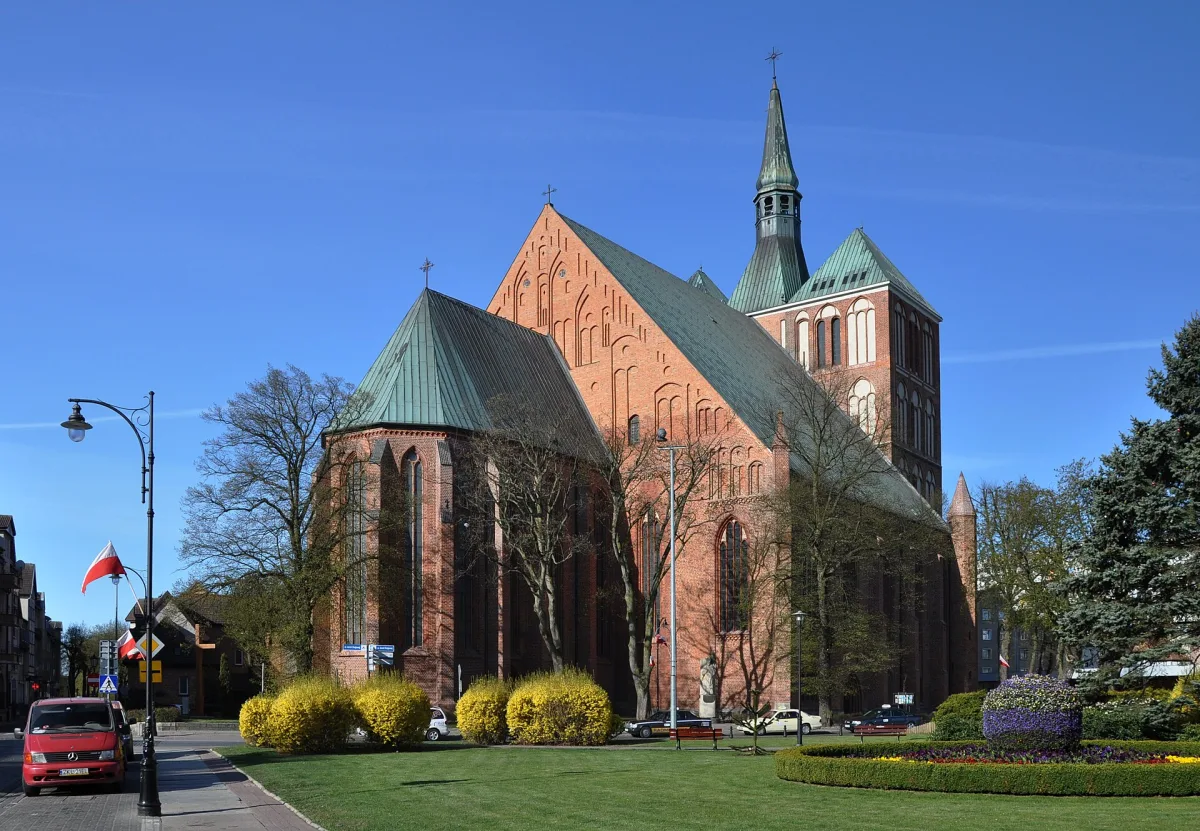
The cathedral stands in the centre of the town, next to the Bishops' Palace and the Museum of the History of the Kamień Land. The parish publishes information about organ recitals and visiting on its website, so that is where to check the rules before a visit.
Be the first! Add a comment.
You need to log in to add a comment.
Log in