
Sidonia von Borck is one of the best-known figures of Pomeranian folklore, and at the same time a person of whom court records survive. The two layers are easily confused: the trial of 1619-1620 is documented, while the story of revenge on the dukes is a legend popularised by literature. Below we separate the one from the other.
Who Sidonia was
According to Wikipedia and the Encyclopedia of West Pomerania she was born around 1548 in Strzmiele, into the knightly Borck family. After her father's death, her brother Ulrich took over the care of her and her sister. The Encyclopedia writes that the brother failed to honour the agreement on an annual allowance and a dowry, and that this was said to be the beginning of the sisters' tragic fate. Wikipedia adds that according to the court files Sidonia spent years in disputes over an inheritance, changed her places of residence and had a reputation as a quarrelsome person. She lived, among other places, in Szczecin, Stargard, Chociwel and Resko. In Resko the ruins of the castle of the knightly Borck family stand today.
In 1604, as both sources state, she was admitted to the Protestant convent for unmarried noblewomen in Marianowo, in a former Cistercian nunnery. Because of her age and origin she became deputy to the abbess, but after a year she was deprived of that function. Wikipedia gives the reason: she was considered quarrelsome and acerbic. Today the monastery complex in Marianowo includes a Gothic church and the west wing of the convent.
The accusation and the trial
The Encyclopedia of West Pomerania states that a rumour of practising witchcraft appeared in 1612, and in 1619 the accusation was brought by Jost von Borcke, administrator of the convent in Marianowo since 1611. According to the same source, about 50 people testified against Sidonia, and the testimony of the herbalist Wolde Albrechts proved especially incriminating. Wikipedia notes that Sidonia surrounded herself with animals, was in contact with herbalists and gave medical advice. Wikipedia links this with the first accusation of witchcraft in 1612.
Wikipedia describes the course of the trial as follows:
- on 18 November 1619 Sidonia was moved from the prison in Marianowo to the prison in Szczecin,
- in December 72 charges were brought against her, among them the murder of several people, including Duke Philip II, who died in 1618, contacts with fortune-tellers and with the devil, and magical practices,
- in January 1620 Eliasz Pauli became her defence counsel,
- on 28 June the court in Magdeburg permitted the Szczecin court to use torture,
- after torture on 28 July Sidonia confessed to the charges, then withdrew her testimony, and on 16 August she was subjected to further torture.
The Encyclopedia of West Pomerania summarises this more briefly: under torture she confessed to all the charges brought, and in 1620 she was found guilty of the deaths of nine people.
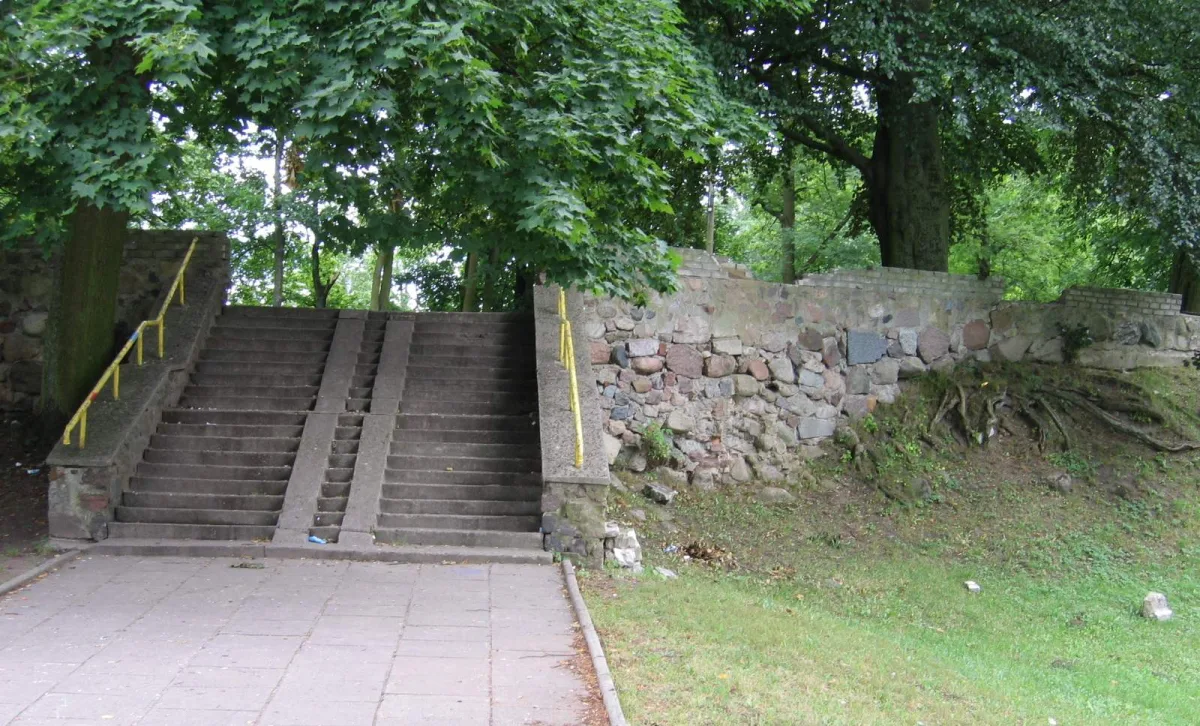
The execution: date and place
The sentence was beheading, followed by the burning of the body. The Encyclopedia of West Pomerania states that it was carried out on 19 August 1620 at the Mill Gate in Szczecin, outside the town walls, with a sword. Wikipedia in its biographical box also gives 19 August 1620, but in the text it writes that the final sentence was passed on 1 September 1620 and that the exact date of death is not known. The versions therefore do not agree, and there is no reason to treat one of them as certain. The place is agreed: in front of the Mill Gate.
Wikipedia adds that on the anniversary of her death members of the Szczecin Historical Society lay flowers near the place of execution.
The prophecy for the Griffins
Among the charges, according to Wikipedia, the most serious was casting a curse on the family of the Pomeranian dukes, the Griffins. After parting from Duke Ernest Louis, Sidonia was said to have prophesied that fifty years would not pass before the line died out. Wikipedia writes that this was regarded as a political crime, especially in view of the unexplained deaths of successive dukes. The last of them, Bogislaw XIV, died childless in 1637.
Wikipedia thus describes the charge of a curse and the fact that people connected it with the dying out of the dukes. The source says only that such an accusation was made.
The legend of the lady-in-waiting and the duke
The Encyclopedia of West Pomerania calls the story of Sidonia one of the most popular Pomeranian legends of the Romantic era. According to the legend, a young, beautiful girl came to the court in Wolgast (Wołogoszcz), Duke Ernest Louis fell in love with her and promised her marriage, but for dynastic reasons did not keep the promise. For this betrayal Sidonia was said to have taken revenge on the whole dynasty.
Wikipedia gives this thread as part of the biography: Sidonia lived at the court of Duke Philip I in Wolgast, accepted the proposal of his son Ernest Louis, who under pressure from his family withdrew and in 1577 married Sophia Hedwig of Brunswick. The Encyclopedia presents the same story as a legend. The year of the duke's wedding, 1577, is given by Wikipedia, while the Encyclopedia treats the story of the affair and the revenge as a legend.
Meinhold's novel and the later fortunes of the subject
The legend was made famous by Wilhelm Meinhold with his romance “Sidonia von Bork, die Klosterhexe”. The Encyclopedia of West Pomerania states that it appeared in 1843, while Wikipedia in its bibliography lists an edition of 1847, so the date needs a caveat: the two accounts give different years. The English translation “Sidonia the Sorceress” of 1849 was prepared by Jane Francesca Elgee, the mother of Oscar Wilde. In 1860 Edward Burne-Jones painted two pictures inspired by the story. Theodor Fontane wrote the short story “Sidonie von Borcke”, treating the historical material freely, and in 1910 Ludwig Hamann published a novel about the convent witch of Marianowo.
The Wikipedia text observes that several decades after Sidonia's death those writing about her argued for her innocence and readily reproduced her image. The double portrait, showing her as a young and as an old woman, is according to Wikipedia the work of an unknown 18th-century author and is in the National Museum in Szczecin.
Among modern references Wikipedia lists the novel by Leszek Herman “Sedinum. Wiadomość z podziemi” and the book by Elżbieta Cherezińska “Sydonia. Słowo się rzekło” of 2023.
Be the first! Add a comment.
You need to log in to add a comment.
Log in