
A prince who ordered astonishing things
Philip II, Duke of Szczecin from 1606, studied in Rostock and made a two-year journey around Europe, during which he was particularly fascinated by Florence. According to Wikipedia he was a patron of culture and a collector of works of art. He died in 1618 and left no offspring. Of his commissions the most famous turned out to be a piece of furniture that in Polish literature is called the Pomeranian Cabinet (Kabinet Pomorski), and in German Pommerscher Kunstschrank.
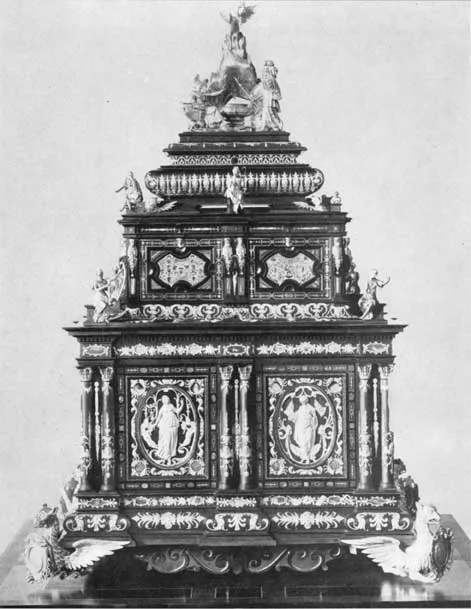
The cabinet is an ornamental chest-type piece of furniture with a multitude of hiding places and small drawers. According to Wikipedia it was 1.15 m wide and 1.36 m high. It was ordered in Augsburg from Philipp Hainhofer, a local art dealer and diplomat who knew the duke personally. The German Wikipedia describes the whole as a desk for the ducal cabinet of art, fitted out like a miniature chamber of curiosities.
Augsburg, 1610-1617
The Polish Wikipedia states that the piece was made in 1610-1617 under Hainhofer's direction, and that more than 20 craftsmen worked on it in the Augsburg workshops. The German Wikipedia speaks of 24-28 people and lists them by name: a joiner, a stonemason decorating the piece with inlays of precious stones, goldsmiths, painters, an engraver, an organ builder, clockmakers and others. The discrepancy in the number of makers results from different estimates in the literature, so it is worth reading the two sources side by side.
According to the German Wikipedia the work dragged on, because further ideas for the fittings were added during construction. The piece, taken apart, reached Szczecin at the end of August 1617 and was assembled here. The duke took possession of it on 2 September 1617. Hainhofer attached a description of the piece and of about 200 objects contained in it.
What the drawers hid
The exterior was made of ebony and decorated with fittings and inlays of silver and precious stones. According to the German Wikipedia the piece stood on four figures of griffins, holding shields with the arms of Pomerania and the arms of Holstein, the house of the duke's wife. The top was crowned by Mount Parnassus shown in silver with a figure of Pegasus. Enamelled medallions were placed on the sides, and the insides of the doors were decorated with paintings of the four elements.
Radio Szczecin, reporting on the multimedia version of the cabinet, lists objects from the drawers: astronomical and mathematical instruments, boards and pieces for games, table silver, toilet articles, scientific instruments and paintings. It also mentions a mathematical spoon that turns into another tool, and a knife with a compass. According to Radio Szczecin the cabinet quickly gained fame as the largest and most complicated work of its kind. The Polish Wikipedia describes it as an object of the highest class among works of this type in Europe.
From Pomerania to Berlin and into the fire
According to the German Wikipedia the piece remained in the hands of the Griffins until the male line of the dynasty died out in 1637. It then passed to Anna de Croÿ, sister of the last duke, and her son Ernst Bogislaw de Croÿ. He bequeathed it in his will to the Electress Dorothea of Brandenburg-Prussia, wife of the ruler of Brandenburg. That is how the cabinet reached the Berlin Kunstkammer. In the 19th century it entered the collections of the Berlin Kunstgewerbemuseum, and Radio Szczecin states that this happened at the end of that century.
The fate of the cabinet was decided by the war. The Polish Wikipedia states briefly that the piece itself burned in 1945, and the surviving contents are still in the collections of the Berlin Kunstgewerbemuseum. The German Wikipedia adds a detail: the piece was taken to the Neue Münze vault in Berlin, where it was destroyed by wartime action, and most of the contents survived.
The cabinet in Szczecin today
The original is not in Szczecin. The Ducal Castle has, however, recreated the piece on the basis of archive materials and photographs in the form of a multimedia application. According to Radio Szczecin the user can open virtual drawers on a touch screen and view their contents in a three-dimensional version, and the application was shown in the Elizabethan Hall of the castle. The version was prepared by Szczecin IT specialists.
The application was shown in the Castle of the Pomeranian Dukes in Szczecin, the former seat of the Griffins, the dynasty from which Philip II came.
Be the first! Add a comment.
You need to log in to add a comment.
Log in