
The duke who united Pomerania
Bogusław X was born in Słupsk in 1454. According to the entry in the Encyclopedia of West Pomerania (Pomeranica), from 1478 he was duke of all Pomerania with his seat in Szczecin. Wikipedia states that he took power in the Duchy of Szczecin and Słupsk in 1474 after the death of his father, Eric II, and in 1478, after the death of Warcisław X, he also took over the Duchy of Wołogoszcz, thereby uniting the Pomeranian duchies into a single state organism. He went down in history with the epithet the Great, which, according to Wikipedia, was given to him for a wise and mature policy.
From the beginning of his rule he had to reckon with his neighbour to the south. Wikipedia describes how the young duke refused the Elector of Brandenburg the feudal homage that his father had previously paid, and Brandenburg threatened war. The dispute dragged on for years, with sieges, truces and the Treaty of Prenzlau (Przęcław) of 1479, under which Bogusław formally became the elector's vassal, although, as Wikipedia writes, he did not intend to give up his independence.
The wedding to Anna Jagiellon in Szczecin
One way to counterbalance Brandenburg was rapprochement with Poland. According to Wikipedia, the first attempts to bind Pomerania to the Polish Crown were made as early as the time of Casimir IV Jagiellon, and their result was the duke's second marriage, to his daughter Anna Jagiellon. Negotiations were held at the turn of 1489 and 1490. Wikipedia states that on 7 March 1490 a marriage contract was signed in Grodno and a wedding by proxy took place, with Adam Podewils standing in for the duke.
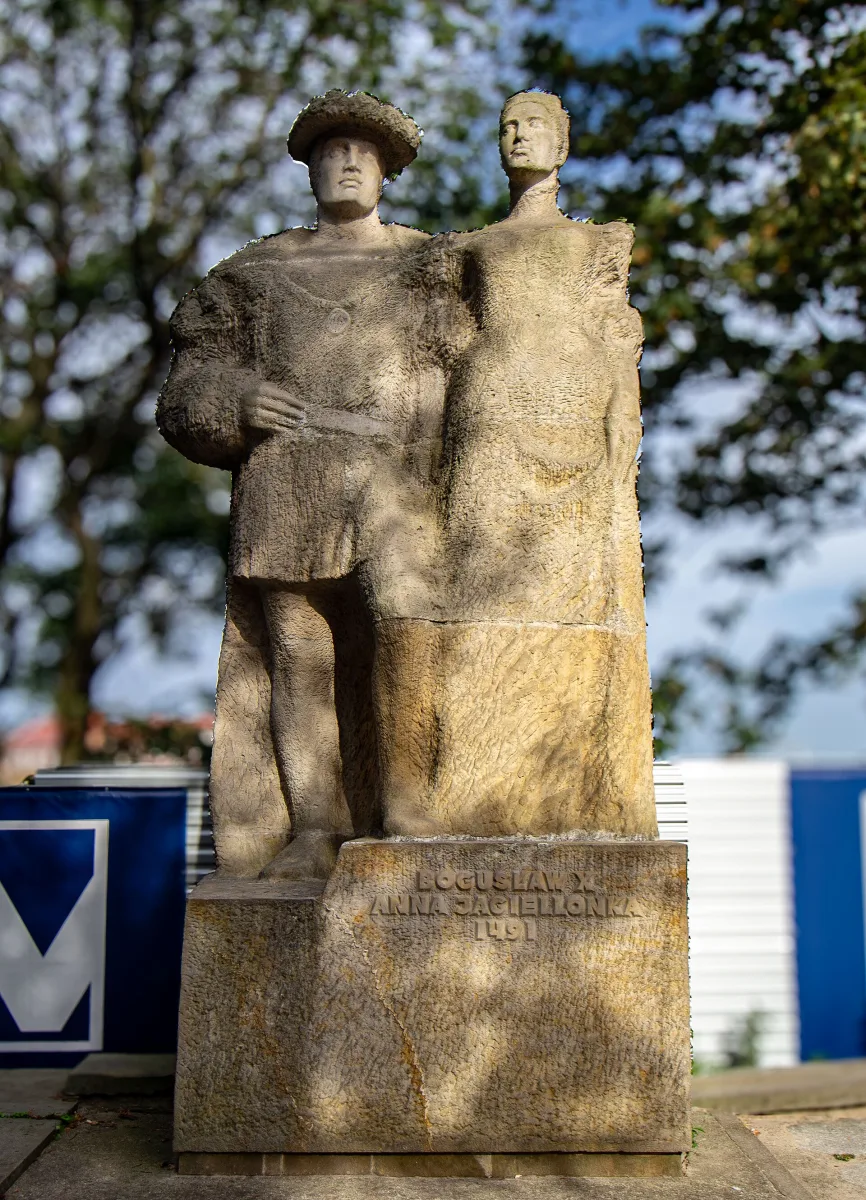
The actual wedding took place in Szczecin on 2 February 1491. According to the entry on Anna Jagiellon, the ceremony was very lavish, and those who attended included the duke's mother, Sophia, and the dukes of Mecklenburg. The bride was 14 years old at the time. Today the memory of this marriage is recalled by a monument by the Ducal Castle in Szczecin (the Castle of the Pomeranian Dukes): according to Wikipedia it was unveiled in 1974, and the plinth bears the inscription "Bogusław X i Anna Jagiellonka 1491". The figures of the ducal couple can be seen on the Monument to Bogusław X and Anna Jagiellon.
The Treaty of Pyrzyce in 1493
According to Pomeranica, the Treaty of Pyrzyce is an agreement on inheritance concluded in 1493 between Bogusław X and the Elector of Brandenburg, John Cicero. The entry lists three main provisions. First, the Pomeranian dukes were released from the obligation to pay homage and swear a feudal oath to the electors. Second, Bogusław undertook that the dukes would not become vassals of other rulers. Third, he agreed to Brandenburg's succession in Pomerania in the event that the House of Griffin died out, and Brandenburg renounced its overlordship over Pomerania.
Wikipedia, in the entry on Anna Jagiellon, gives the exact date of the agreement: 26 March 1493. It adds that in the dispute with Brandenburg the duke asked for mediation from his brother-in-law, the King of Poland, John Albert. The entry on Bogusław X points out that, under the Pyrzyce agreement, the Brandenburgers retained an expectancy, that is, the right to take over Pomerania should the Griffin line die out. Pomeranica thus describes the agreement as a release from vassalage, while Wikipedia stresses its other side: the provision on inheritance should the Griffins die out. According to Pomeranica, the later Treaty of Grzmiąca (Grimnitz) of 1529 referred back to the Pyrzyce provisions.
Pilgrimage to the Holy Land, 1496-1498
According to Wikipedia, on 16 December 1496 Bogusław X set out on a journey that took him to the Holy Land. The expedition lasted until 12 April 1498. Before the duke reached Venice, from where the pilgrimage was to set out, he met European rulers, including the German king Maximilian I. The talks concerned the title of prince of the Empire, which was meant to protect Pomerania from further claims by the electors, but according to Wikipedia they ended in failure.
During the duke's absence the duchy was governed by Anna Jagiellon, supported by the Bishop of Kamień, Benedykt Wallenstein, and the chancellor Jerzy Kleist. Wikipedia writes that she was 21 at the time and stayed at the Szczecin castle with three children. The expedition also left its mark in literature: according to the same entry, Bogusław X is the hero of the first Renaissance play about the duke's journey to the Holy Land, written by Johannes von Kitscher and published in Leipzig in 1501.
Death and the fate of the tomb
Bogusław X died on 5 October 1523 in Szczecin. Pomeranica notes that in older studies, following Thomas Kantzow, the date of 30 September was given. He died in a manor by the cemetery of St Mary's Church. He was buried in the old collegiate church of St Otto, in 1557 his remains were moved to the collegiate church of the Blessed Virgin Mary, and in 1575 to the new castle church of St Otto.
Be the first! Add a comment.
You need to log in to add a comment.
Log in